Showing posts with label Pulps. Show all posts

Wednesday, March 27, 2013

Marvel Science Fiction Cover Caption Contest

Marvel Science Fiction is a science fiction magazine that existed for a very short publication run  near the end of the pulp era. For a time pulps were changing into the SF/Fantasy anthologies that would populate racks but they had a rough time of it. Published by Martin Goodman it was the descendent of Marvel Science Stories, Marvel Tales and Marvel Stories

Stating that sales and longevity of SF & Fantasy magazines in the 1950s was fair to middling is an understatement. Often the lurid covers, in an attempt to attract male readers, had the mixed result of catching a few sales but because of mature themes sales were probably lost because the books were considered for older readers and kept out of reach of younger buyers (at least as far as parental oversight was concerned).

One of the ways a limited promotional budget was stretched was to offer reader contests with prizes. Marvel Science Fiction held a Cover Caption Contest that encouraged readers to send in funny or pertinent one-liners to accompany the cover. The prizes from MSF consisted of original scripts and artwork, a mind-boggling thing today. It was an early form of the lolcat meme phenomenon, or to coin a phrase, the beginning of the lolpulp. Until relatively recently publishers considered art for such publications as pulps and comic books entirely disposable and outside of the initial cost to the creator ultimately worthless. This was an extension of the final product likewise being thought of as worthless after initial sale. Few artists ever felt this way but that was the nature of the work for hire business model. Unless the artist had a previous deal then art was often thrown out, given away to visitors or employees or re-purposed by the publisher with no thought to the cultural value. So giving away scripts or art made perfect financial sense. Outside of postage there would be little added expense to the publisher.

The results of the MSF caption contest had responses that were not the height of wit or insight. But attempts at seriousness or humor aside the great draw of winning the contest were the prizes. The first prize was a script from the issue and believe it or not, original art was the second prize. Don't get me wrong, an original script by Fritz Leiber would be nice but a spot illustration by Frank R. Paul or Hannes Bok would be killer. I already own a few Paul illustrated pulps and they are becoming increasingly difficult to find in both good condition and in my price range. FYI, one of the most expensive vintage comics that exists has a Frank R. Paul cover, that of Marvel Comics #1 (1939). Amazing how perception has changed over the years that a script would be preferred over artwork. I'd say this change was mostly due to the monetary worth and cache of an original Hannes Bok over a typed script.


The first caption contest shown here is for the August 1951 issue and the publisher is behind the idea enough to devote a full page to it. The winning entries are variations of "They Went Thataway" and "Guided Tour". Serviceable enough. Simple enough that if I read that I'd be mailing in a thousand variations myself confident that I could put the previous winners to shame and reap all the prizes. As it turned out wit, talent and hard work wasn't really necessary.

The next contest is to caption a classic Hannes Bok good girl art cover of a world where gravity fails. And that is where things go south in several figurative ways. The November issue of Marvel Science Fiction was the last one before the publisher would turn to other, presumably less expensive efforts with a higher rate of return, namely Atlas Comics, which would one day revive the Marvel name.


The winning entries of  "Another Law repealed?" and "Paging Mr. Newton" are okay but not great and belated kudos to the winners. But in particular the last four entries were particularly uninspired and generate untold amounts of jealousy in me decades later.


The winning 3rd-6th place submitted the despairingly the lame "HUH?",  "HEY!" and a tie for "OOPS!" which depresses me no end. Unbelievably these entries were awarded original art. The illustrations in this issue are credited to Harry Harrison (who did illustrations before becoming an author), the legendary Frank R. Paul, Hannes Bok and veteran pulp contributor Ames. If these pieces still exist somewhere think how important to art and pulp history they would be that if in a museum or library collection.

It is nearly impossible to say if the winners did or did not receive their prizes since MSF ceased publication with this issue. If they did then the people who won are some fortunate few and proof that the world is indeed topsy-turvey.

Thursday, January 05, 2012

The Hydra Club

The Hydra Club, a function-less invite-only organization of science fiction contributors from the pulp days of yore.

From Marvel Science Fiction (November 1951). Written by Judith Merril, art by H. Harrison.

Wednesday, August 10, 2011

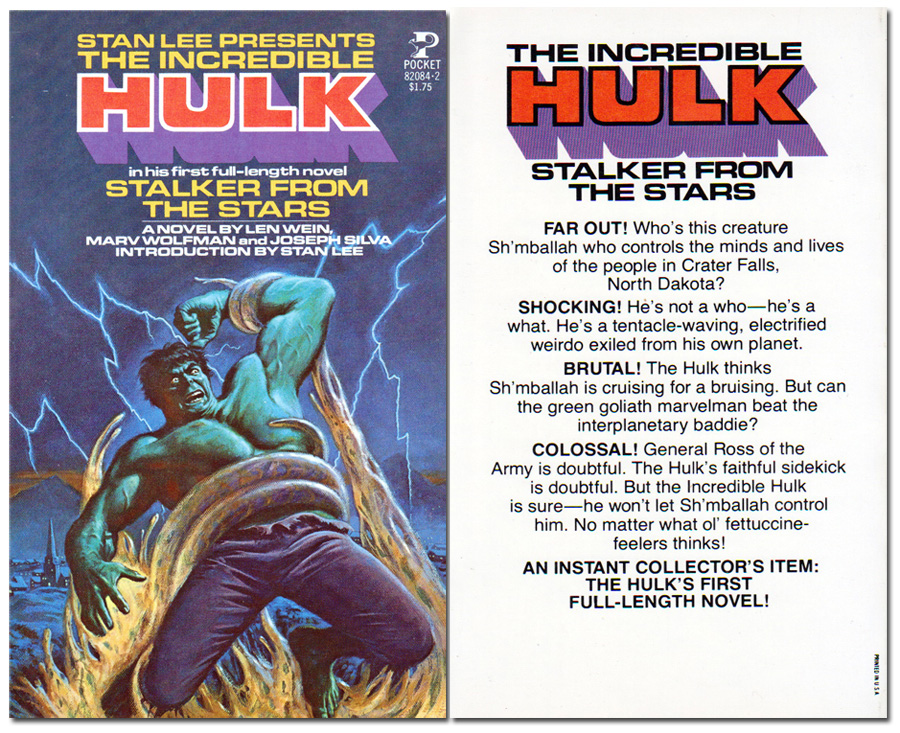
From the Collection: Stalker from the Stars

Those unfamiliar with Marvel comic book history would find the Hulk prose novel Stalker From the Stars reminiscent of cold war SF cinema but the book is really a blend of a 1950s Atlas/Timely alien invasion story (inspired of course by real world fears and concerns) featuring an un-evolved 1970s Hulk. This had precedent at the time as several Marvel heroes had come up against old villains from Marvel's SF and Horror books of the past. While the dialog of SHIELD agent Clay Quartermain made me want to travel to the Fictionverse just to beat him up overall the book is not a bad read for a young adult novel.

Front and back covers of Stalker from the Stars (1978).

Sunday, October 24, 2010

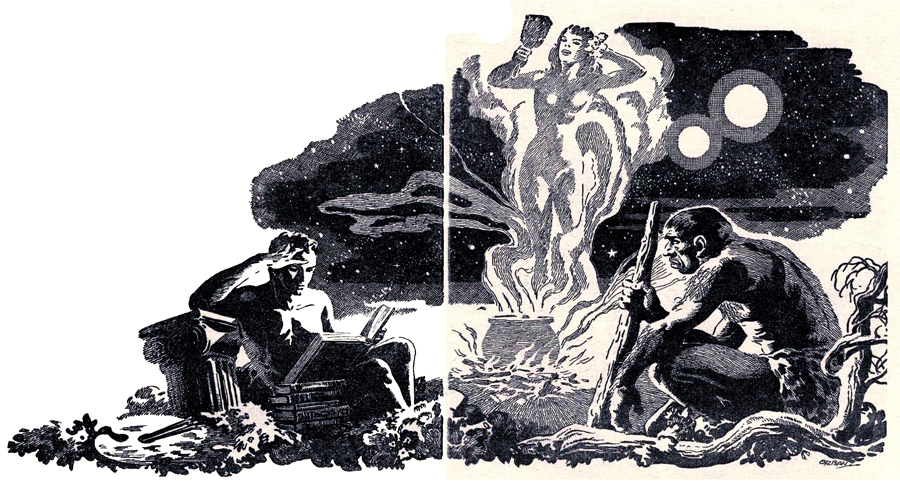
The Two Shadows

From The Two Shadows, published in Startling Stories (March 1951). Story by William F. Temple with art by Orban.

Monday, July 26, 2010

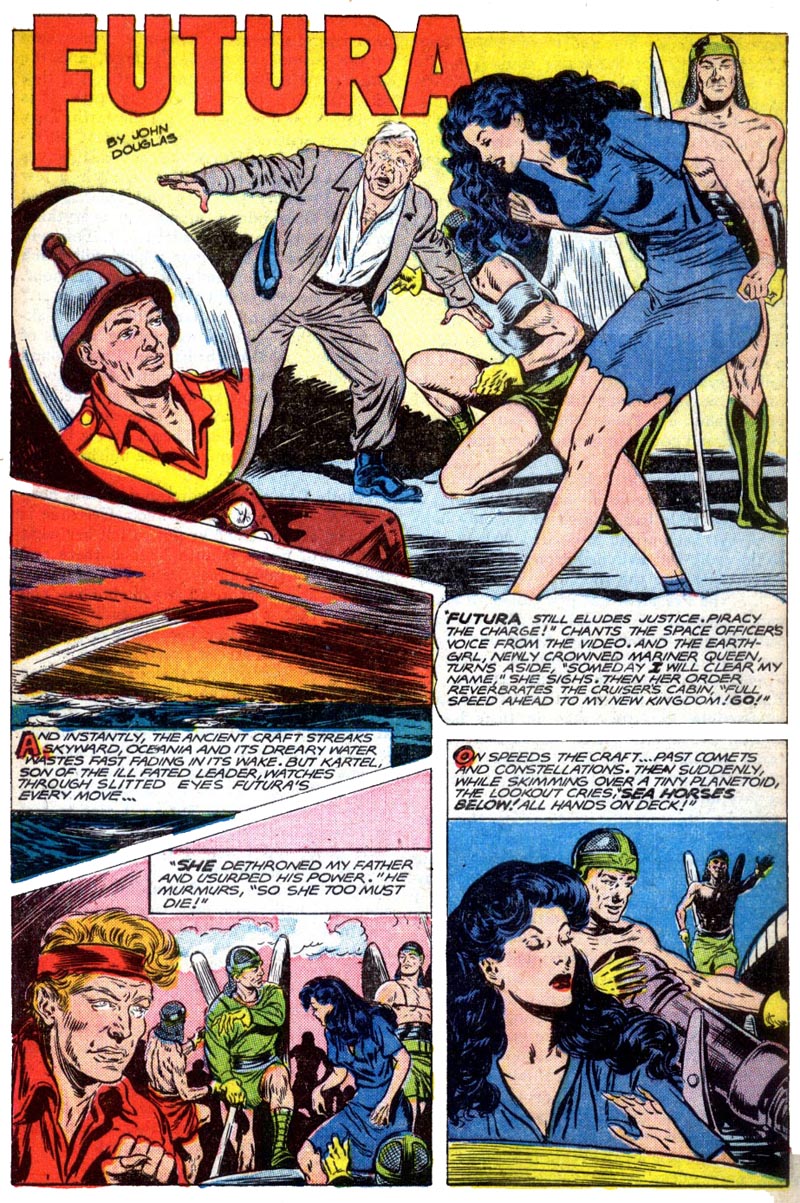
Futura - Chapter 22

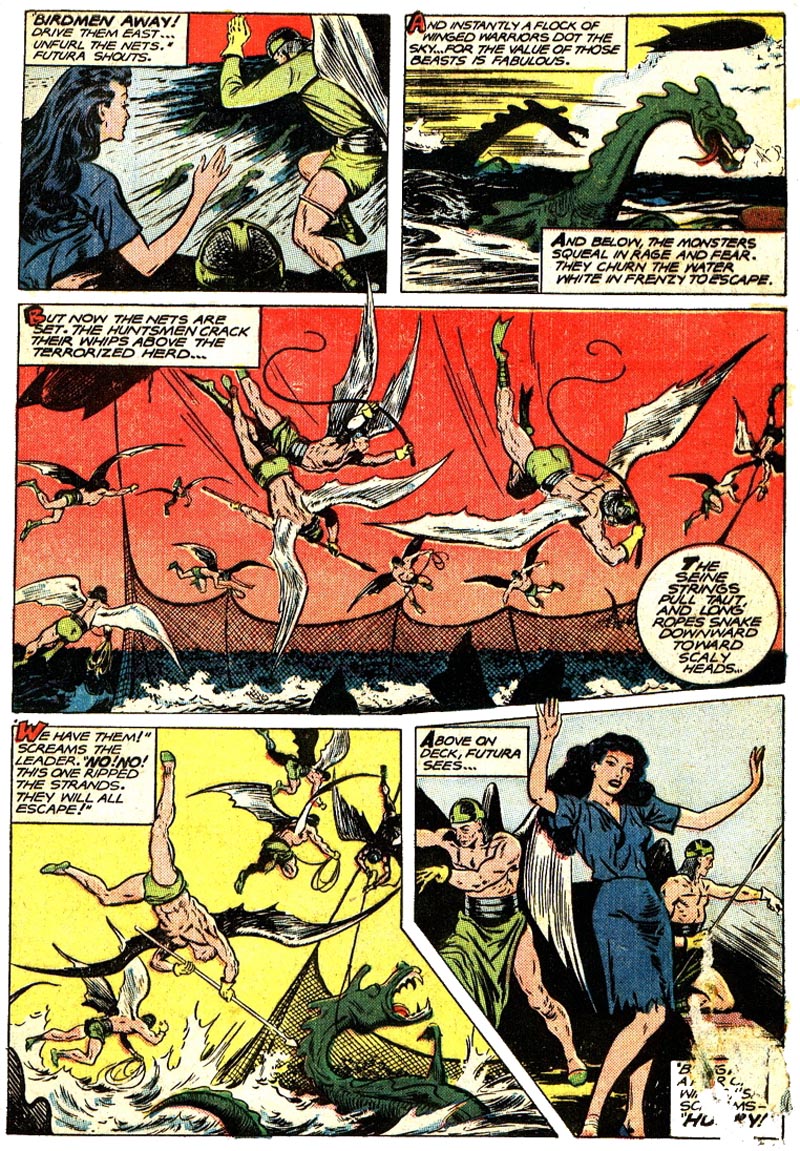
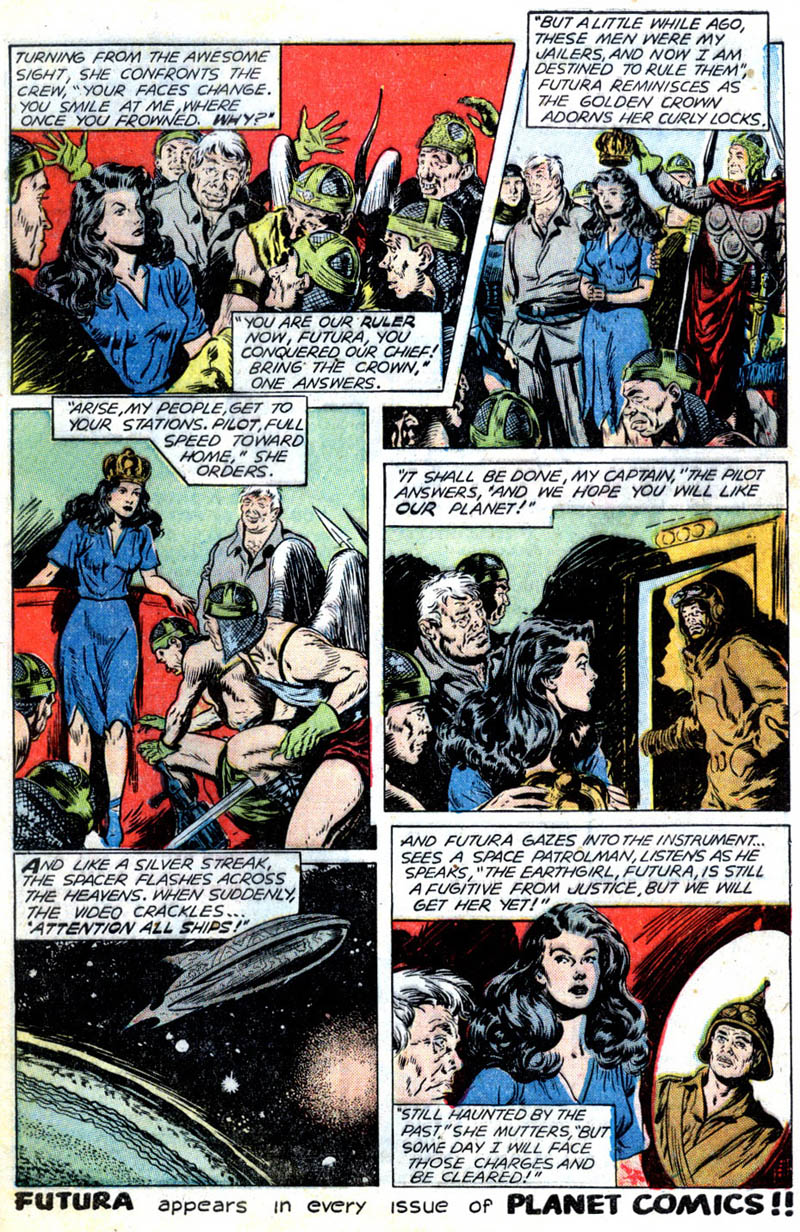
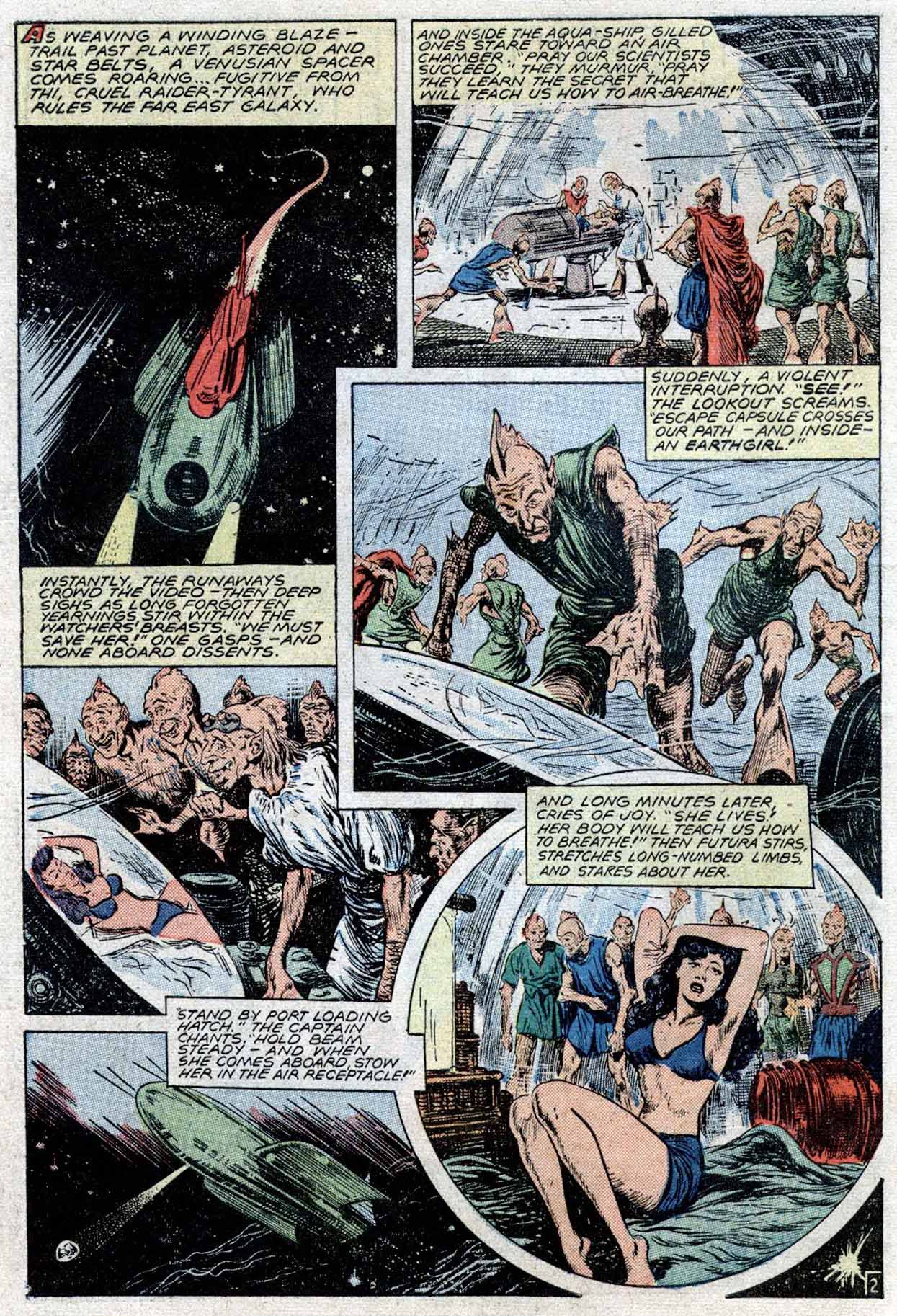
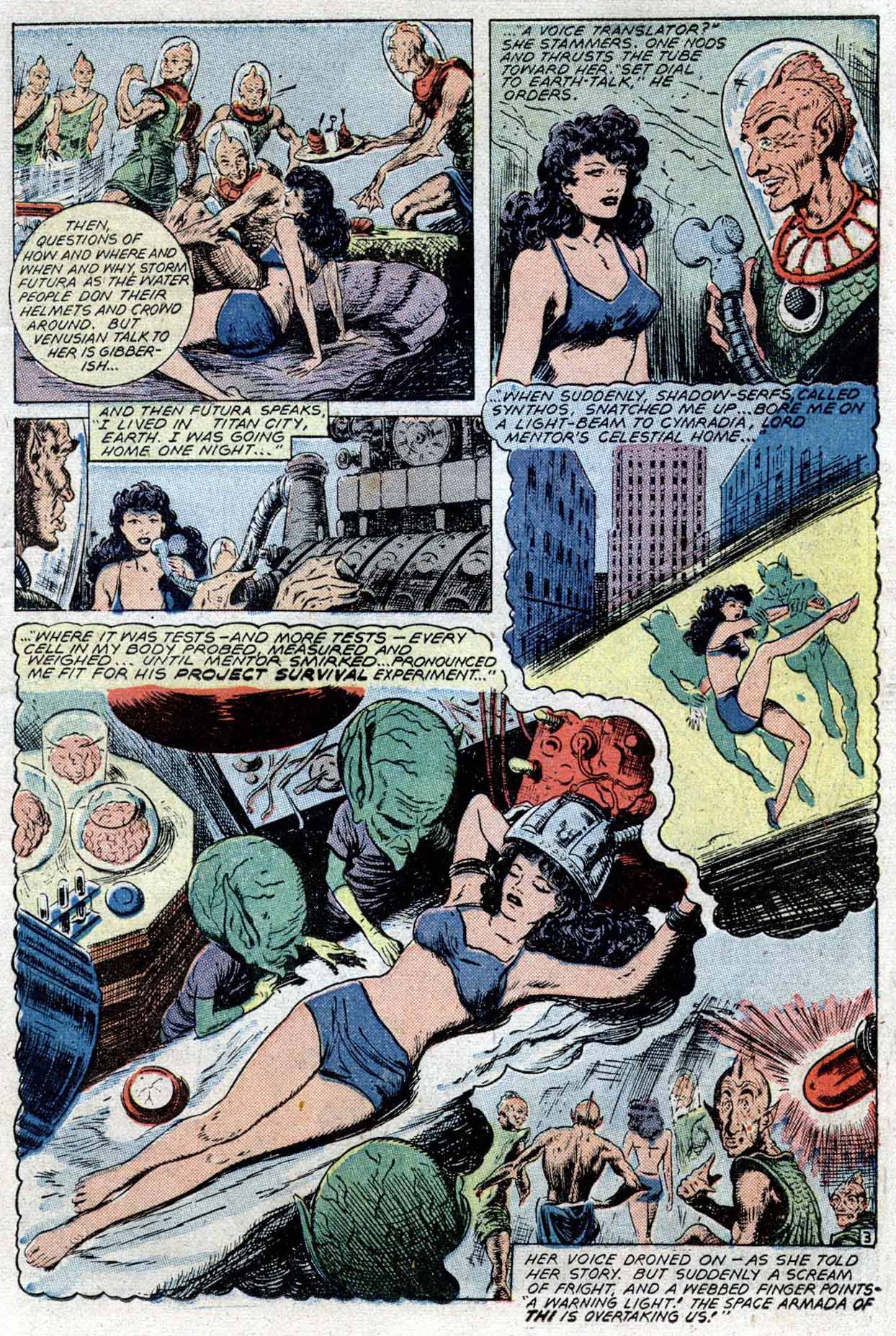
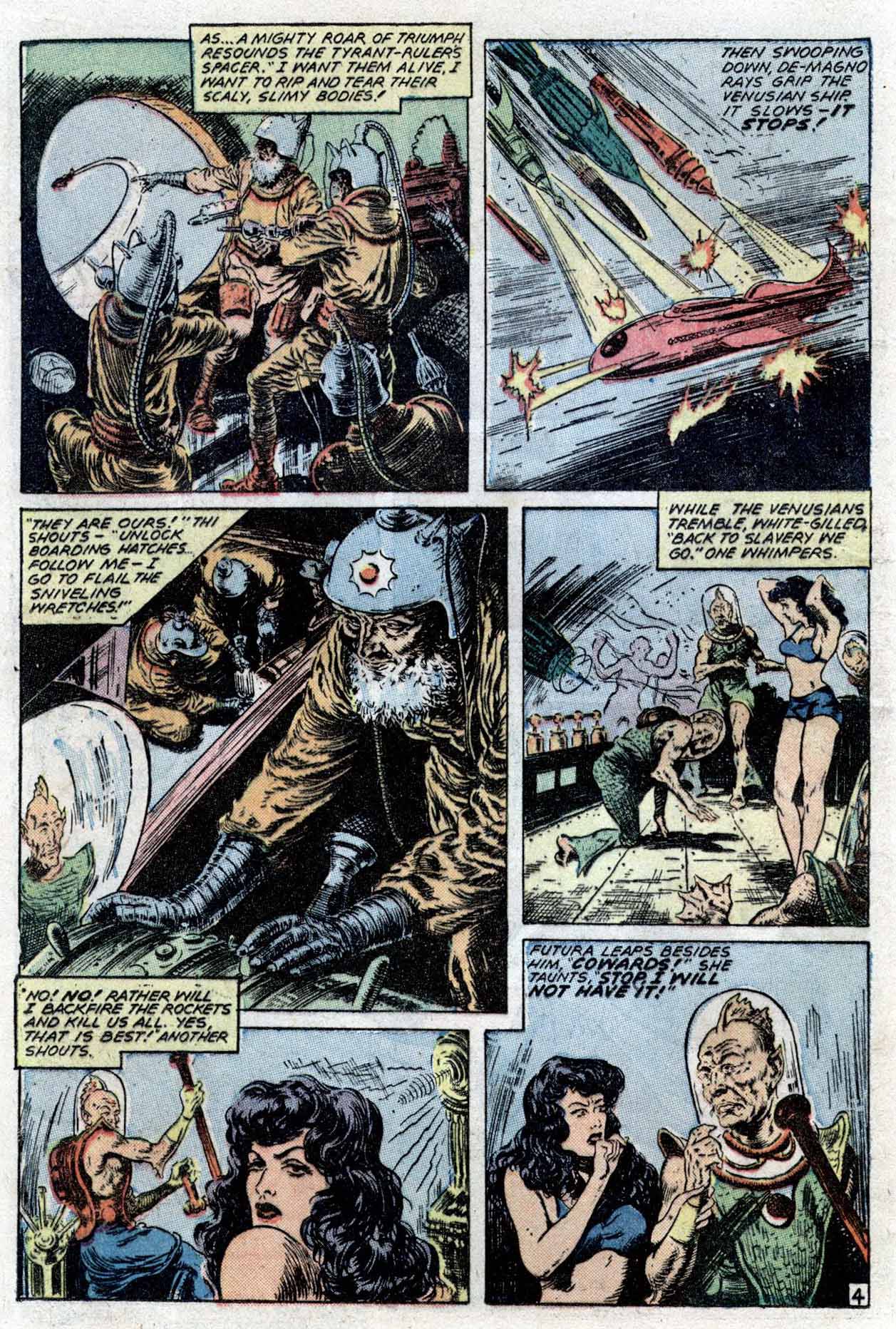
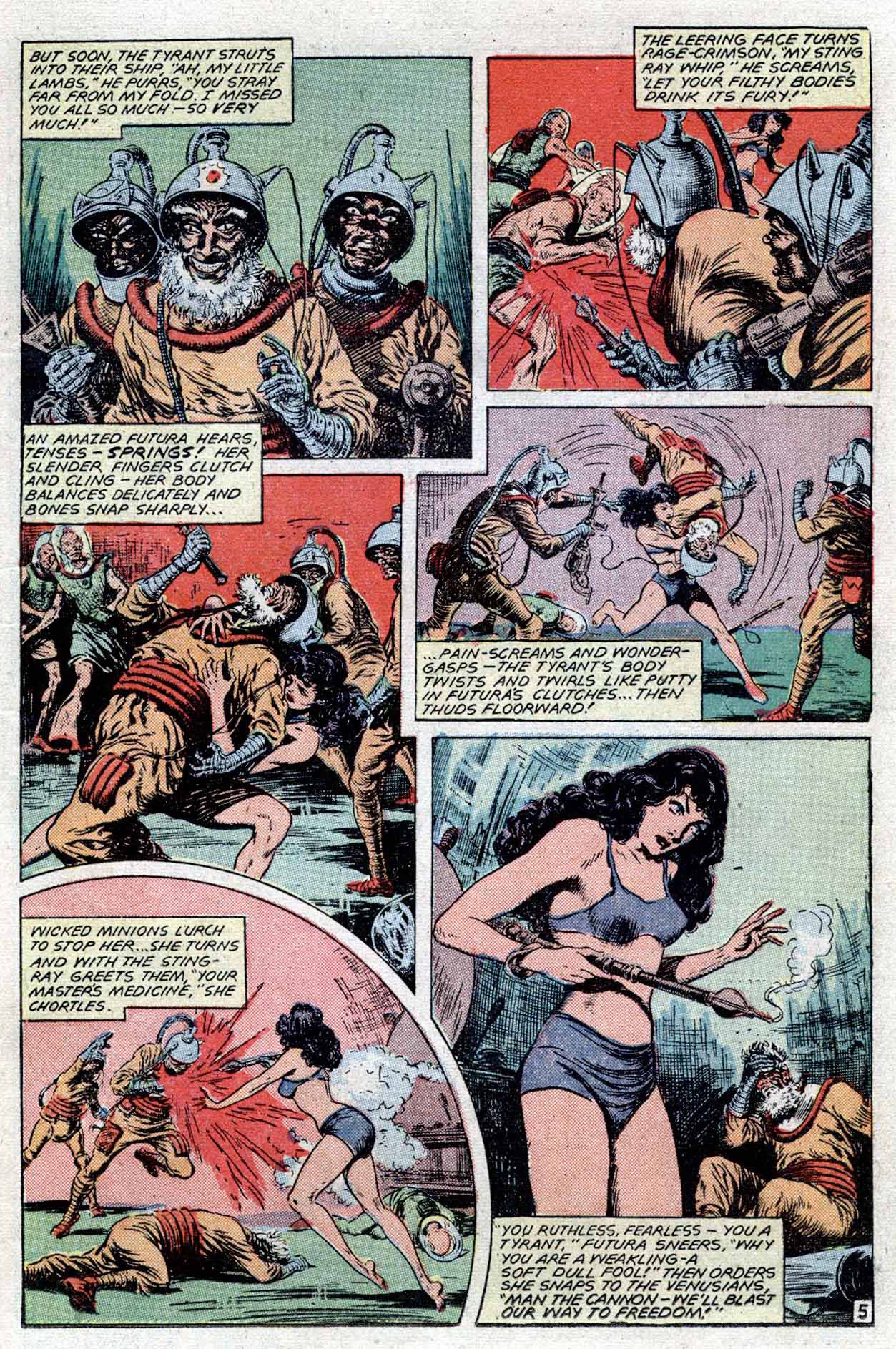
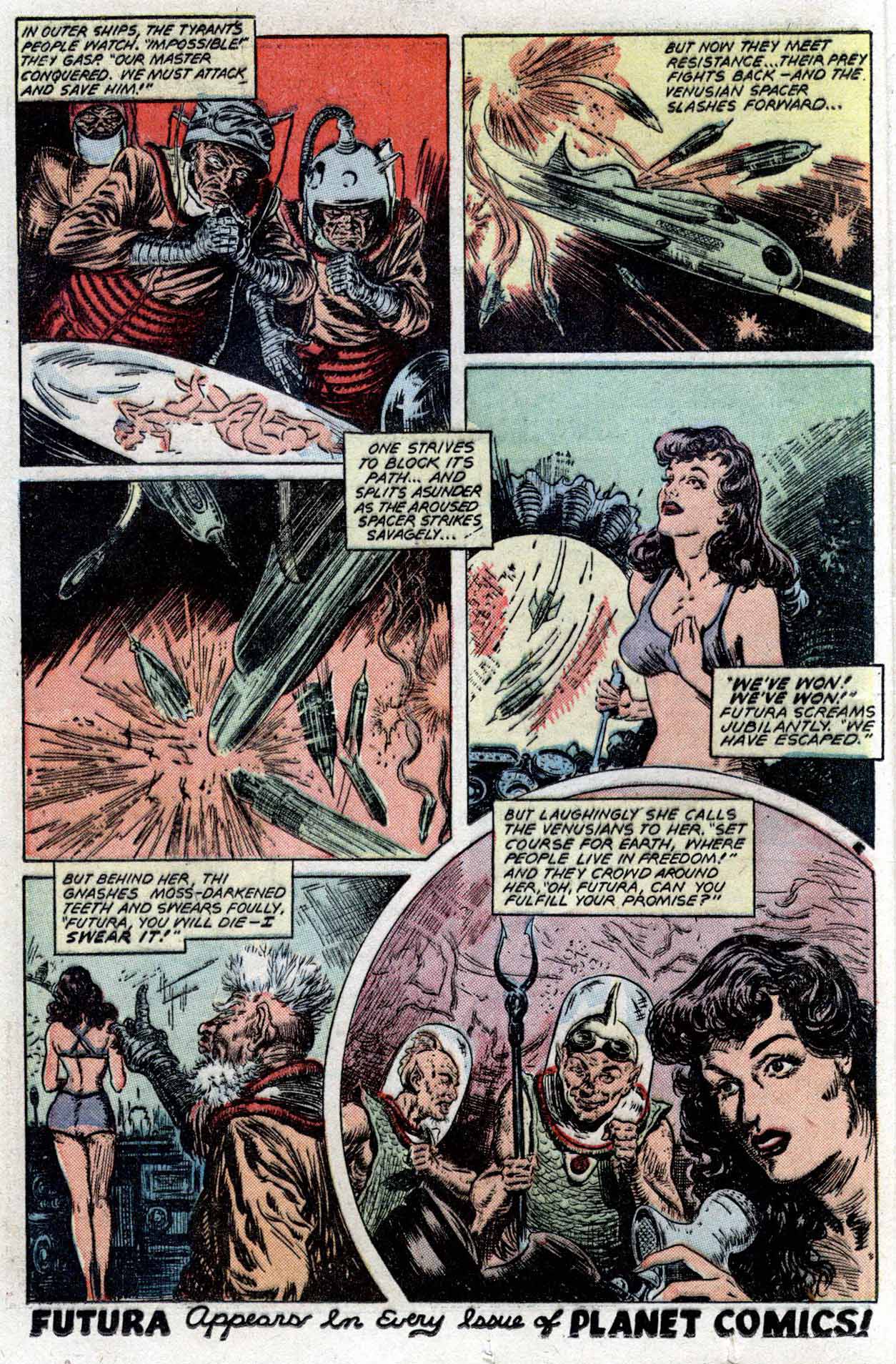
Planet Comics #64 (Spring 1950) marks the finale to the Futura Saga. It took far longer to get there then I originally planned but the Planet Comics issues I was seeking are pretty rare and hard to get a hold of. Fortunately there are friends and other resources that allowed me to fill in the gaps in her story. This issue is one of those online copies floating around.

For those readers not patient enough to click through her entire tale, here is some back story:

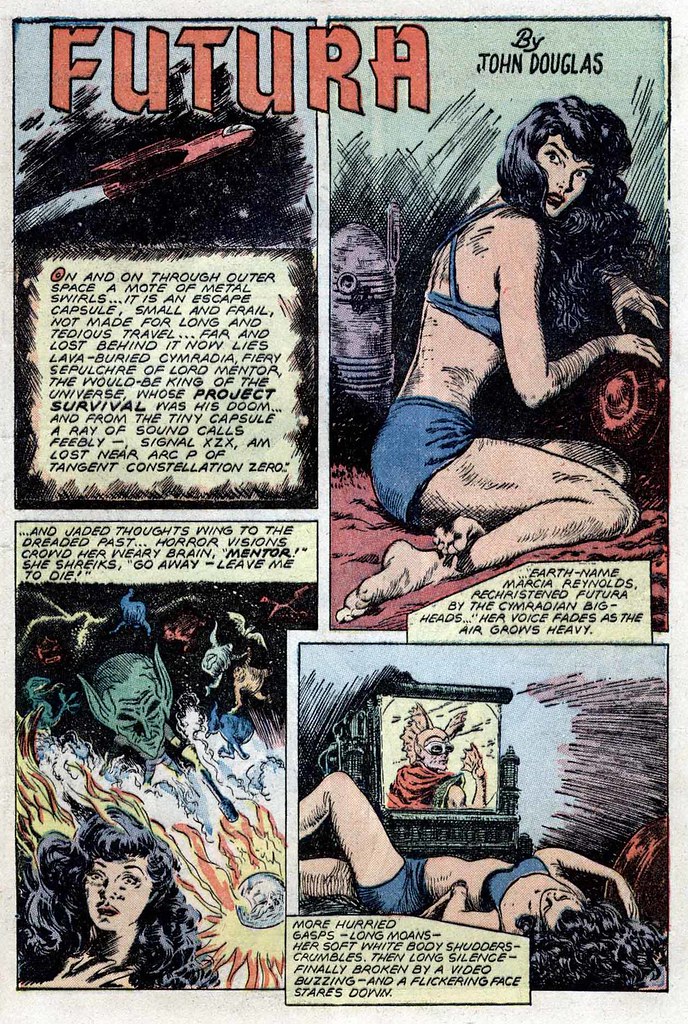
Futura's tale began in Planet Comics issue #43 in July of 1946. Secretary Marcia Reynolds is kidnapped from Earth and enslaved for medical experiments by the Brain-Men of Pan-Cosmos. She escapes, a bit too easily in fact, and steals a ship intending to head back to Earth. Unknown to Marcia Reynolds, now called Futura by her captors, her escape is being carefully monitored to measure her suitability for inclusion into the Pan-Cosmos genome.

Forced into situations that test her mettle, Futura evades her intended fate and gains allies, makes enemies and is a central witness to the fact that messiahs can be dangerous to your health. As her story continues, Futura becomes a wild card and her presence as a destabilizing threat to the status quo could not be tolerated by those in power. Fortunately for Futura the fragmented leaders of occupied space are corrupt, lazy and not used to rebellion from their cowed populace. Futura meets every challenge, fighting back ferociously and without hesitation.

For Futura does not just defeat an opponent, no. She utterly destroys an enemy by erasing their entire culture leaving them without a power base. What remains when she is done renders them in a state where they are no threat for the foreseeable future. While this tactic is not necessarily the action of a hero it certainly is that of a leader of nations. This Geo-political approach on a galactic scale is something that having recently emerged from a devastating World War the readers of the day could easily identify with.

So without further preamble here is the final climactic chapter to the Futura Saga.

Unlike many other of the Planet Comics serials Futura has a definite end to her tale, though some foreshadowing of trouble is evident. Reading the entire story of Futura I was not disappointed. While the series was sometimes the victim of the whims of scheduling, editors and creators and the series had some detours and false starts with the storytelling it was enjoyable and fantastic fun. Most serialized pulp tales, of which Futura is certainly descended from, have some element of empire-building in them and this tale was no exception. The average man, or in this case woman, is plucked from obscurity and thrust into "a world they never made" and by the end of the adventure they are Lords or Kings or Queens. Futura is cast in that mold.

Futura is different, however in that she did not simply storm the castle and sit upon the throne thereby declaring victory and an end to tyrannical rule. She leveled the playing fields of Pan-Cosmos and known space, leaving every culture she came into contact with vulnerable to being rebuilt from scratch by someone else with the strength or character and arm to do so. In this instance, Futura herself. Futura may not have intended to and she often acted for selfish reasons related to her immediate survival but the result was she destroyed a galaxy in order to save it. In her final adventure it is evident she rules Oceania and the stage is set for her to take over known occupied space.

So what does the future hold for Futura?

Fan interest in Golden Age comic books is steady and it is exposure on the internet that is most likely the reason. Forums and blogs are probably directly responsible for some collections of old stories being collected by various publishers, namely the Fletcher Hanks and Boody Rogers strips to name a few examples. These books were collected not only for fans but for those not familiar with graphic art that until recently has been lost and forgotten by even many hard core aficionados. It would be nice to see a hardbound collection of Futura but admittedly the sometimes wandering storyline could be somewhat difficult to present. Taken as a whole the Futura story does not present a particularly cohesive universe and a reader has to suspend their ideas of 'continuity' and mentally edit some entries. It could be understood that many modern fans would not appreciate the abrupt shifts in the cultural backgrounds of the Futura universe.

It is difficult to measure if there is enough of a fan base to support a revival of Futura. Often it is easier and makes better business sense for someone to create an entirely new character inspired by an old character than it is to revamp one, no matter how enthusiastic one may be for the project. Any new entries to the Futura story would have to be a personal endeavor at heart, a labor of love for the character like the one that appeared in the 1980s. One that some may not understand but hopefully can appreciate because that admiration was was shared.

So will we see Futura again? Only time will tell. I, for one, can hardly wait.

Tuesday, July 20, 2010

Futura - Chapter 21

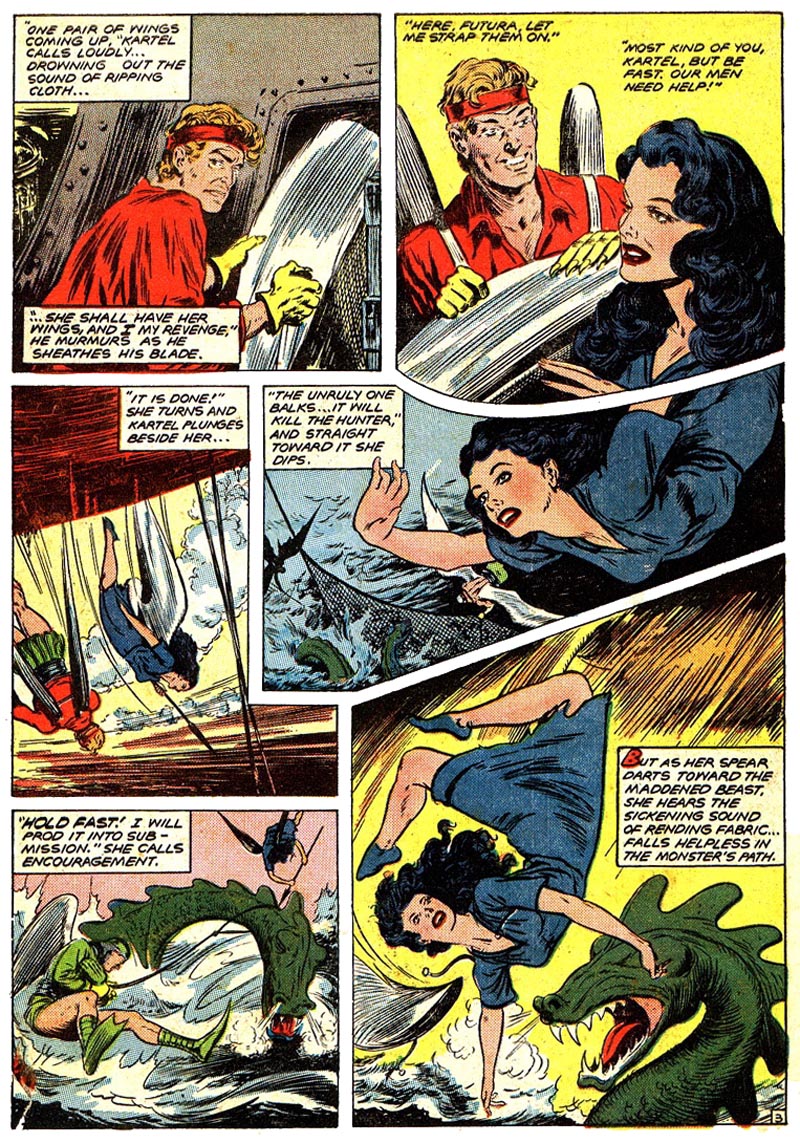
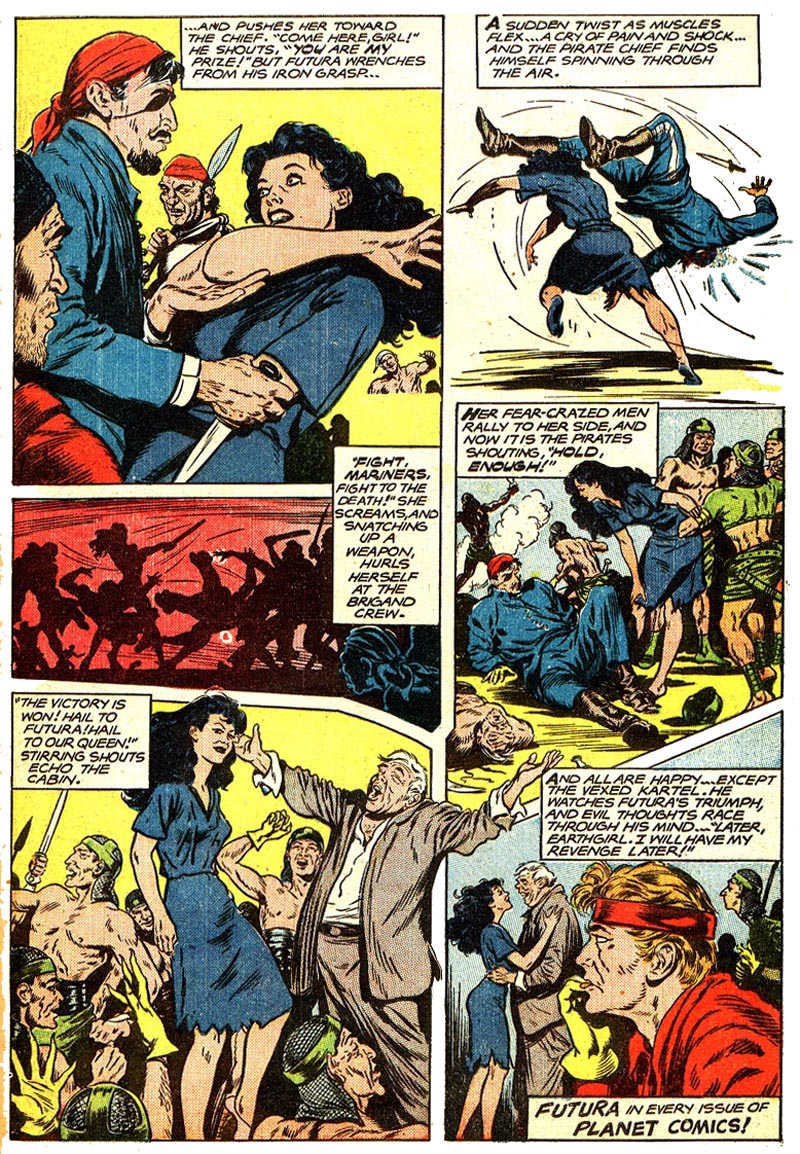
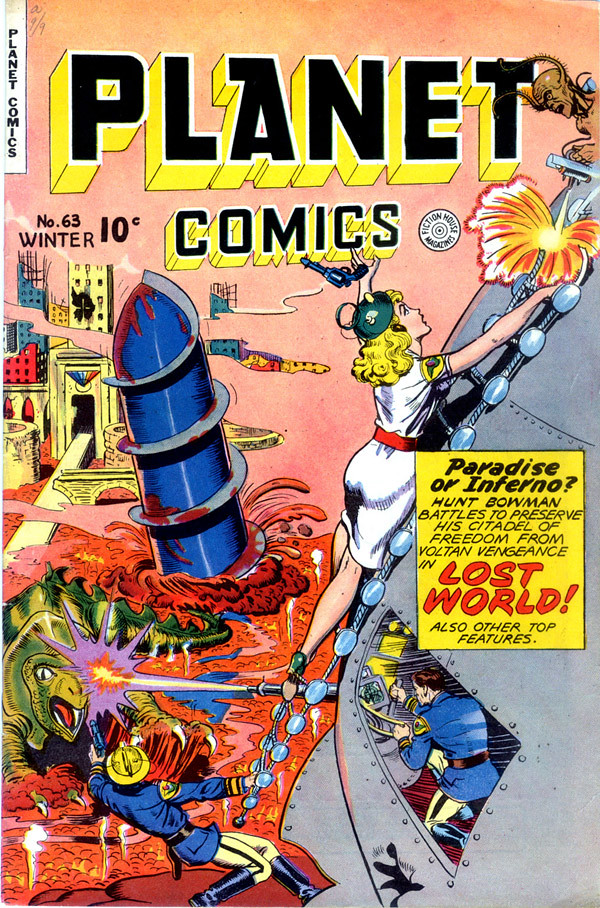
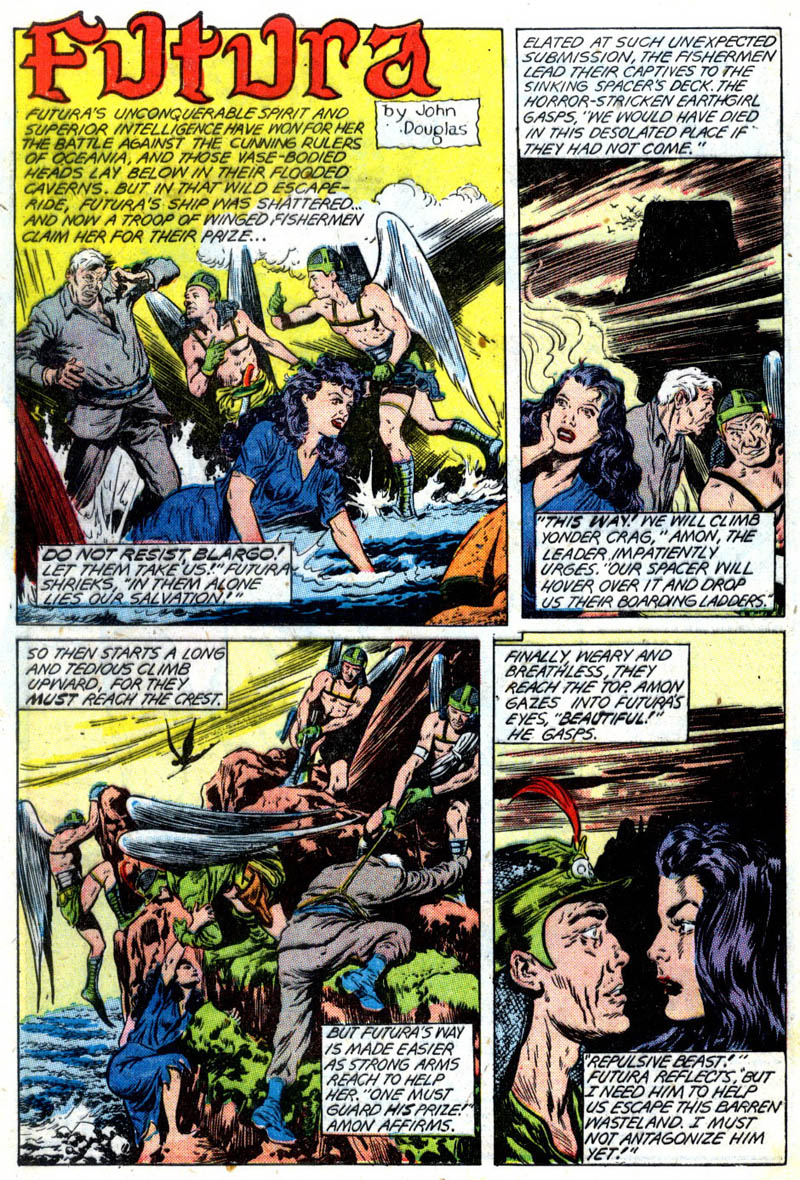
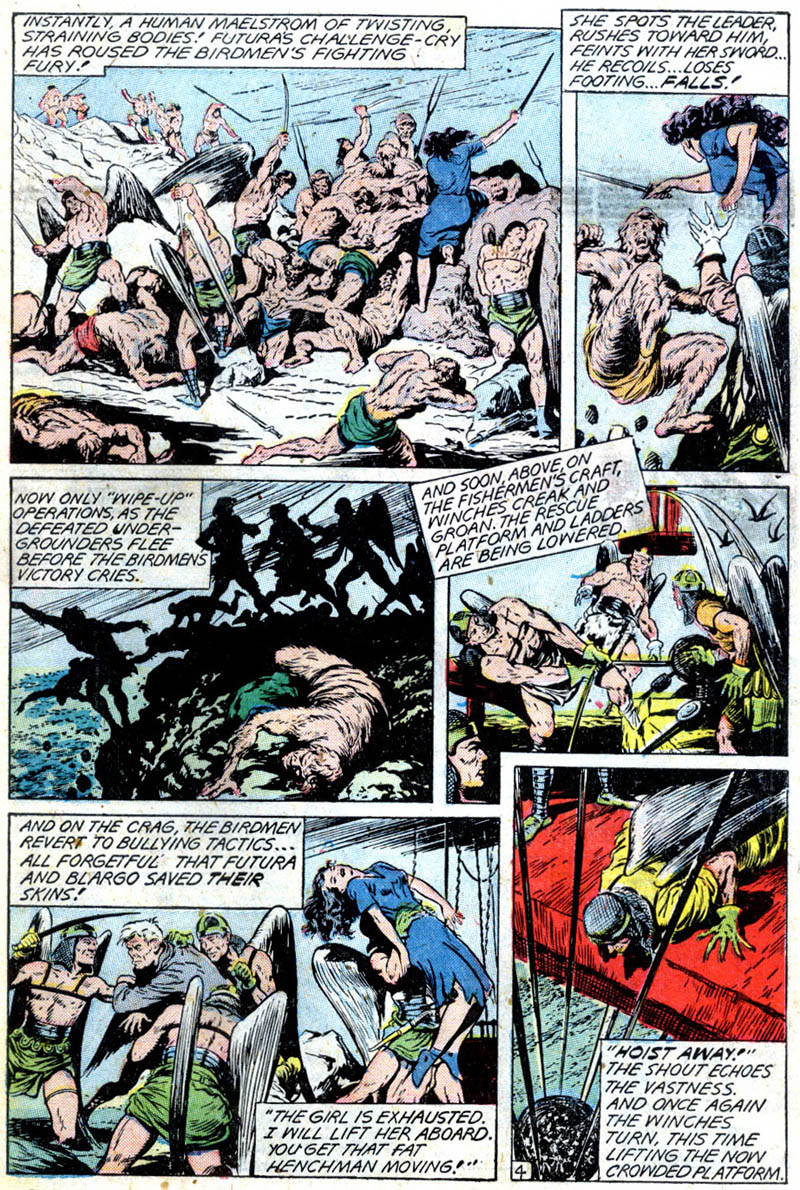
Planet Comics #63 (Winter 1949) gives us the penultimate chapter to the Futura Saga. In this issue one can see where Futura's long, strange journey has been leading. Alliances shift rapidly as Futura once free of the Jar-Heads, turns against the very enslaved mutated people, albeit mind-controlled, she once sympathized with.

There is a lot of good imagery in this chapter that profiles Futura without the cheesecake that could be so common in her story. The last panel of page three is nearly iconic and the battle between the mutants and the Hawkmen is magnificent.

This chapter firmly establishes Futura in a setting more reminiscent of the Alex Raymond-drawn Flash Gordon strip. Yet familiarity with other popular forms of entertainment would not save the character from limbo. With only one more issue in the Planet Comics series to feature her story Futura would soon be consigned to the occasional black and white reprint of Golden Age comic books. An original story featuring a "Futura" character would not be produced until the early 1980s, a gap of thirty years between appearances.

Thursday, July 15, 2010

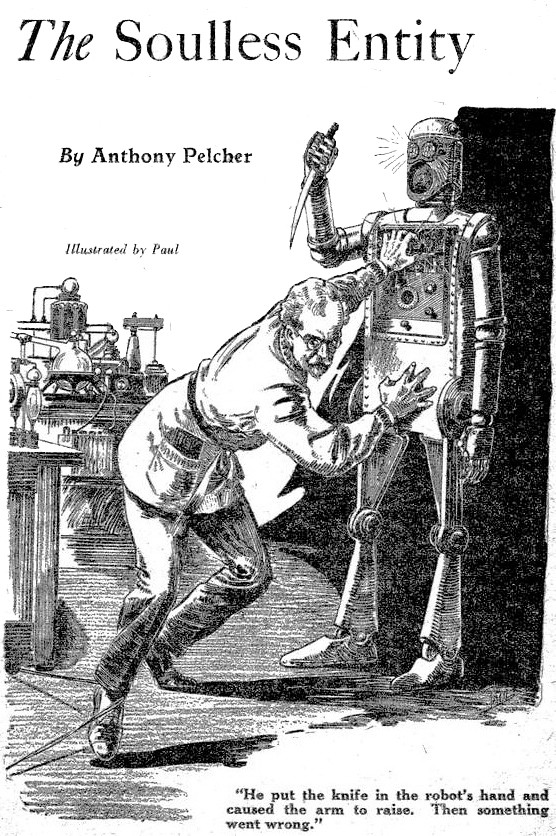
Then something went wrong

From Thrilling Wonder Stories #1 (January 1931). Art by Frank R. Paul.

Saturday, June 26, 2010

Planetary Evolution

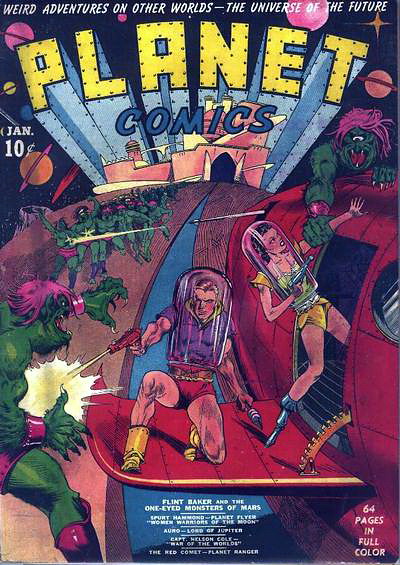
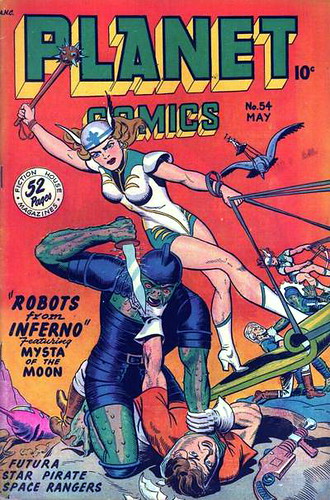
From the silly yet earnest early artwork depicting the hopeful future that still seemed to be steam-powered in spite of claims of cosmic and atomic power to the latter-day cover art that depicted hostile and strange life forms poised to consume and assimilate all civilizations, Planet Comics by publisher Fiction House is one of my favorite comic book titles. Not only did it feature Futura, a star-lost woman who alone fights for her freedom against human tyrants and aliens, but the title was both a perfect reflection and herald of trends in science fiction.

The long-running Planet Comics serials revealed what was popular, woefully passe and perhaps even what was anticipated in entertainment media of the genre. Styles were aped and innovation occurred in quantity. Aside from the tales the thematic transformations of the covers were likewise a good indicator of the changes that occurred over time to popular science fiction and the tastes of the market. Particularly noteworthy are the covers that feature women as being depicted as other than damsels in need of rescuing. While this happened more than some would think in the pulps and comics it was actually reflected in the stories within the magazine with the tales of Futura, Gale Allen and Mysta being prime examples. Though the artwork often favored stereotypical male power fantasies there are a number of covers that are progressive for the time.

Witness the evolution of 73 issues of Planet Comics from the early Pulp influences to the distinctive EC house-style of the 1950s by clicking the picture.

Planet Comics 001

Planet Comics by Fiction House Publishers (January 1940-Winter 1953).

Saturday, June 12, 2010

Don't go away, Renee

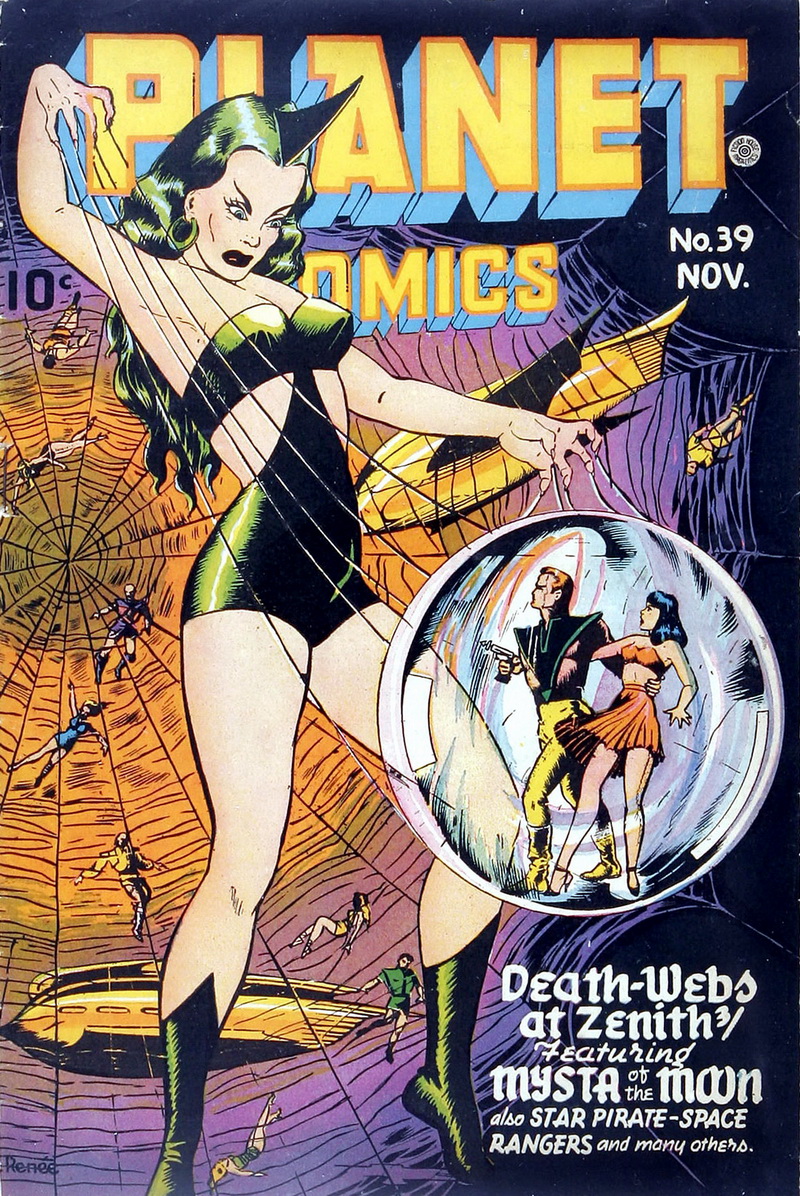
Cover of Planet Comics #39 (November 1945), drawn by Fiction House creative talent Lily Renee. I want this cover on a t-shirt or a big glossy framed poster for my wall. Or both.


Tuesday, May 04, 2010

From the Collection: Jack of Eagles

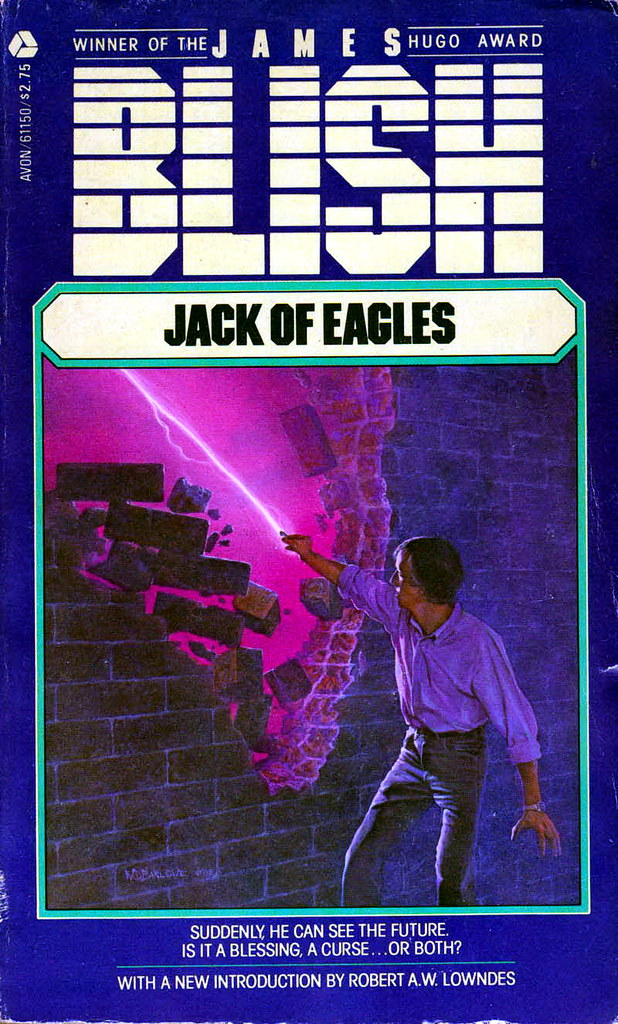
Originally published in Thrilling Wonder Stories in 1949, expanded to novel-length in 1952 and re-issued in 1982, Jack of Eagles is one of the lesser-known novels of award-winning author James Blish.

James Blish was most familiar to me in my youth as the author who adapted the Star Trek television shows to book form and wrote the original Trek novel Spock Must Die! One of the ways in which I was introduced to a greater universe of science fiction was through screenplay adaptions of James Blish.

That Jack of Eagles has not been reprinted is a shame as this story is a must read for anyone who is a fan of tales involving telepathy, telekinesis and other mind powers. I would go so far as to say anyone thinking of writing a novel or cinema using those fantastic elements and want to experience how to do the subject matter right should read not only Theodore Sturgeon's More Than Human but Jack of Eagles as well.

Wednesday, November 25, 2009

Futura - Chapter 12

The overall science fiction themes of Planet Comics typically followed whatever trend was the most popular at the time. Early in the series the stories were verging on the silly, reflecting the Hugo Gernsback-style of science fiction, or "Scientifiction" that was prevalent in the pulps. Space ships were simple reaction rockets that flew through the cloudy, ether-filled space between the stars that arrived at their distant destination in hours. Mysterious rays that performed miraculous feats of destruction were fired with precision from hand-held weapons. Atomic steam powered the giant cities while prop planes soared between monolithic buildings. All very charming and a product of the times. But grumblings among fandom existed even then as readers often complained about the nigh-magical feats of machines and the impossible actions derived from simplified and fanciful physics. These type of complaints from readers would go virtually unanswered for decades until the secrets of how fictional and impossible science worked by a different comic book company that published their Official Handbook of the Marvel Universe.

As the elements of science fiction evolved so did the various stories in the Planet Comics title as a part of that evolution. The earnest naivete of the pulps gave way to a relative realism as technology prompted greater speculation as to what the future may be like. As the public was increasingly educated as to the true nature of the universe the more wild fictional elements were reigned in and fictional space travel was made ever more local and confined to the greater solar system. The settings of science fiction became more "plausible" even as it remained just as fantastic and impossible.

As the universe became more complex the story elements became inversely simplified. No longer did ships zoom to other galaxies and visit Cymradia or Mongo. Adventurers typically remained within the solar system as there were suddenly plenty of stories to be told featuring the wild, heavily populated planets of Mars, Venus and Saturn. Eventually these ideas would also fall to the wayside as readers recognized that Pellucidar and the feudal Mars of John Carter were unlikely in the "real fictional universes". Currently these problems of unlikelihood are solved by the concept of alternate realities and other dimensions such as DC Comics' Skartaris. The next entry in the Futura Saga from Planet Stories #54 (May 1948) is an example of the evolution towards "unlikely realism" in science fiction. The ideas of far-flung, magical planets like Cymradia are left behind in favor of Space Pirates plying the star lanes of Venus and oppressing the fish-like people of that planet.

Chapter 12 of the Futura Saga finds our heroine continuing her journey into space, fleeing the world she inadvertently helped destroy in Chapter 11. Not having learned anything from her previous efforts to free oppressed people, Futura pledges to aid the Venusians in their struggles against a piratical tyrant. The art is a pleasing step up from the previous chapters and is a return to the style of the early Futura chapters and reminiscent of the Buck Rogers and Prince Valiant strips, though there are more than the usual number of gratuitous Good Girl Art poses than in previous entries.

Happily, Futura does some serious butt-kicking in this chapter. Her fight scene is made made all the more interesting in that it was way back in 1948 that the creators chose to break the tiresome cliche of the "Helpless Captive" that still permeates most action fiction to this day. The cliche of the prisoner who nonetheless has access to weapons but doesn't use them is a sore point for me when watching a movie or reading the scene in a novel or comic book (I'll expound on that after Thanksgiving in a My First Book of Noir post, Jenny vs. The Crime Empire). It is so darn silly and is a sign of lazy scripting and false drama. I rank it right up there with the "Lucky Break" (When the weapon held by the bad guy jams right when he has the drop on the hero).

Page five is an utter delight. Enjoy.

Monday, September 07, 2009

Flower Girl

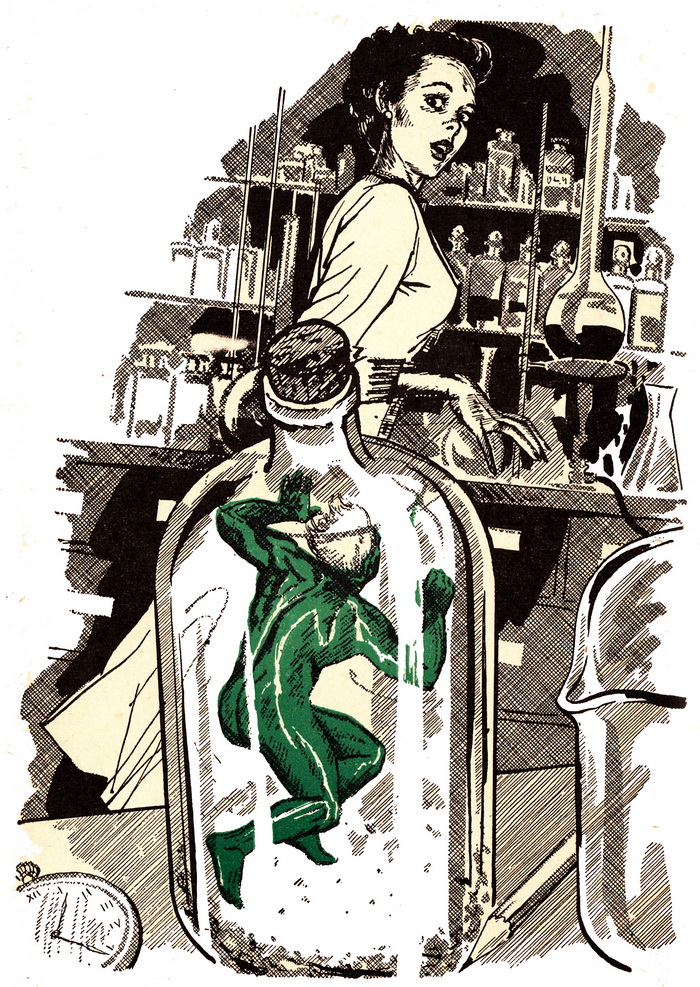
From the story Flower Girl by Chester Cohen with art by Eberle.
Rocket Stories Magazine
(September 1953).

Wednesday, September 02, 2009

The Man from Saturn


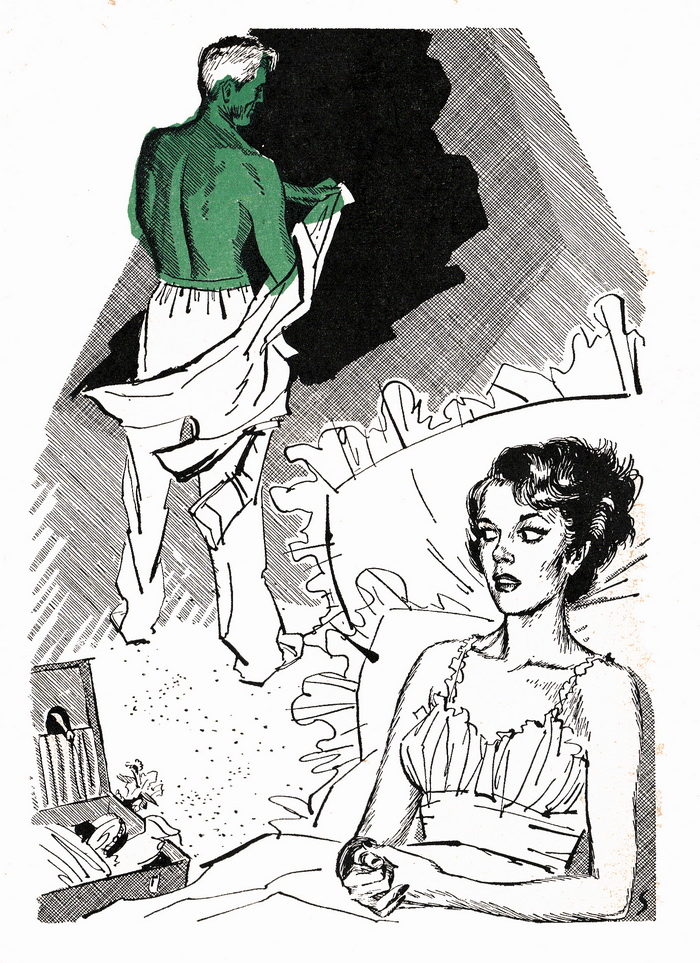
The Man From Saturn, from Amazing Stories (June - July 1953).
Story by Harriet Frank Jr. . Artist uncredited, possibly art director L R. Summers.

Sunday, August 30, 2009

You've gone to infinity and beyond, baby

Illustration for Underestimation, from Rocket Stories (September 1954).
Story by Alger Rome with art by Eberle.

Wednesday, August 26, 2009

I'm the only Darb here

Diamond Bomb - Dalliance Is Murder (May 1939)

I'm having a blast with the my new mystery-thriller-pulp character, Diamond Bomb. It may not be worth a visit here to anyone else but there are no comic books featuring Krypto out this week yet and as much as I enjoy Green Lantern there isn't anything I can add to the discussions that are already out there. All the Diamond Bomb posts are is provenance, anyhow.

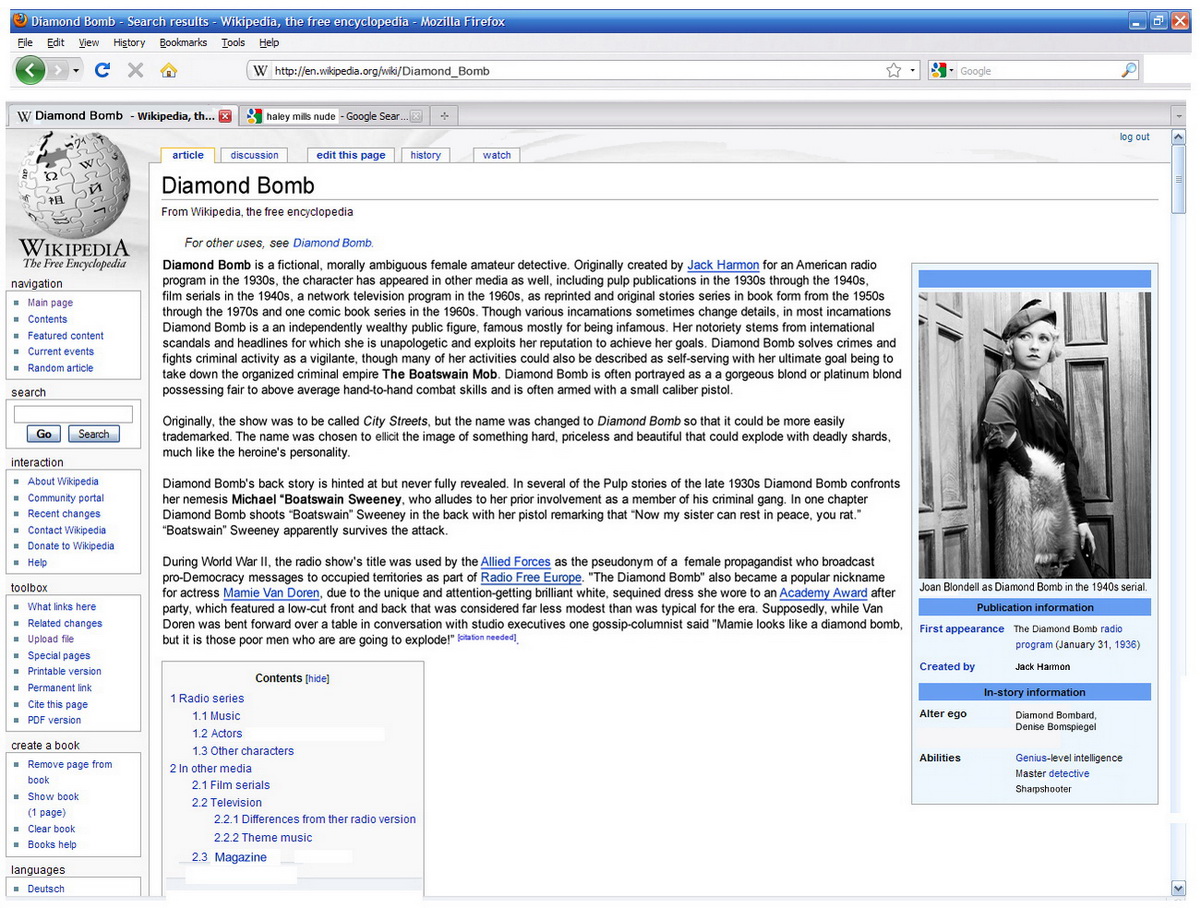
Here's a wiki page mock-up about the character featuring actor Joan Blondell as the character.

Tuesday, August 25, 2009

Knot A Bad Girl

In the 50s and 60s and even well into the 70s old pulp series found new audiences as the relatively inexpensive and in some cases, public domain, stories of the 30s and 40s were repackaged as cheap paperback books. While considered to be disposable entertainment by both the industry and consumers many of these books featured the work of artists who were masters of their craft and examples of their work are much sought after by collectors. The nature of the industry and the readers of the time ensured that mint copies of the books are exceedingly rare and in many cases the original art is lost forever.

One of the more popular artists of the era was R. A. Maguire, who specialized in his depictions of sexy, dangerous women. Maguire typically turned in a classic work no matter the theme, whether it be crime, adventure or sleaze.

If Diamond Bomb had existed to have her fictional Pulp adventures reprinted in the 60s boom of crime novels then I would definitely would have insisted she be envisioned by Maguire.

Original art The Brass Halo by R. A. Maguire. Check out his gallery at R. A. Maguire Cover Art , you won't be disappointed.

Monday, August 24, 2009

Wednesday, April 15, 2009

The Spirit Was Willing

From the July 1977 issue of Cosmos science fiction magazine is a short article by art director Jack Gaughan. In it he briefly reminisces about his time working for Will Eisner. Included with the article as the centerpiece of the magazine was an original work by Eisner featuring the Spirit and a few of the cast in a scene referencing the Spirit's science fiction adventures. I've never seen that particular art anywhere else so I thought I'd share it with the Eisner fans.


Tuesday, January 27, 2009

Anti-War Pulp Art


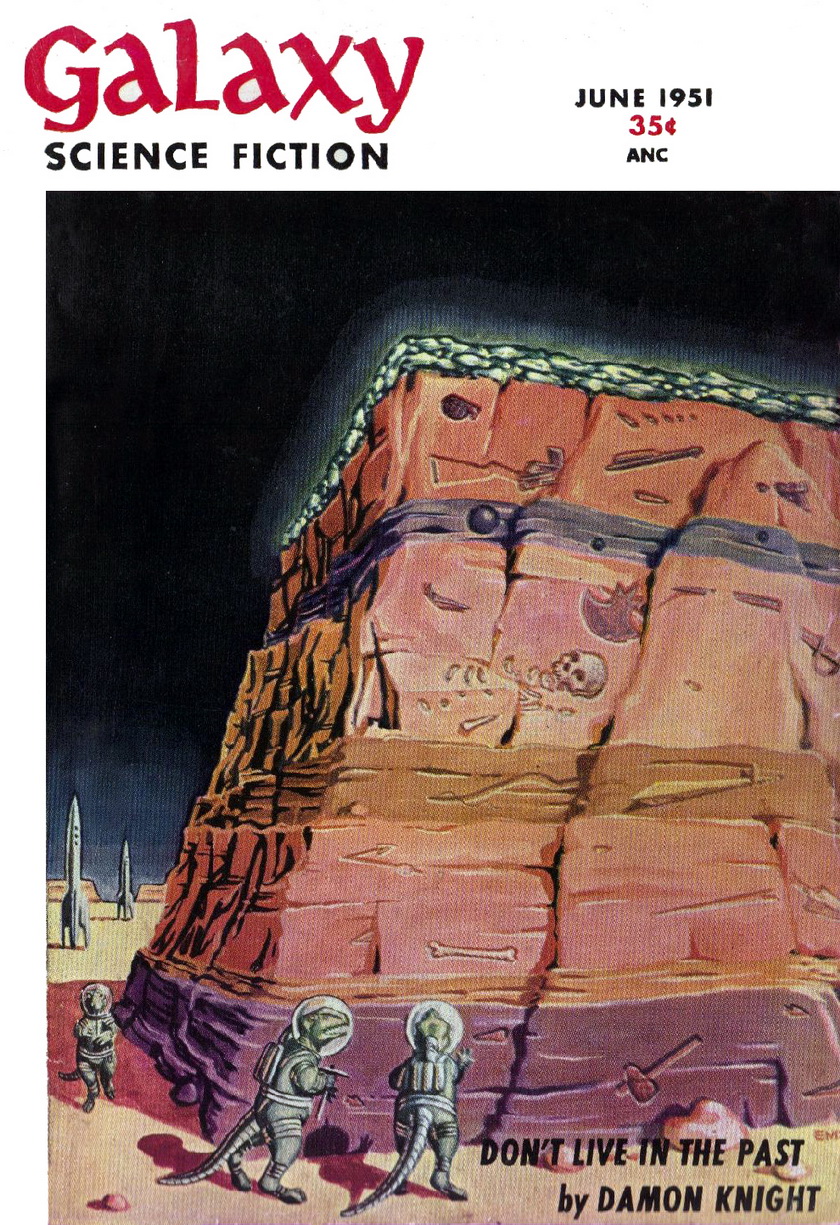
It took me a few seconds to catch on that the uppermost layer of the archaeological site of ancient Earth battlefields being studied by the lizard scientists was radioactive slag.

Saturday, January 24, 2009