On December 3rd, 1992 the very first text message was sent to and received via an Orbitel 901 phone.
The message?
The message?
"Merry Christmas."
 My birthday is this week and in celebration my lovely wife purchased for me an iPad. I'm not crazy about (a) the price and (b) the DRM but she received a substantial employee discount from her work that brought the tablet down to a reasonable price. I have to admit the tablet is a lot of fun. I don't have the kind of job where I will use it for work so it will primarily be a source for entertainment though it does have some useful tools available. The tablet is easier to carry around than a laptop and larger than a phone so it is in my "Goldilocks Zone" for personal devices. That is, it is just right.
The moment I opened the box I was determined to personalize my iPad before I looked for nifty applications and games. Being a comic book aficionado there is little better a source to declare your comic book geek cred than by displaying art created Jack "King" Kirby. The late artist and conceptualizer Jack Kirby is famous his work on Captain America, the ground-breaking run on Fantastic Four with Marvel Comics and his Fourth World space opera saga for DC Comics. Jack Kirby routinely drew over-the-top, rule-smashing spectacle that sometimes was not appreciated in his day. But even during those periods when some companies and readers didn't always support Jack Kirby's output he always had fans who never let him or his employers forget just how much they appreciated him.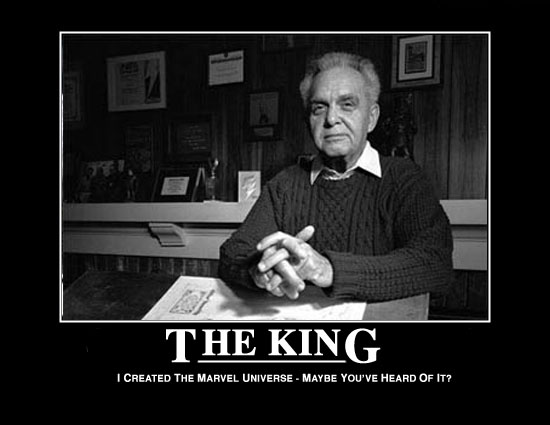 There are few creators in the comic book field past and present that could get away with the artistic stunts Jack Kirby routinely excelled at. Those that try and succeed usually emulate Kirby's unique line style or layouts. Other than unique characters and landscapes Kirby also drew fantastic, impossible and arcane machines that in one story operate by magic and others via super-science, though Kirby often made no distinction between the two, particularly when it came to his depictions of the Asgardian gods in Marvel's Thor series.
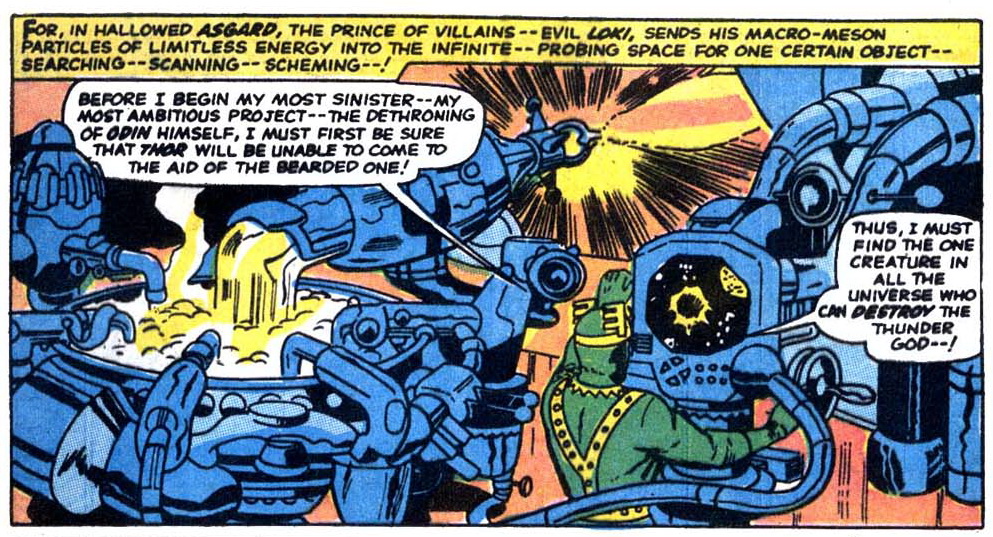 Jack Kirby drew for the floppy. In his day the trade paperback consisting of many collected stories was rare and as a concept was underutilized. Kirby didn't generally create art that would serve a purpose much beyond that month's entertainment in what was then considered a disposable format, the comic book. Much of today's comic book art is created with multiple forms of formats in mind for immediate use specifically designed to fully exploit other forms of media. As a marketing tool, an entire industry exists just to supply fans with the extra art and prose outside of the regular periodicals to fulfill their needs. One of the most popular and easiest image types to be found are those created as background pictures for phones and computer monitors, commonly known as "wallpaper". There exists plenty of comic book covers and pages created by Kirby that would serve as a good background image to express my appreciation of the King but a die hard fan such as myself wants something unique.
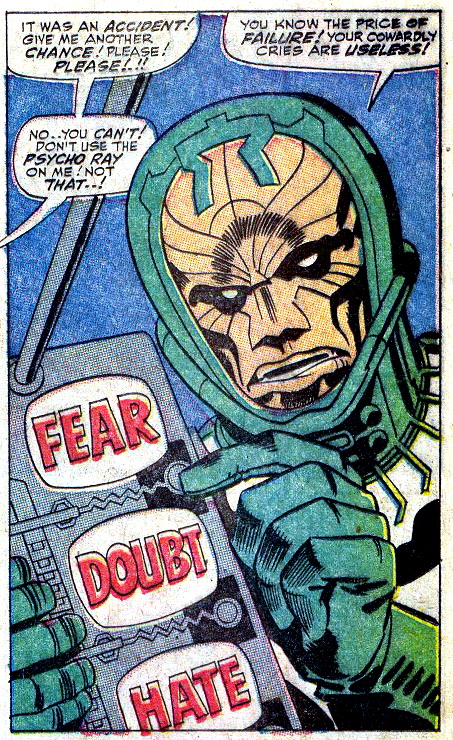 I had something definite in mind for iPad wallpaper but I couldn't find anything suitable outside scans of Kirby panels. The closest I came to what I wanted was some fan art in the Kirby style. Cool images to be sure but not precisely what I was looking for. What I really wanted for my iPad wallpaper was the ultimate Kirby gadget: The Control Box, the emotion-controlling weapon wielded by the 1960s Fantastic Four villain the Psycho-Man. In the Marvel comic books the Psycho-Man is a despot from another universe who uses the emotions of fear, doubt and hate as weapons to terrify and manipulate human beings, torturing them until they become subjugated to his will. The Psycho-Man has been an semi-recurring character in various Marvel series since 1967.
Looking around the web I found only a few fan-made Kirby-inspired images of the "Mother Box" device designed for the cellphone. The Mother Box is a sentient and benevolent computerized nanny that guides and assists both the good and evil New Gods of Jack Kirby's Fourth World series. Examples of the Mother Box for the phone can be found here and here and here.
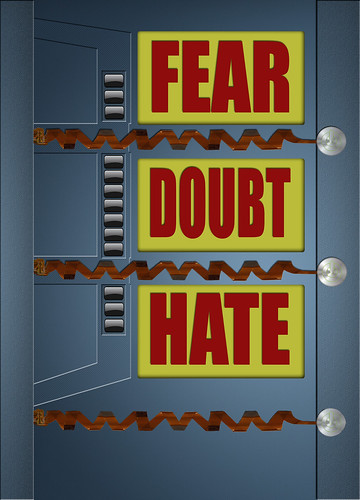
My searches for a suitable image of the Psycho-Man's Control Box met with negative results so I decided to create one of my own. My photoshop skills are nearly non-existent but I thought I'd try to create my own Control Box anyway. Initially, I tried to emulate a comic book style of the Control Box but quickly discarded that in favor of a more realistic depiction.
Firstly, I chose a minimalist metallic wallpaper for the background. That gave the surface of the Control Box a texture that made it seem more real, as if it was cut and shaped out of some alien sheet metal in a hidden lab by some insane, cursing alien who muttered to himself, swearing dire retribution on all those who wronged him. Because you just know the young BEM who grew up to become the Psycho-Man got beat up everyday for his lunch credits at Microverse Junior High. After that I created the FEAR, DOUBT and HATE status screens, throwing in some drop shadows to make them appear 3-D. For the control switches I used a standard power button image. I chose a green light for the button because there was enough red adjacent to it. I then embossed a couple of over-lapping trapezoid shapes on the left side, cut out some sections and added some more generic control buttons. I created a couple of textured surfaces for the right and left sides to add depth. Of course the Control Box would not have that special Kirby touch without some gratuitous zig-zag lines running across the surface. This was for me the most difficult part of creating the Control Box. Initially, I intended to make some curvy lines but the simplistic line art distracted from the other more photo-realistic parts of the Control Box. I considered a more 3-D effect by inserting a wave-style bike rack into the image but again, I didn't like how it fit into the overall style.
Then I considered using standard circuit boards. Reversing the image of a circuit board would make any text on the surfaces appear sufficiently alien so the English words and numbers wouldn't be too distracting. I kind of liked the idea of Psycho-Man building a prototype Control Box showing exposed circuitry. But none of the ones I found online or had in the garage I scanned worked for me. I wasn't enthused about making a jagged or wavy circuit board myself as my PS skills would have made it obvious I shaped the image by deleting sections defined with a polygonal lasso tool.
I was kind of stuck with what to do to finish off the Control Box. It just would not do not to include the ultimate in stylized Kirbyism. Then I had the idea of using an image of a flexible printed circuit. Cutting and pasting the image of a length of FCB across the surface of the Control Box gave me that special Kirbyesque zig-zag of actual circuitry and I really liked the end result. So I loaded the Control Box image into my iPad and I couldn't be more pleased with how it looks. I've decided to share it with any other fans to put onto their phones or tablets if they want. So take a gander. Here is my re-imagining of the Psycho-Man's Control Box, created by Sleestak after Jack Kirby. Hope you dig it.
 One of the more seemingly harmless though in reality careless acts a parent can do is placing the name of their child on the exterior of their child's clothing. Predators could sometimes use that information to the disadvantage of a child who would believe anyone who knows their name must be a friend of the family or knows them.
While it statistically isn't all that likely that having a name visible on an outer article of clothing will make a child the victim of a crime it becomes ever so slightly more possible that they will. Given their druthers a predator goes for the easier target, something that allows them to separate prey from the herd. For that reason the makers of those stick figure family car window decals advise against identifying the family members by name. I would advise against displaying them at all.
So it was that yesterday while at the mall I witnessed one of those Things That Make You Go Tsk. A barely-supervised child was running up and down the sidewalk, playing, ducking out of sight, wandering further away from the parent by increments and being distracted by things. All in all being a typical kid. She was pretty gregarious and talked up every person that walked by. Not a problem mostly except that on the front of her dress was a piece of tape with her name written on it, apparently a remainder of a class field trip that was not removed before school ended.
When her Billy-esque wanderings brought the child to my side I asked her for her name tag  because I had lost mine. Without pausing the youngster stripped the tape off and handed it to me. As she then bounced off to play I wadded up the tape and tossed it into an adjacent trash can. The parent, siting on a bench a few feet away, paused the phone conversation long enough to glare at me with her piggish, dead, hate-filled eyes. "Yeah." I told her. "You probably don't want strangers to know your daughter's name." She then resumed her phone call, annoyed perhaps that a complete meddling stranger was the better parent to her child than she was.
The name tag incident led me to think about how funny/cool it would be to put an ambush QR Code on a shirt or on stickers to place around playgrounds. When some weirdo photographs happy children playing on a jungle gym their phone will detect the code in the camera field and immediately lead them to some website like whyareyoutakingpicturesofmykidyoufreak.com, preferably with some self-starting, screaming audio designed to draw attention to the creepy stalker. The destination of the code link is limited only by the imagination of the creator.
QR codes are easy to generate and print out on a variety of media. Don't be surprised if some educationally-themed QR codes start showing up in the wild around some local San Diego playgrounds, schools and parks.
In a previous entry I linked to an example of the Dark Halo, the extinct video artifact caused by the limitations of the equipment of a bygone television age. While the Jimmy Dean video had some good music and was a fine example of the unique lens flare it is this Boing Boing segment showing a candle burning on the old Mr. Wizard television science show that demonstrates the Dark Halo perfectly.

 I may be the only one to ever comment on an extinct video artifact; that of the Dark Halo, a unique lens flare common to early television. There were a number of limitations to such new and expensive means of communication and for decades the promising technology was unable to fulfill its full potential as a medium. It was, in spite of its advanced nature, a fairly simple means of communication and it would take years of development and the anticipation of market penetration to work out all the bugs.
Early television worked but it didn't work all that great. Static, ghosts and other problems caused by transmission, reception and the limits of the equipment made television viewing something of a general disappointment. Television wasn't the slick eye-party of modern times. The questionable quality was endured because that was all there was. It was the transmission of the information, not the experience, that made broadcast television worthwhile in the early days.
One of those artifacts of broadcast television of days long gone that surely caused concern among broadcasters was the Dark Halo. I'm sure there is a technical term for it but I don't know what it is. The Dark Halo was a lens flare caused by the inability of the camera or equipment to fully process the image against an overwhelming light source. It was caused by a bright point of light reflecting into the camera. Typically a bright, intense reflection from a ring, piece of metal, glass or sequins on a dress or suit would cause a bright flare on the image. Instead of a bright, white glow and haze the equipment would instead create a momentary darkened halo around a bright center. In modern film craft the bright lens flare is a camera technique used on purpose for effect (Star Trek, CSI, etc.) but in the past it was an annoyance that highlighted the limits of technology.

 While sitting at home pondering the future I considered what form DRM (Digital Rights Management) and copyright may take in years to come.
Technology always continues to improve and be what was once the province of huge corporations and countries are made more accessible to the average consumer. The old ways of recording events are rapidly being phased out. As gears and switches in the telephone are no longer utilized soon actual film may be a thing of the past. Perhaps this is the last generation that will actually expose light to an emulsion to make a photograph except for the historical hobbyist.
So with the recording of digital media and the fact that the average person can easily manipulate complex data what will become prominent in the after-market of the future will be the demands of businesses and governments to control information and ensure revenue sources by protecting intellectual properties. This already exists in one form in regards to music and DRM and is the reason I will not purchase some brands of music players. I support the spirit of copyright and disagree with those who believe that anything once created is free or can be copied and mass-produced for profit without compensation to the creator. I can get behind DRM, EULA, trademarks and copyright. That is, within reason. I have about 400 compact discs and even more DVDs that I have purchased over the last 15 years and I refuse to let any person or company dictate where and when I can listen to them and in what format. I routinely copy movies to my laptop or music to my player and watch and listen to them in a more convenient format when out and about. It is one thing to watch a movie during lunch on a park bench and an entirely different matter to make copies of Good Luck Chuck and sell them at a swap meet or hand them out to the entire office where you work. If companies no longer sell a product and instead intend only to lease it temporarily then they should quit dancing around the subject and just take that position. Tell the buyer the rules flat out instead of misleading the consumer by letting them believe they actually own what they just purchased.
So I have imagined that copyright law in the future will be even more restrictive and probably applied to ridiculous levels in an always connected, online and on-demand electronic world. Currently DRM or copyright is applied when the content is created. In the future it may be applied before something actually exists.
I imagine that soon technology will be available, and then the inevitable law, that would require all recording devices to access a license database of copyrighted material prior to allowing the photograph or video to be successfully recorded. In the near future all image recording devices could be required to determine if the the image or subject in the selected scene was protected by copyright or was restricted in some way. Anyone attempting to take a photograph of a work of art, something in public venue or some other media or subject that is otherwise protected would find their attempts blocked by the software of the recording device. Even today with little effort and varying success commonly available software can analyze a digital image for content such as in facial or shape recognition or in use for comparison for differences between images.
The future camera loaded with restrictive software would otherwise function normally, but the software would block and spoil the image for the user unless a fee is paid to the owner of the copyrighted subject or an EULA is strictly adhered to.
The recording device would simply not capture an image if something restricted by copyright is anywhere in the image field.
I could understand the use of this technology in protecting works of art, documents, company or government secrets and the like. The extreme power of repeated camera flashes can result in a fading of paint and inks, destroying precious art, movies would be recorded by small cameras in theaters for the purposes of bootlegging and bad people could take photographs of military installations in pursuit of nefarious deeds.
While the technology would be deployed in the interest of protecting intellectual and actual property it would of course be abused rather quickly. Some legal department somewhere would claim that the image of a Torrey Pine that has existed for centuries on a San Diego bluff in a protected National Park was their intellectual property because a stylized image of it is on their company letterhead. Future DRM would prevent visitors or Forest Rangers from taking photos and documenting the tree for posterity or health management. The legal fight to determine the ownership of the image of the tree could drag through the courts for years. As I was just reminded, something similar actually occurred in regards to a Californian Cyprus tree several years ago.
As actually happened, the Steel Bean sculpture in Chicago was considered copyrighted and no one was allowed to take photos of it. People were routinely harassed and threatened if they posed with or took a photo of the publicly-funded sculpture. Future DRM of the kind required for digital recording devices I have imagined would ensure a poor photo of the sculpture. Unless the tourist forked over a fee to to the City of Chicago to release (temporarily?) the rights to create a special memory then their visit will be disappointing and an unhappy girlfriend will result.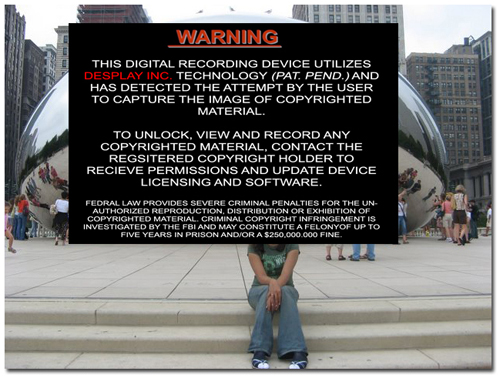 Typically, as history has shown when money is involved, everyone wants a piece of the action. So the software and database would be enforced to extremes and nearly everything would be restricted against general use by the public for some reason or another.
So much for liberty.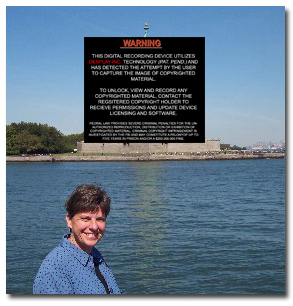 We won't always have Paris.
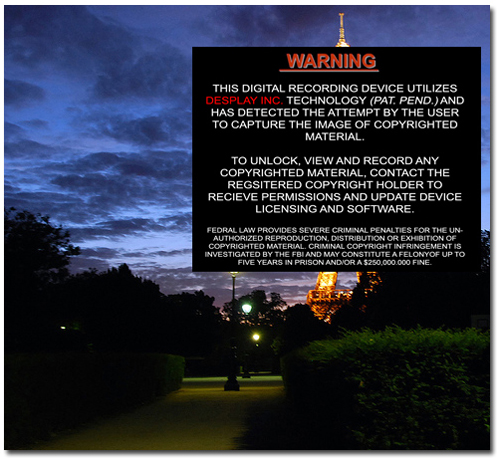 A lovely sunset. Or was it? I let my annual subscription with the Desplay Inc. photo pool lapse!
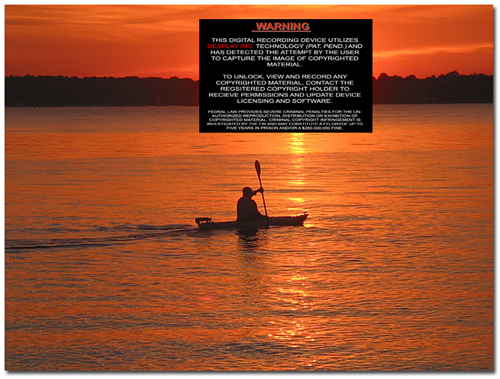 There are even times when some governments and businesses claim events are copyrighted and cannot be recorded without permission. Of course, they will never allow anyone to obtain that license to reveal the details of any event they wish suppressed.
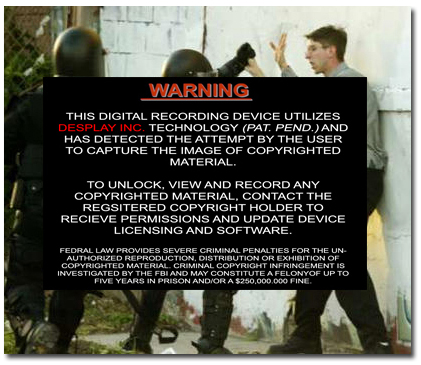 Imagine how differently some events would have played out in the world media if the future DRM software was available now to stop a bunch of poorly led soldiers from using their cellphone cameras?
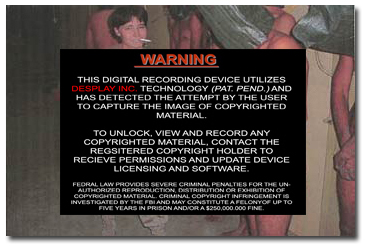 Good luck getting that software patch from the government of Darfur.
 Genocide? What genocide? You have no proof!
Of course while the blocking software would be a boon to government agencies seeking to control the flow of information to the public, there will always be the inevitable errors and over-enthusiastic application and it is usually to the detriment of mankind. An oversight by failing to obtain the proper licenses will block the Hubble telescope from capturing a once-in-a-billion-year celestial event. Oops! Sorry, the Universe will just have to keep its secrets just a bit longer!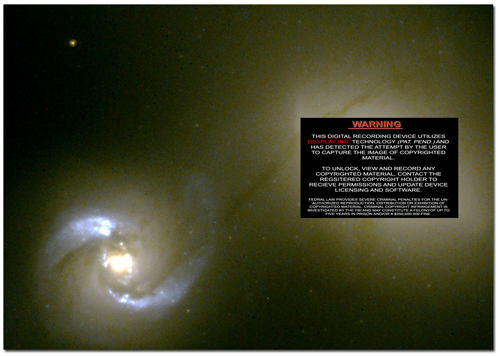 Careless application of the database and poor maintenance will inevitably cause tactical setbacks in the battlefield of tomorrow.
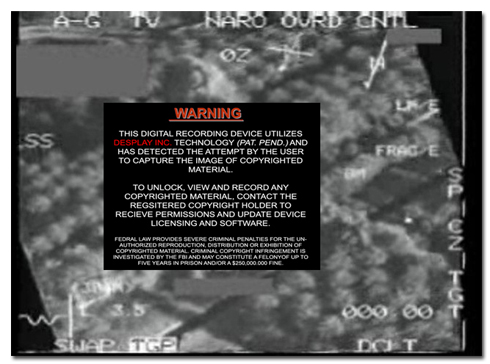 As the role of high technology continues to increase the license database of allowable copyrighted images may not be updated at the same frenetic pace as war operations. Terrorists could list their facilities as copyrighted and international law would not allow the other country to access satellite or public images to plan attacks or mount a defense. The scene as viewed via the digital recording devices of gun cameras and guided missiles may be blocked by the database and the success of the precision air strike would be in doubt. All due to shoddy customer service and failure to renew the licensing subscription by the client.
If the eager cameras cameras of the Paparazzi were to be denied taking photos of copyrighted celebrities then there would be fewer incidents of road rage, mishaps and tragic accidents.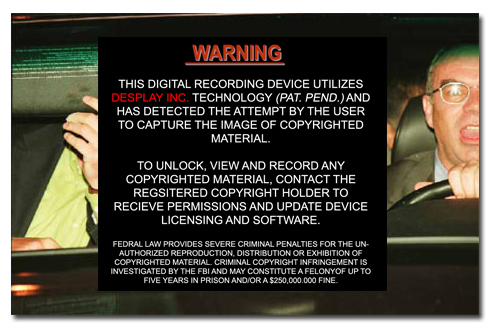 Yet by using the future DRM the publicity-hungry celebrity would gain some control over the use of their image.
 Any incident that would possibly gain them positive or or negative publicity would be managed with greater success by restricting the use of the image until a deal is made to send revenue their way or even to stop publication of the image entirely.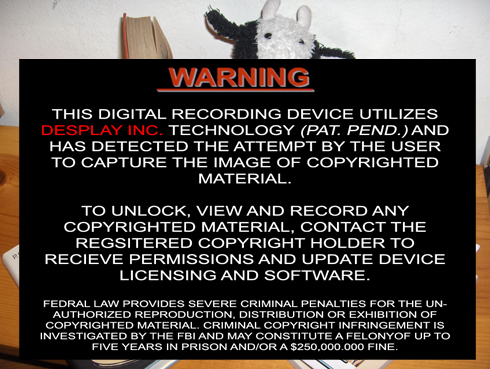
The media would love the future DRM and next to the government be the biggest client of the software. Revenue would pour in with the control of their news images as affiliates and websites pay to unlock photos and videos for viewing. That is, until some company or individual decides that a negative story needs to be censored by blocking an image connecting their product to their misdeeds.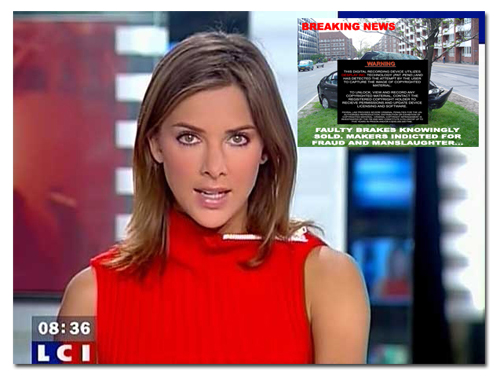 Then of course the media would wring their collective hands and cry about censorship, ignoring that they themselves are some of the greatest violators of free speech, open dialog and have long given up any right to claims of journalistic integrity.
As usual, only the average consumer will be inconvenienced in any way. The future DRM that I imagine will of course not hinder the tech-savvy any more than the restrictive attempts on digital media do today. Digital recording devices will be illegally modified and software will be hacked to provide images unhindered by the wishes of the copyright holders. An entire underground movement over being able to freely view the objects of the real world will be created, diligently working in the shadows to bring an unrestricted reality into the light.