I'm concerned enough about the state of comic books that I pay attention to, if not campaign about, the negative portrayal of women in comics. My stance is usually that much of the fanboy/girl service in the way women are drawn and scripted that abounds in comic books is not necessary and is therefore just ridiculous. Silly attempts to justify the Power Girl costume aside there are a few instances where the exploitation of the female form in a comic book is an important part of the story. One such example was in the Seven Soldiers mini featuring The Bulleteer. One premise of the story was the fetishistic nature of the superhero so it could be argued the manner in which the female Bulleteer was rendered was necessary since she was the victim of her husband's sexual obsession with superheroes.
Another example could be the recent issue of World's Finest #3 (February 2010) featuring Supergirl, Batgirl and Catwoman. In this issue Batgirl and Catwoman find themselves in conflict with robots created by the Toyman. Throughout the entire very physical fight Catwoman's costume remains closed and serves as protection, which is what a good costume should do. It is only when she is rendered unconscious and tied up that her costume is unzipped exposing her breasts. Catwoman is often portrayed with a casual opened front to her costume but in this instance it is doubtful she did this to herself.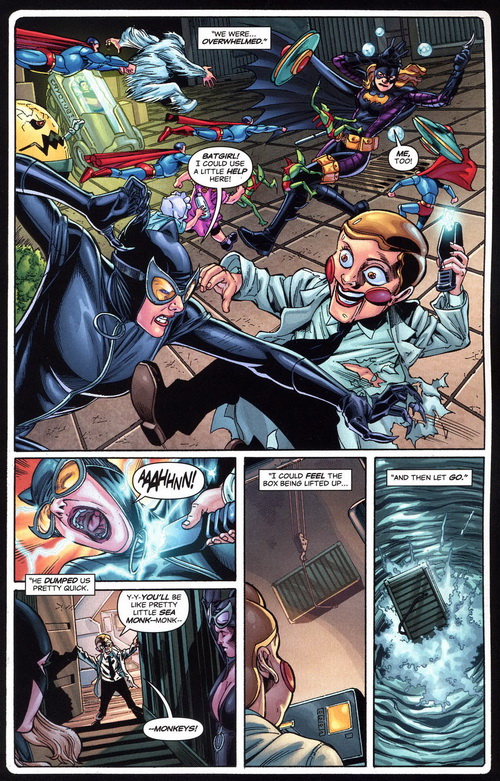
On the other hand, if the creators just decided that a woman being tied up and showing her boobs was sexy and drew her that way just because they could, then shame on them.
Tuesday, December 29, 2009
Skinning the Cat


Tuesday, June 17, 2008
Futura - Chapter 1

The Planet Comics title ran from 1940 to 1953 and gave readers a steady exposure to impossible, fantastic science fiction and featured a few of the stories of Fletcher Hanks. While the contents of the book eventually changed near the end of its run into a one-shot anthology title it was through most of its life a book that hosted long-running serial adventures featuring a familiar stable of characters. It was a title a reader could grow up with.
Many of the characters were modeled with various successes after concepts that could be found in Buck Rogers, Flash Gordon and John Carter along with stylistic elements popularly found in the super-hero comics of the Golden Age. Some of the longest running series such as The Lost World, Gale Allen, Mysta of the Moon, Space Rangers and Auro, Lord of Jupiter lasted a decade and longer.
Another series that had a multi-year life span with Planet Comics was Futura, which was serialized in that title starting in July 1946 with issue #43 and probably ending in Spring 1955 with issue #64. An over 20-issue run of nearly ten years!
Futura is the story of an office secretary named Marcia Reynolds who was shanghaied into space to serve as the test-subject of an alien seeking to repopulate his planet. In the beginning the tale of Futura, while eerily drawn, is very typical of what the market expected in a comic book story with the lead character being a female. Marcia Reynolds, as Futura, was gorgeous, scantily clad, threatened by amorous bug-eyed monsters and tied up a lot. In fact, the story could easily be interpreted as both a dream by the character and a power-fantasy for the reader, the caveat being that the typical audience for the book was male and Futura usually extricated herself from difficult situations and often lead the charge into battle herself.
The quality of the art and writing varied greatly over the next several chapters and much of the narrative added to the idea that Marcia Reynolds was in a dreaming state, in particular the story featuring forest sprites and a magic sword. But soon the creative team picked a direction that leaned more to classic Space Opera and with issue #53 began offering lush art and rich story-telling that were stylistically on par with the details that could be found in the Flash Gordon dailies. Over the course of her story Futura quickly becomes less of a victim and her journey from frightened breeding stock to strong, independent woman is a fun and interesting one.
The first chapter of Futura from Planet Comics #43 (July 1946) is presented below. As ever, click the pictures to make for easy reading. Enjoy!