 Frank Frollo drew for Funny Picture Stories #11 (Nov 1938) one of the most economical comic book action sequences I've ever read.
Probably in the interest of filling space Frollo decompressed the action so far that often a pivotal panel has all the typical excitement one would expect from an Indiana Jones-type adventurer occurring off page and is merely implied. Many of the characters don't react to what should be a frightening or anxious moment and are depicted either staring at objects, gesturing or not reacting at all.
The lion threatening one of the characters is about a half mile away, something that doesn't really inspire tension and even the captions in the word balloons are spaced out, making it appear that everyone speaks while interjecting extended pauses.
While hero Jack Strand contemplating an open gate for an unknown time prior to climbing over an uncompleted crowd barrier is amusing, the most glaring example of economical artistry or script not matching the finished product is the hilarious scene where the enraged lion leaps from the arena and rushes into the crowd of spectators. Not that you'd know it from reading the story.
Thursday, September 22, 2011
Least Exciting Comic Book Action Sequence Ever


Friday, June 03, 2011
Marga the Panther Woman
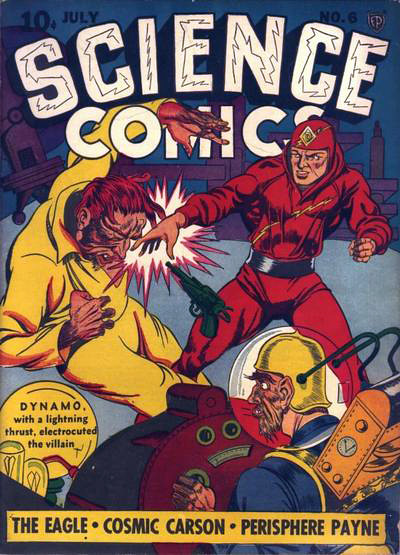
While the latter characterization is a lot more family-friendly it is a bit boring. The Marga as depicted in Science Comics #6 is not PC, decidedly unkind to animals, a sociopath and a whole lot more interesting.


Wednesday, May 19, 2010
There's being mischievous
...And then there is this little demon seed.
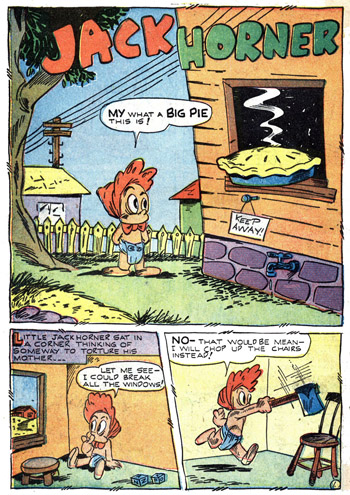
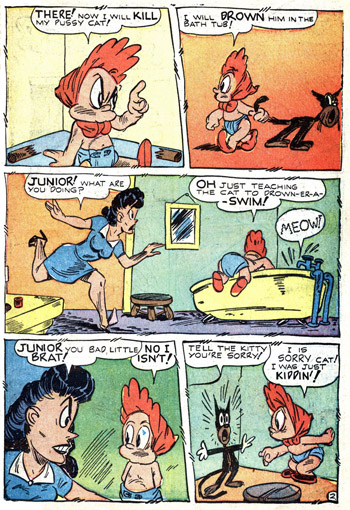
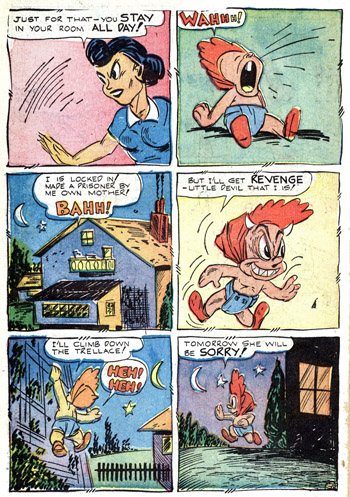
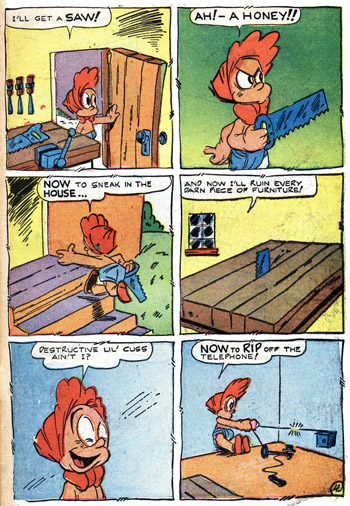

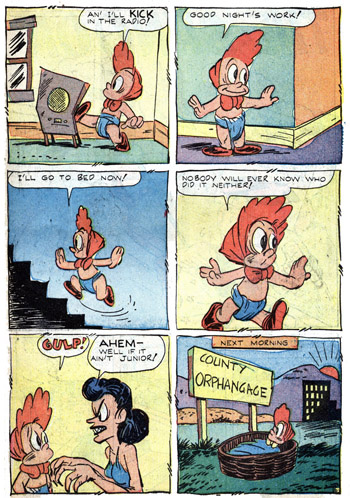 From the psychotic man-baby contemplating the gigantic mystery pie with horrible, unnamed ingredients to the shark-toothed demon-mother-wife-jailer and the rushing river euphemistically named the "County Orphanage" this Golden Age attempt at humor begs for a modern-day treatment by a good horror or shock writer. There's undoubtedly an entire unknown back story to this tale and I believe we are looking into a region of hell.
From Jack in the Box #11 (October 1946).
Wednesday, July 08, 2009
Thursday, June 26, 2008
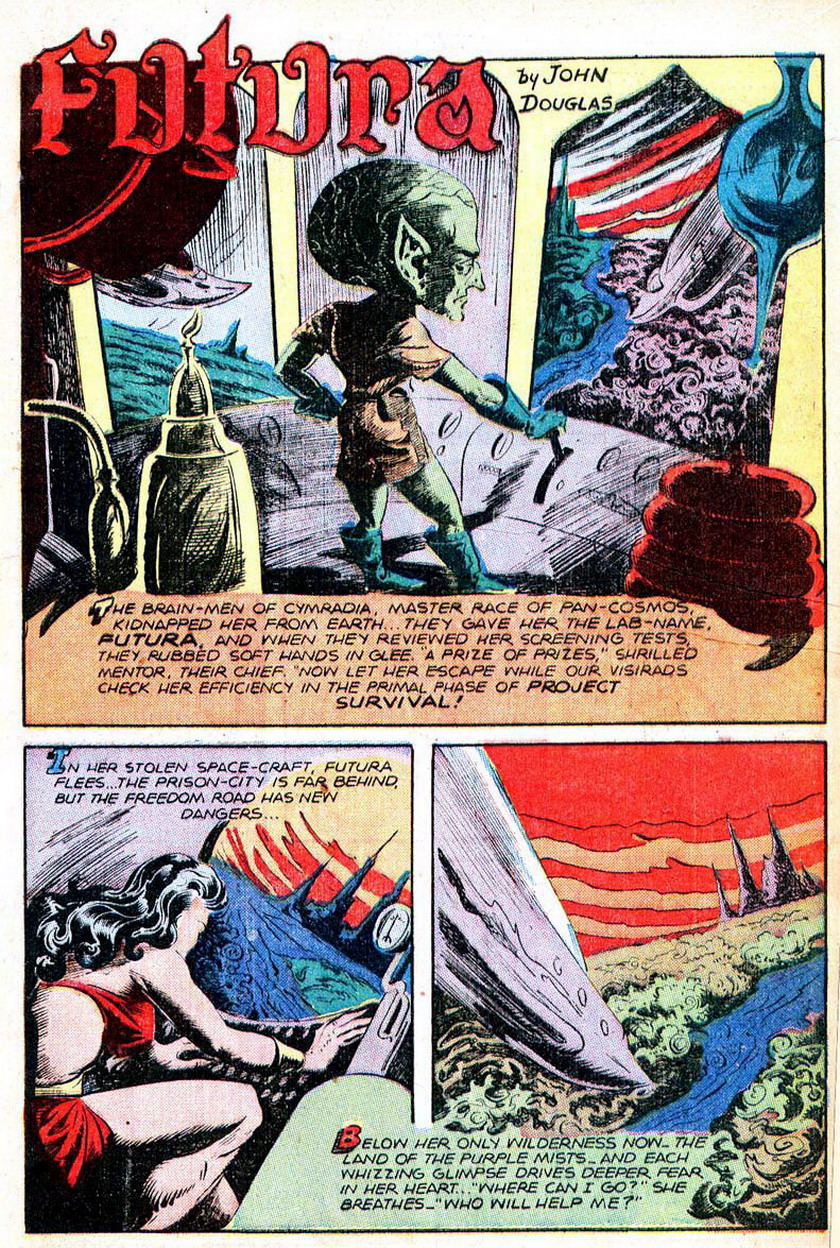
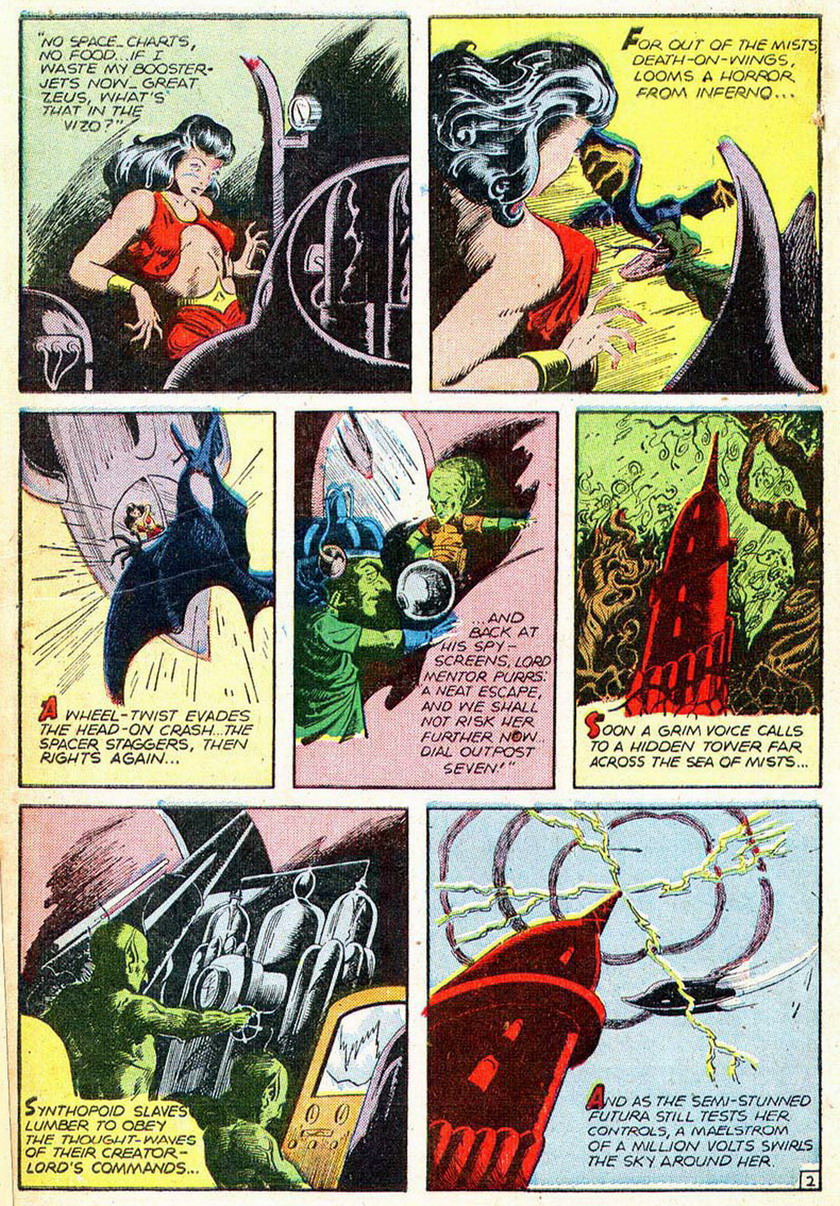
Futura - Chapter 2
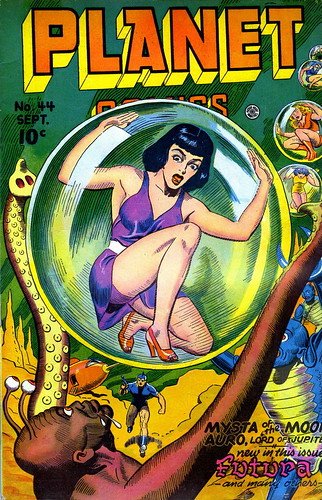
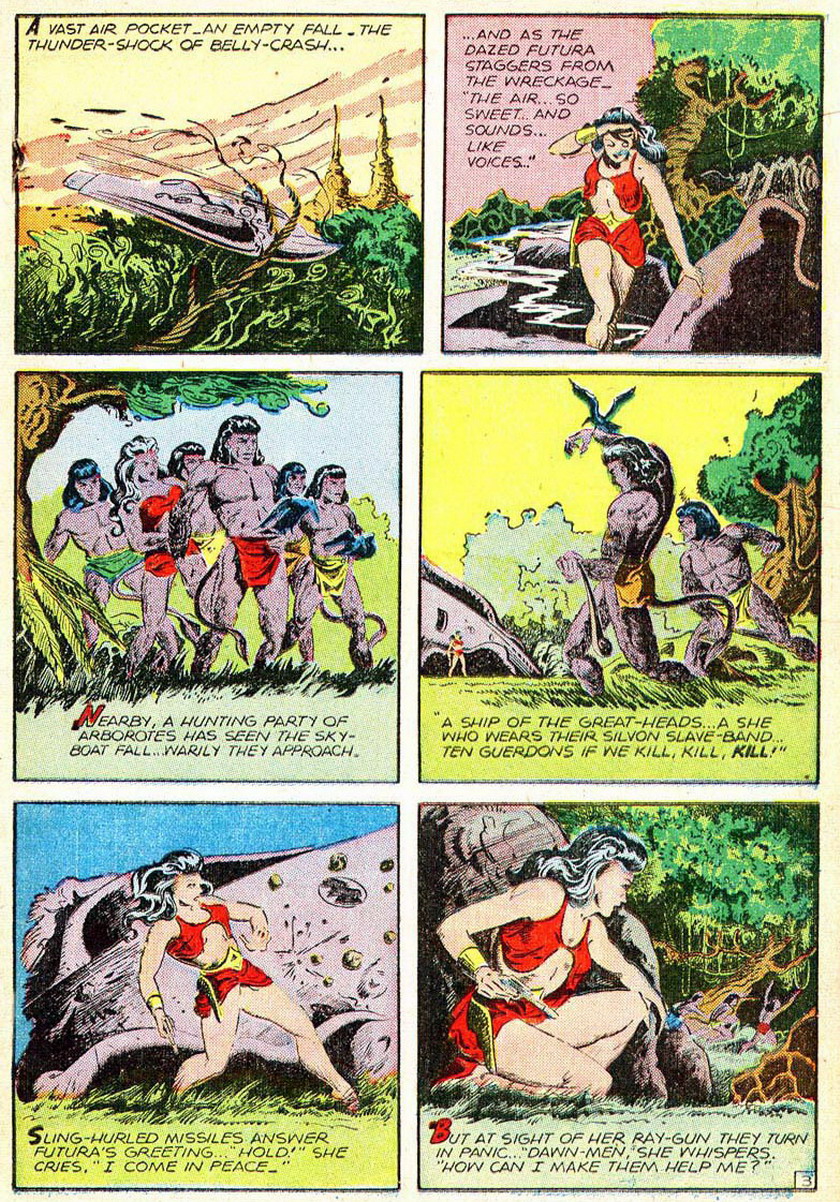
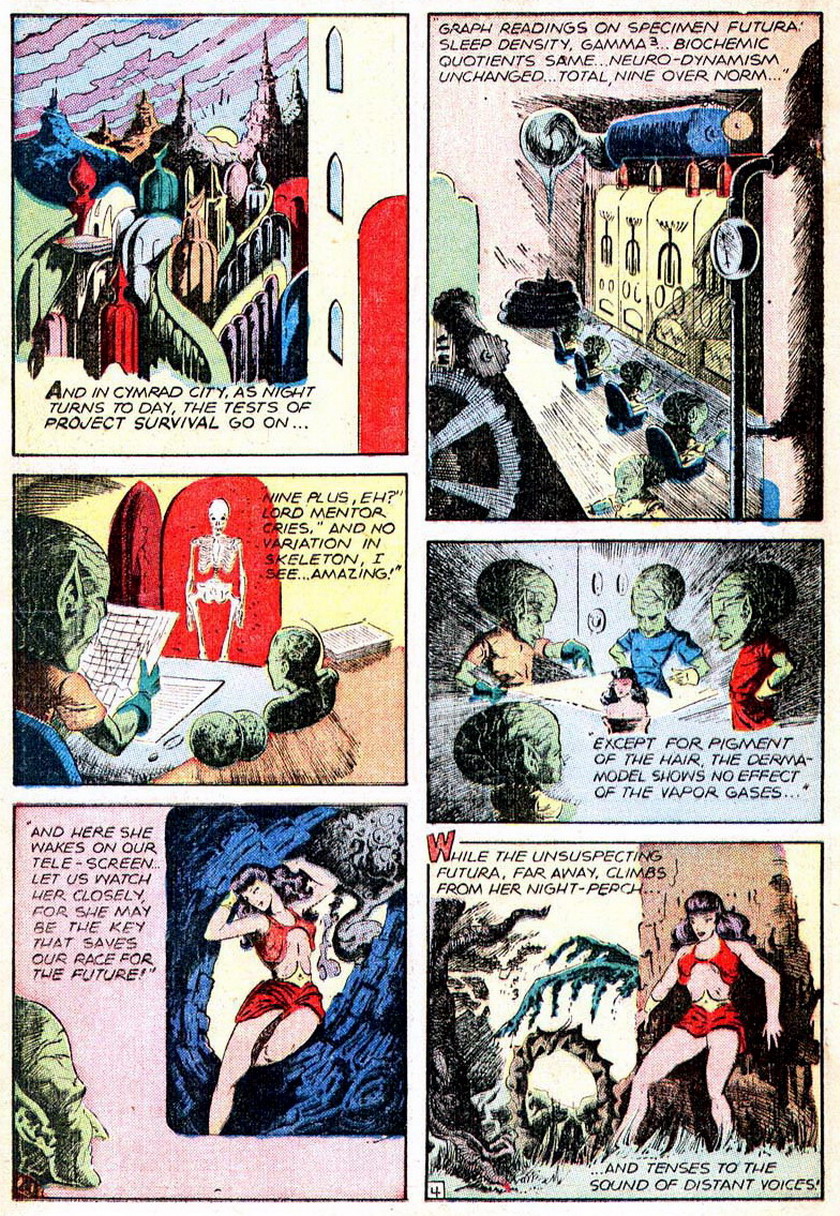
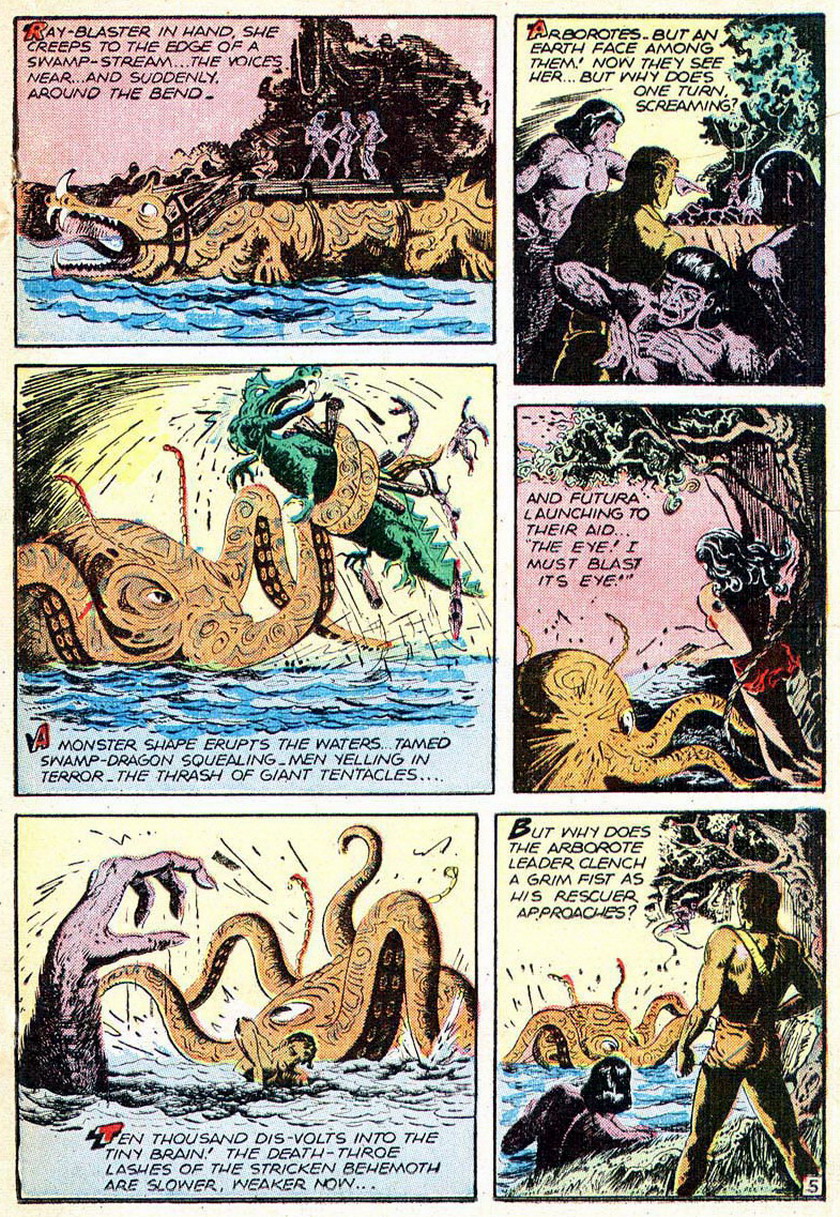
Unknown to Futura her escape was engineered as a test of her survival traits and superiority to the other test subjects and her every action is being observed and evaluated. If Futura's genetic material is truly worthy of being harvested and added to the line of the Brain-Men of Cymradia then her success or failure in the wild landscapes and untamed cultures of the galaxy will ultimately decide her fate.
Or will it? The masters of Pan-Cosmos may discover to their regret that their test-subject might not meekly run through their maze and may smash down the walls instead and choose her own path.
Planet Comics #44 is the second installment of Futura and was published in September of 1946. Issue #44 is one of the few covers that advertised Futura. None of the cover art during the run directly appeared to feature her. Most of the Planet Comics covers typically contained elements that could have been derived from all or none of the stories for that particular issue and seemed only to be tangentially representative of the contents. This is either by accident or design. Due to deadlines and scheduling of material, most comic book covers of the era were designed and created separate from the contents of the book. It was a common practice that a "house artist" would create a cover, usually from a description of what the publisher wanted for that issue, that would hopefully capture the attention of consumers on a crowded newsstand rack. This practice continues in the comics industry, most famously at the DC Comics company in the 1960s, where under the direction of Editor Julius Schwartz cover art would be designed the writing staff would use as a guide or inspiration for a story.
The art for the second chapter of Futura is on par with or superior to all the other entries in this issue, with the possible exception of the Mysta of the Moon story. As noted previously, it appears that only Futura suffered the more economical art direction that seemed to bypass the other, presumably more popular serials.
Enjoy!

Tuesday, June 17, 2008
Sleestak's Rule of Jungle-Adventure Storytelling
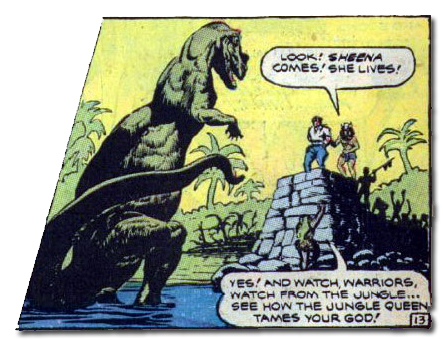
Sheena #7 (December 1949).
Tuesday, February 19, 2008
Cool Golden Age Page of the Day: Fly-Man
Irreversibly shrunken to doll-size as an experiment in crime-fighting, disfigured by being burned in acid by a bad guy, Fly-Man dons a mask and stabs evil in the back!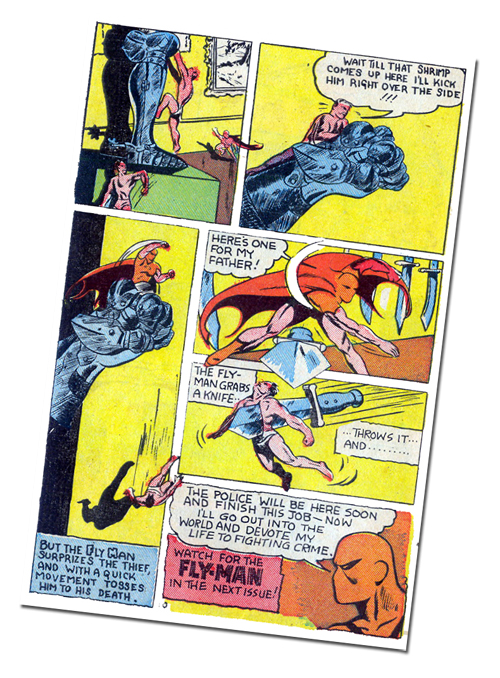
Wednesday, November 28, 2007
Giant Golem vs. Giant Nazi Robot Dinosaur!
The Boy King was an exile from the Nazi-threatened land of Swisslakia who came to America to gather support and aid America in the fight against Hitler. Boy King fought spies and saboteurs that threatened America's security, using his wits, royal fortune and a skyscraper-sized Golem that only he could command. Strangely, the Boy King and American officials never considered using the Golem to step on and squish all the Nazis. Hitler and his cronies were not so innocent though and considered the Golem a potent obstacle in their goal of conquering the world. In order to defeat the Boy King and his statue the German High Command orders the construction of a similarly-sized weapon that would attack and defeat the Boy King before moving on to crush all American resistance. What they came up with was the obvious response: a Giant Nazi Dinosaur Robot.
In the Golden Age there was a whole lot of pulse-pounding content jam-packed in about 30 pages of art and story. In those days, decompression meant that was what the artist did in a bar after a long day of trying to get paid by a cheap publisher. There is plenty of non-stop action in this story. In Clue Comics #4 and #5, the heroic Boy King defends American shores from a giant robot, battles his arch-nemesis (a Nazi officer with extending prosthetics for hands who comes off kind of like one of the Robonic Stooges) not once but several times, fights an octopus, meets a cute girl and there is even a slow-moving death trap thrown in for good measure!

Be prepared to freak out.
Tuesday, November 20, 2007
The Eye Sees
In the December 1939 issue of Keen Detective Funnies debuted one of the most enigmatic super-heroes of the Golden Age of Comics. The issue featured the omnipotent character of THE EYE. The feature, titled The Eye Sees, was created by Frank Taylor and ran for a few years until the title suspended publication.
The Eye was a god-like creature of brutal retaliation and terrible justice. The supreme being that metes out revenge was a concept which became a recurring theme of the type of hero that would later be commonplace in comic books of the Golden Age and could be found in the form of such characters as the Specter, Stardust the Super-Wizard, Green Lantern and others.
The Frank Taylor creation was unusual in several respects, one being that it was one of the few characters that went without elaboration and readers never received an origin or back story. Another aspect of The Eye was that it was different from many other "heroes" in that it was very Old Testament when dealing with mortals. The Eye did not simply perceive wrongs and act to correct them from on high through improbable means. The Eye demanded unquestioning obedience from the people it deigned to assist and ordered them to do some actual field work to attain justice.

You can download and observe for yourself the debut story of The Eye Sees by zapping the picture with your lightnings.