Showing posts with label Grocery Store Artifact. Show all posts

Thursday, November 07, 2013

Wednesday, May 15, 2013

Kimchi, America's Favorite Side Dish

Kimchi is a spicy, fermented cabbage side dish that I became acquainted with during my time in Korea and has remained a part of my diet ever since. There are a quite a few varieties of Kimchi. The types of kimchi were created as a practical matter in the time before effective refrigeration and food storage and is based partly on the availability of seasonal vegetables and the weather. Kimchi is a popular and traditional side dish in Asia but for those outside of that region it can be an acquired taste.


Relax. You don't have to be a "foodie" to enjoy kimchi. It isn't some odd, esoteric concoction that you eat only because it is hip, unique or have to endure once or twice because everyone is talking about it. One of the worst things to happen to kimchi was it being "discovered" by yuppies in America during the late 1980s. The costs of the ingredients skyrocketed, quality suffered and making it from scratch became more of a luxury than a must have condiment in our refrigerator. A few years ago crop failures of the main ingredient caused a crisis that required the Korean Government to take action.

Glass jars are best for storage in refrigerator


Like many foods foreign to the American experience there are a lot of unsubstantiated, unscientific claims attributed to eating kimchi. These are mostly cultural in origin, perpetuated today as selling points and continuing traditions. Plenty of  the restaurants not owned by large chains commonly have signs posted declaring the unrealistic and miraculous health benefits of various dishes.

Disappointingly, this is endemic among much of the advertising for consumer products also. Online you can find even more information claiming all sorts of woo-woo magical powers attributed to all sorts of foods so don't get excited. Cabbage and red pepper are not parts of the formula for the ancient Asian mystic secret of good health, virility and long life. It does not "clean the blood", "revitalize the spirits", "strengthen the kidneys" or anything else beyond the basic nutritional value of the ingredients which are not insubstantial.

As example of the questionable common knowledge attributed to some foods: An ingredient used for more than a century as a flavoring in drinks touted as a natural health miracle with wondrous properties eventually was discovered to be a very  powerful natural carcinogen. The deleterious effects where ignored or unknown for years because of the power of superstition, folk remedies and the criminal carelessness of homeopathy. Only trust peer reviewed science, kids. 

The Wall of Kimchi at a local market. One of them.
There can be a lot of salt found in the recipe for kimchi. If you have special dietary needs make sure you never trust the hip, word-of-mouth promotion or self-serving public relations and hard sell of any food stuffs.

Do some research, read up and be informed. While I can't grant any special health properties to kimchi I've eaten it when congested. From anecdotal experience, the spiciness make me feel better, drains and opens up the sinuses. But so will chomping on a jalapeno,  gnawing on a lozenge or rubbing Mentholatum grease on my chest. Nothing magic there, just the body's normal and natural responses.

If you have wanted to try kimchi or Korean food then as a start I suggest visiting the Korean restaurants in your city. The All-You-Can-Eat BBQ is enjoying increasingly popularity but that may be over-whelming for the uninitiated. You can cook Korean meals yourself but if unfamiliar with the style rather than going through a trial and error stage find out what the authentic dish tastes like first.

As a way of easing into a world of foreign cuisine try the lunch menus during the day at Korean restaurants. They are simpler, priced reasonably and you won't have to deal with the crowds, wait time and hassle of the evening dinner rush and cooking the meal yourself at the table, though that can be a fun experience.

Most places serve a large spread of side dishes with even the smallest lunch menu item so don't be surprised by the amounts you receive. If you don't like wasting food get a to-go tray when done (if the establishment supports that, some don't because of people that take a yard when given an inch).

One of those side dishes will usually contain at least one variety of kimchi. Keep in mind that a lot of these dishes are not created from frozen, processed food that is microwaved and slapped on a plate following some corporate franchise photo-template of what a perfect and homogenized dish will look like. Quality of supplies change daily as expected with fresh items so don't be discouraged if something isn't up to your expectations or doesn't look like you think it should from your experiences in the freezer aisle of the local market. Asian meals have a lot of vegetables in them but eating an authentically prepared dish will very much remind you that meat is made from animals. Expect bone, gristle where you are not used to it.

Babimbap and side dishes
If you want kimchi regularly at home there are a lot of good cook books available and even recipes for it online. You can eat it as is out of the jar or use it in cooking. Heck, make up your own ideas. Browse a market that carries a variety and decide what size and type of kimchi you want. Many Asian and American markets sell kimchi but it is a Korean specialty so try Korean markets first. I prefer the cabbage that is pre-cut in the jar because it is more convenient to use and less messy. I also enjoy the large radish kimchi. The type you get is based on what you are going to use it for. FYI, when cooked kimchi often gets spicier, via reduction.

Most modern American grocery stores keep a brand or two of small jars of kimchi in the cold aisle, usually by the tofu. These brands are okay but not what I prefer. I personally find the most typical brand found in a regular grocery store to be pale, watery, lacking in heat and tasting strongly of salt and vinegar. A trip to a Korean or Asian market is your best bet for quality kimchi. Just compare the rich colors of the kimchi made for a knowledgeable and particular customer base and the kind you find in a American chain grocery. You can easily see the difference. Unlike many food products in this instance the color is an indicator of manufacture and quality. I also appreciate kimchi in a glass jar over plastic for storage purposes.

Kimchi prep at home:
You've bought a jar of kimchi, now what do you do? Like most people you are probably just going to put in the refrigerator to keep it cold. Sure, you want to do that, eventually. But first you might want to prepare your kimchi by letting it ferment a while before putting it away. Don't worry, it's easy to do though this will be a process that should take overnight. You can eat the kimchi right away after you buy it but letting the contents ferment a bit will improve even the taste of the grocery store brands. I recommend tasting some for a before and after comparison.

Leaving food out overnight is something you have to decide for yourself if you want to do. My wife is a native Korean and we have both prepped kimchi this way for nearly 25 years without ill effects. Some of the ingredients are stored for months without turning. This is how she learned to prepare it growing up in Korea. She is from a generation that still makes almost everything from scratch. Again, up to you.
  1. Before retiring for the day place your kimchi jar in a plastic bag and place it in a sink. If your sink is the type that stains then you will want to ensure any liquids (a brine which will be red in color) go directly into the drain.  
  2. Loosen lid. Loosely tie up bag. Kimchi is very aromatic so be prepared for that to permeate the area.
  3. Leave in sink overnight.
  4. In the morning you may notice bubbles in the jar and swelling of the contents. Some juice will probably have overflowed. This is from the contents fermenting. Tip a bit of the juice out.
  5. Tighten lid firmly.
  6. Rinse exterior of jar thoroughly and dry off.  
  7. Put in refrigerator (I suggest on a paper towel or plate to catch any future drips).
If you sampled the kimchi yesterday when you got home do it again today. You should definitely notice a difference in taste and texture. Kimchi has a very strong presence but keeping the lid tight and exterior of the jar clean should prevent any odors being absorbed by the other contents of the refrigerator.

If you don't want the kimchi to ferment in the manner I described then make sure you drain some of the liquid from the jar before you put it away. Even kept cold right from the store the contents will ferment a bit over time and the fluid may leak out into the refrigerator


The uses for kimchi in cooking is varied. Other than the many Asian recipes it is traditionally used for I put it on almost anything. Burgers, grilled cheese, hot dogs, burritos, pizza (after I remove the pie from the oven, some like it baked into the pizza) and anything I can think of to spice up the meal. There is a place in San Diego that makes a butt-kicking bulgogi with kimchi burrito and some serious kimchi fries.

Read more about Korea's side dish online here: Kimchi at Wikipedia.


Sunday, October 21, 2012

Grocery Store Artifact: Probable Causes

This is a follow up to the post Before donating at the register.

Went in to work last week to see the signs threatening employees that don't ask for donations were all removed. They were removed by a directive from the corporate level. The store manager informed everyone that they are no longer allowed to post signs offering free items for not begging for donations or run raffles. Their are a few likely reasons I can speculate about for this but I doubt it is because the company is taking pity on the cashiers. In last month's big training session the district manager spent 30 minutes impressing upon everyone to get as much in donations as possible because it is a good thing to do and you can make a difference. The 'or else' was inferred but unspoken though we were told a charming story of how the least-donation earning employee in the district in danger of being terminated turned her prospects around and is now a shining example of a 'can do' attitude.

Here are some of the reasons I can think of why the signs were disposed of:

Compliance: One scenario is that the law prohibits it or the union has finally responded to what must be a huge flood of grievances from workers. People have been terminated, censured and demoted because they are not bringing in enough in customer donations. A manager would be pretty stupid to put that cause as a reason for termination so they dissemble or fabricate other reasons. An investigation would reveal a disturbing trend and restore the job but unfortunately even with a union at their side many young employees give up knowing they can get a job for same pay with less work somewhere else.

Cost: Since most stores that give away free items have no way to account for them being disbursed (this is a trail many managers would be uncomfortable being tracked and accounted for). The amount of shrink, or rather product loss, on whatever is being given to the customer (2 liter soda, reusable shopping bag, etc) must be prohibitive company-wide. For example, a large retail chain used to give away boxes and books of matches for free. That is, until a few years ago someone saw the annual losses in matches sales and how much the store was giving away and put a halt to it. Likewise someone may have noticed how much the company was losing in bags and soda and made the connections to the timing of donation drives.

Complaints: At least once per hour I receive a complaint from a customer about us asking for donations. Some display a good nature, some resigned. A few are hostile. At more than 4000 customers a day per store imagine the complaints nationwide not just at the store level but those getting phoned in and via internet messaging to the corporate level. This is least likely reason some of the pressure is off the cashiers. Unlike other complaints about service, cleanliness and diversity of products so important is the goal of fund-raising that a company will commiserate with a complaint but they would never, ever stop their attempts to collect for a cause.

Public Perception: Increasingly, particularly due to the fraud and public relations disasters of the last several years charities are under ever more scrutiny as to what they do with their collected funds. Calls for clarity and transparency particularly during rough economic times of charities are increasingly frequent. Charity drives that pledge 'up to' 2 million in donations, yet regularly collect 7-9 million during the drive are being asked to account for where the surplus is going. Some companies are forthcoming with where the money goes and unsurprisingly some are very resistant to the idea of letting the people who gave them money become aware of where it all went. Is most of it going to cure a disease or to buy a sitting board member a Porsche or paying for fact-finding junkets to vacation resorts? Some companies that support causes, the most popular of which is for breast cancer awareness, use a marketing tactic known as 'pinkwashing'.  This is when a company has minimal involvement or is not actually participating in the cause but for marketing purposes gives the impression through imagery and color scheme that it does. I am also wary of any charity that states they are promoting 'awareness' and 'education' and not directly making the promotion of medical science and a cure their primary mission. Depending on the charity  the terms 'awareness' and 'education' could mean nothing more than pink ribbons on things to buy and may not be in their purview or mission to promote such basic preventive services as mammograms or a healthy diet.

Conflict of interest: This is the most likely cause for removing the signage on the registers and relieving the pressure on the cashiers. Among other things how much a store collects in donations has a direct bearing on a store manager's evaluation. Lesser known is that most companies also attach a financial incentive to performance. Bonuses for top-performing managers can be very lucrative. No single aspect of managing a store can ensure a large bonus and they are evaluated on a whole but politics coupled with success in desired 'sexy' areas lead to positive evaluations and then a bigger bonus.

Some time ago in the company I worked for the financial incentive for the cashier that collected the most for a donation drive was removed. It was eliminated because of the discovery that company-wide many would add a donation to the customer's bill without their knowledge. It would have been a good idea to stop the manager incentive at the same time but the corporate mind-set is that unless threatened the workers will not ask and the managers won't put in the effort unless they make it worth their while.


Managers are notorious for gaming the system to their advantage. Nothing wrong with that. It is expected they do the job the best of your ability by being smarter, faster and more competent than your peers. But there is a line you don't cross. They often collect donations prior to the official start date and continue to collect after the drive is completed. Funds from one drive may be diverted to the cause more favored by their direct superiors. Found money or errors in the store's favor, which is supposed to be applied to the total sales for the day will be instead added to the donation total (such funds are recorded separately and returned if someone claims the money or requests a refund, we just don't let it sit loose in a drawer). They hold raffles and do other stunts designed to create an unfair advantage over other stores.

Since the signs were removed and word came down that raffles and other donation attempts are no longer allowed then it is highly probable that enough managers made noise about their disadvantages compared to other managers. They may have felt they were marginalized or punished for following the rules. With the added aspect of employees grievances the issue may have been brought to someone's attention. It is probably that in the interest of ethics, keeping the peace and fairness put a stop to the practice which made life a bit easier for the cashiers. For now.

Truth is, requesting donations over and over sometimes in the same order bears good and positive results. Undoubtedly there will be a marked drop in donations merely due to many of the cashiers no longer feeling they have to request one from each and every customer. If that happens I speculate that the pressure on the workers will return multiplied many times over but be presented in terms that are not so public and will have to do more with an employees' general attitude and overall job performance.

Update: According to memos the new Breast Cancer partner (one that is more focused on an actual cure, not 'awareness') allied with the store did not want employees forced to ask for donations under threat of penalties so the practice was halted. It was not reintroduced in the ensuing donation drives since. 

Wednesday, October 10, 2012

Grocery Store Artifact: How haste makes waste that affects your food

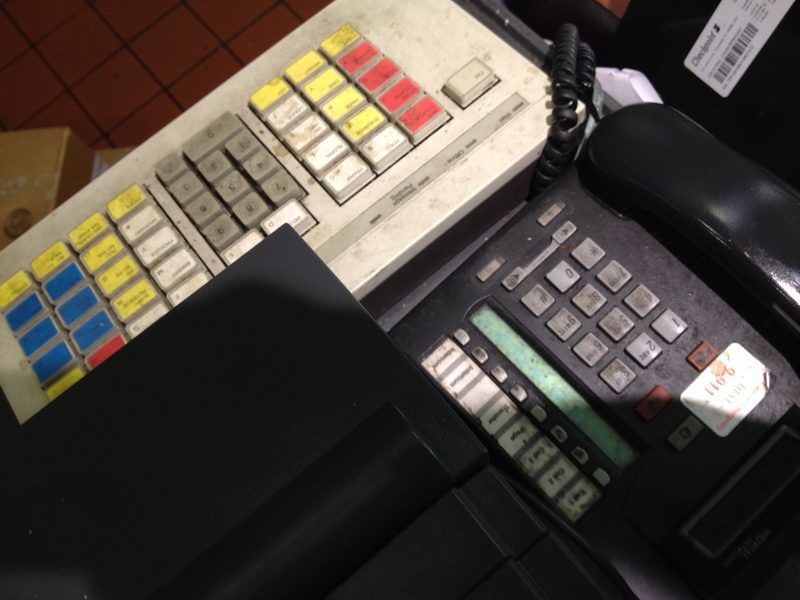
Thinking of eating at your local deli? Work spaces looks nice and clean, staff looks appropriately groomed, caring and conscientious? Well, before you do take a glance at the phone and any register behind the counter. Regardless of the service and appearance of everything else if the secondary equipment is unclean then in spite of how everything else appears they may be indicative of a greater problem in the service area. In the delicatessen the grime on peripheral equipment consists at the least of a slurry of meat and vegetable oils, fats and other bits of food and chemicals transferred by touch and deposited via the air from venting ovens, fry vats and steam tables. In short the surfaces of any neglected food prep area equipment are a constant and unhealthy vector for germs.

Much of this is directly due to the economy and the way it shapes retail establishment operations. Certainly, any business can be prone too cutting corners on safety. Not all eating establishments fall prey to this mentality but even those who truly care about quality and their products can unintentionally create an environment where food safety is less than a primary concern. When sales are depressed then the number of employees available in store departments are reduced. More work is given to less and less staff without an increase in the time allowed for completing the extra tasks. Budgets for staffing is tight and few stores can afford to have any department work at a loss. This leads to a constant atmosphere of playing catch up with the wrong decisions to let certain things go by the wayside in an attempt to stay current with basic duties. Haste in this instance, makes waste that could end up in the food chain.

Speed and trying to keep up with the basic demands of the department are not the only cause of  sub-standard work areas but most of the problems in an otherwise fine environment stem from time pressures causing stress on the employees. Likewise depending on where you shop basic food prep areas and hygiene may be unfavorable because people are sometimes lazy, slovenly or careless. That is why most cities have entire departments dedicated to training, certification, sanitation, inspection and rating of eating establishments.

As a minimum all the equipment whether it is used in food prep or not should be as clean and presentable as possible. Dirty phones and cash registers in the service area, normally not directly related to food prep, may reveal that the staff could be under pressure to serve customers at the expense of department safety. Primarily this may be because of employees feeling they are unable to fully complete their tasks while ensuring they assist customers as close to possible to the end of the business day without occurring any overtime or going past their scheduled shift. Rightly or wrongly employees often feel that they do not have the time to clean anything but the basic equipment before they are forced to sign out from their shift and depart. When the department is closed for the day the equipment, main and peripheral areas should be thoroughly cleaned and sanitized. If the peripheral areas are not being fully cleaned then the department is not being properly managed. This negatively affects the consumer.


This is not alarmist. I've worked in a deli and have often observed people absentmindedly touching a handle, cleaning rag, phone and etc. while properly wearing gloves but failing to change them before helping another customer. While California is stricter regarding food prep standards my deli employment experience was in Maryland. The region is which I worked did not require food workers to obtain training and certifications in handling food safely and instead relied on an employer's sometimes inadequate and poorly executed on-the-job training programs. In Maryland all my food safety was learned from co-workers and in total consisted of about an hour of common-sense tips of how to clean equipment, cut and handle food over a the span of a week or so while I worked.

The majority of what I learned about food safety wasn't volunteered and there were no set training tasks to be completed, goals to be met or a curriculum. If I didn't specifically ask about something I wasn't told how to do it or how to care for it. For instance, a probe is used to check temperatures on the products in the case to ensure they will not spoil. Employees regularly inserted the probe into the products one after the other. They did this because no one had ever told them that using the same probe was a bad practice and caused transference of one product between another. FYI: You place the probe between the bricks of cheese, not poke into the product.

Since some products were cooked, some raw, some older than others and some were still sealed this violated basic hygiene and caused cross-contamination within an entire stock on a nearly daily basis (The proper way to check the temperatures was to place the probe between each item in the case). In contrast, a class provided by a vendor of popular deli meats and cheeses to learn how to properly present and sell their product comprised of a classroom course of 8 hours a day for 5 days (employees that failed the course were demoted to bagging clerk or terminated, depending on their pay scale going in). While that was Maryland human nature is much the same everywhere and there are problems common wherever you are. Being a manager is guiding human nature into other better directions to achieve goals.


Staff working in rough economic times are often not scheduled past closing for the purposes of cleaning or other duties. For example, if the deli closes at 10 pm then odds are the employees are also scheduled so that their shift is over at about the same time. The closing workers are often forced to clean and prepare the deli for the next day near the end of  the shift and hope no customers arrive which would cause them to clean the equipment again and accrue overtime or work past their schedule. This would violate the budget for allotted hours and cause them to be punished.

The deli staff may also be under instructions by management that for a positive customer service experience and in the hopes of one extra sale before closing they must assist any customer that arrives regardless of the time or how near the end of shift a staff member may be. During periods of inadequate staffing employees from other departments may volunteer or be tasked to assist departments that prepare food. Some regions have laws that do not require employees to become a certified food handler unless they work in a food prep area for a set number of days. That means a company can use any employee they choose to assist a deli or meat and seafood department as long as they don't work there too many consecutive days in a row. Think about that. 

In the interests of speed and getting their tasks done it is not unheard of for family members or friends of the time-pressured employee to pitch in and help them finish their duties. Non-employees helping is unsafe in many ways. Not being employees they may be injured, are a liability and are not trained or certified in proper hygiene as required by law. I have witnessed this occurring in both Maryland and California (and as a manager have taken steps to halt the practice when I discovered it). A favored restaurant in Southern California I used to frequent recently lost their A-Rating Health Certification directly due to repeated violations concerning non-employed family members without food handler certifications working in the kitchen.


Haste to avoid getting censured or terminated for unauthorized overtime or working past the posted schedule can lead to poorly cleaned work areas and equipment. The night shift employees do what they can as time permits but sometimes leave a lot of work to be done by the opening crew. Common wisdom would be that the morning shift will have more employees available but this is not always the case. Even if staffed with a full complement the opening shift employees then however unintentionally perpetuates the cycle by being too busy with customers, morning food preparation and cooking to adequately clean up what was left undone from the day before. In between customers and the regular duties they then are forced to catch up with work from the previous day all while attempting to maintain standards during the busy day. Also, many establishments have a set time limit on how long a customer's order will take or the item is free. This adds even more pressure to the employee to cut corners in the interest of speed to avoid losing a sale or a customer.

Compounding the problem the prevailing Management theory at most places is if the current employees are unable to do a thorough job in a timely and efficient manner then the next new-hire will. The result of all these factors is employees letting what is considered 'unimportant' in the routine operation of a deli slide in the interests of speed and getting done for the day. Unrealistic performance goals and being under-staffed is a reason there is so much turn-over of employees in chain delicatessens.

High turn-over means that a good proportion of the staff is always new. A common complaint from customers is that no one in the deli seems to know what they are doing. This is due in large part to the rapid exit of knowledgeable employees who can receive the same wages for far less work and stress elsewhere and the steep learning curve of the new deli staff. In my experience it is not uncommon to see a new hire left alone on their first day in the deli because the scheduling budget will not provide for additional workers.

There is no excuse other than personal rationalization for a dirty food preparation area or equipment but the the reality is that this cycle will continue until such time as employees are under less pressure, assigned dedicated cleaning time that is uninterrupted by other tasks, regardless of if they exceed their scheduled shift with or without accruing overtime.

Sunday, September 02, 2012

Grocery Store Artifact: Before donating at the register

I'll go on record saying I don't like asking customers for donations. Sure, most of the various causes are worthy but it is annoying. A lot of customers don't like being asked but at my current work site they are not too hostile about being asked by the cashiers. Some places I have worked in the past the checkers would receive threats, derogatory remarks and complaints to the company above the store level. The complaints were not generalized against asking for charity but worded in such a way that they were attacks against the cashier for "rudeness" and intended to intimidate us into not asking them in the future.

It isn't like we have a choice. So many cashiers dislike asking for charitable donations from customers that store managers have to threaten disciplinary action against employees for those that do not. The signs hanging on checkout stations promising a customer with some free item from the store is ubiquitous and familiar sight during donation drives. Employees can and have been terminated because they refuse to ask for donations. It occurs in some work locations more than others and that can be due to the customers themselves. Employees just don't want to deal with the anger and grief they receive and since managers rarely support the employee they eventually get demoted or terminated.

Truth is, if a cashier asks every single customer for a donation the program will probably be at least moderately successful. The checkout experience is designed to maximize the donations. There are donation jars or boxes at every check stand, prompts at the point of sale pad where you pay with an electronic card and then cashier hits you up. At least one out of ten customers will donate something.

Particularly effective is the soft-pressure sales tactic. Many customers balk at giving a dollar but have little problem with donating by rounding up their purchase to the nearest dollar. It's a really effective psychological trick because often the same customer that would decline giving a dollar will often round up to $1.50, $2.00 or more.
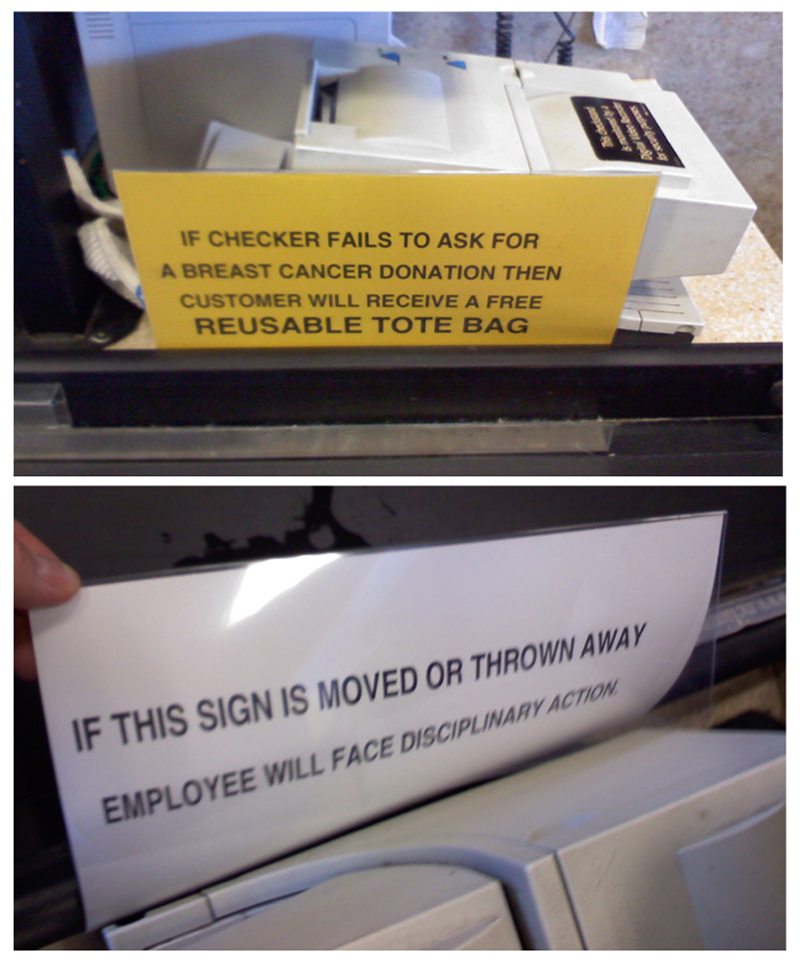
Results at the store level are important. Managers are evaluated by how much they bring in not only in sales but other projects like charitable donations. There is also a large financial incentive for the manager that brings in the most donations. It is not unusual for store managers to personally kick in money from their own pocket to meet the expected goal for that day. Doing that helps them keep their jobs. If they don't or can't make their goal...well, there are plenty of people in line waiting for their jobs who say they can exceed expectations. In a lot of ways sales and donations are really things that managers don't have control over as they are at the mercy of the economy. Employees are under a lot of pressure to bring in donations "or else" so please don't take it out on them.

People should always feel comfortable about where the money they give is going. Where I work the company gives 100% of what they receive in donations to the charity they are supporting. How the charity disburses the funds after they but receive them is another matter. Stores usually receive materials that describe what happens with your donations but the best bet is to check out their online declarations. You may be surprised at what you find. Some retailers accept donations for a cause but will only donate up to a certain amount, say $2 million. But particularly for large chains over the course of the drive they will have collectively amassed far more than that. Depending on the company the extra funds will be dispersed evenly among the many charities they support year round or in some rare cases just go straight into the store coffers.


Charity Do's and Don'ts!

DO: Research. Check retailer websites for their list of charitable declarations. It isn't a big deal. You can even do it on your smartphone while in line. CharityWatch and Charity Navigator might be a few good resources to check where your money could be going.

DON'T
: Dig into the donation jar at the checkstand to help pay your bill. What you buy costs what it costs. If your total is $20.33 don't take the change intended for hungry, crippled children because you don't want to break another dollar bill. This happens at least once daily where I work. Stop it.

DO
: Get the tax identification number for the charity ahead of time before you sit down to declare it on your taxes. If the store or charitable organization's tax identification number for the donation doesn't appear on the receipt ask for it or look it up. Stores should but don't always have on hand paperwork stating the TID number for the charity. Don't count on them being able to find it right away since the office side of a retail store is particularly chaotic and usually overwhelmed with BS. The one document with the information you need will likely be buried in a month-deep flood of motivational/threatening emails or lost in a pile of paper flyers from a promotion that expired 3 weeks ago. Your best bet is to call customer service or look it up on their website.

DON'T
: Come in to the store the last week of April after filing your taxes clutching a handful of receipts demanding a refund for all your checkstand donations over the last year claiming the cashier did it without your permission. That's just cheap and embarrassing. People do this.

DO: Be nice to the cashier when they ask for a donation. Just say 'Yes' or 'No' even though the point of sale pad requested it when you swiped your payment card. They have to ask.

DON'T
: Give the cashier a story about how you "Already donated" or "Not this time, I give every day" or "I give a lot elsewhere" because A) We don't care, B) We're sure you are a good person, C) We know you are lying to feel better about yourself in a public venue with strangers judging you and D) We don't care.

Friday, July 20, 2012

Discrimination in the workplace

"The Sky Fairy is angered! Hide!"
In between lulls at work the clerks and cashiers, instead of doing prep work or cleaning, often stand around and chat. Eventually, one conversation veered into one of the taboos of workplace interaction: Talking about religion or politics.

Last year a clerk and cashier, who here I will call Cindy and Julie, began trading stories of their brushes with the unseen world. I was kind of half-paying attention while I audited the money of a cash drawer ensuring money coming in and going out balanced.

"I saw a ghost, once, too! It was so weird and scary. Yet somehow, I felt that I was being reassured." Cindy said.

Julie's voice became excited. "I know! See, I always forget to clock out for lunch until about a quarter after. Guess when my Grandma died? 15 minutes past two! It's like she is here telling me something."

Listening to their exchange caused me to roll my eyes so much I had to recount the cash. Without realizing it I was laughing. It took a few moments but Cindy and Julie realized I was amused by their conversation. They stopped their chat and directed their attentions towards me.

"What's so funny?" Cindy was sounding defensive. Julie stared angrily.

"You didn't see any ghosts. There are no such things." I said, going straight into JREF-mode, still chuckling. Usually when I am exposed to an adult talking about the supernatural as if it were real I'm just kind of sad and disappointed. But today for some reason I found the idea hilarious. I tried to come off as rational and not condescending. I wasn't very successful at the attempt. When the two repeated that they did see and experience a supernatural event I replied. "No, you didn't."

"Are you calling us liars?" Julie demanded. They were both becoming upset. I always have some prepared  statements in the mental file. The argument I put forth was perhaps lacking in tact itself. My mistake was in assuming the pair were open for a debate.

"You are either making it up, making connections where none exist or you are deluded." I said. "Magic and the supernatural absolutely does not exist. If it did the evidence would be overwhelming. It would be everywhere. No one could dispute it. Without exception it's all someone's personal opinion. If it was factual, if it was real it could be recorded and measured in a form other than anecdotal."

Julie leaned forwards toward me as if to emphasize he words even though we were several work stations apart. "Oh." She said. Her voice was ripe with scorn. "What are you...an Atheist?"

That's exactly how she said it. I could actually hear the italics. Total emphasis on the disgust. Yet what I took from it is she just wanted an uncomfortable conversation to end. It did, not because of the attempted put down or because she had an epiphany but because customers started walking up with their groceries to check out. For the rest of the day they both acted chilly and would not talk to me unless they had to.

Cindy let it go by the end of the shift, displaying a cool shoulder towards me probably in a show of solidarity with Julie. Cindy is young and has presumably has access to the internet so there is hope for her. I was over it immediately. But from then on Julie remained stand-offish and treated me like I had the plague. In her job as a manager, the same as I but with her possessing slightly less seniority, she would not address me unless she had no choice. Julie would call an adjacent work station and have them relay requests or instructions. She would not directly interact in person and would move people around to make sure she was a far from me in the row of check stands as possible. Sometimes she would swap 4 or 5 people and their duties around so she would not have to herself personally relieve me for breaks or for shift changes. If she was the designated person in charge of the shift that day I was passed over for opportunities or tasks that traditionally would be mine or excluded from the process of decision-making.

For my part I certainly didn't hold it against Julie that she was a believer in the Unreal. She was competent at her job and that's where my concerns ended. Julie was one of the few I worked with who did not adhere to the Culture of Half-Assedness that exists in so many work places. But Julie made it clear she had washed her hands of me. Julie employed a somewhat subtle form of marginalization and discrimination but it was there. It was particularly noticeable when comparing our work relationship as it existed prior to my taking on the role of Ghostbuster.

Julie used to ask my advice on how to perform certain tasks and duties. I was glad to help. She was one of those managers who because of tighter economic times was given minimal training and dropped into the job. It wasn't her personal failing if she hadn't been exposed to or given the opportunities others in her position had. Whenever she expressed frustration and not knowing as much about the job as other managers I let her know there is nothing wrong with that, just keep asking questions until you know everything. Something she accepted and I would presume appreciated at least as far as the job went.

In hardly any time at all I went from being a co-worker to The Enemy. If Julie had been in a higher position of authority or had more influence with the upper echelons of management it could have presented me with a problem that could have easily affected my employment. Not from our original conversation about ghosts but due to her trying to force me out of a job solely because I was, in her view, not fit to be around her sort of good people. This discriminatory practice against the non-devout and those with religions not in the mainstream is not rare and in some cases can be quite overt and extreme. Employment can and has been negatively affected. When Julie was transferred to a new work site it was a relief only because her behavior was getting hilariously absurd.  

To this day I don't know what her personal religious beliefs are. I could hazard a guess based upon her actions and the way I was treated by her but I don't want to speculate. I require evidence.

Monday, November 14, 2011

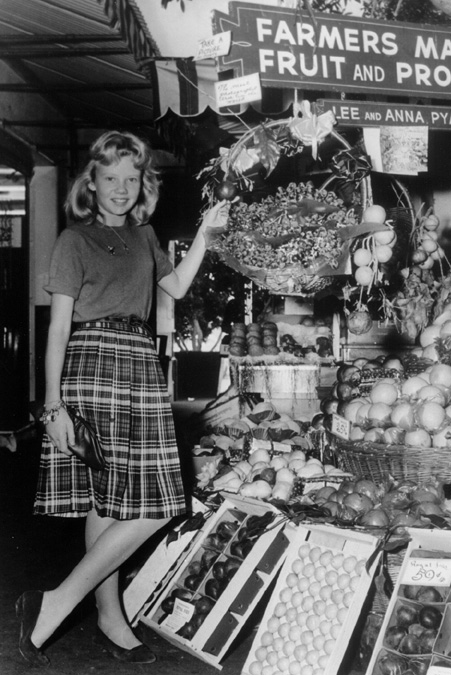
Farmers Market Fruit and Produce

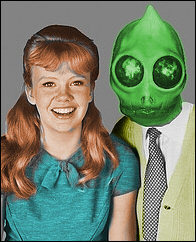
I bet Hayley Mills never shouted, threw a tantrum and assaulted a grocery store clerk because some item was sold out or there were more than three people waiting in a line at a register.

Take a cue from Hayley Mills, folks and behave yourself. Life is too short to go aggro about long supermarket lines.

Also, eat your vegetables!

Wednesday, October 12, 2011

Making a point

"And your total today is $6.66."

"Oh. Don't you think I should buy something else?"

"Uh...If you want."

"You know...666."

"What?"

"I don't like that number."

"Okay. Do you want me to void something off? Add something else?"

"Yes. That's..That's the bad number."

"I guess. If you are gullible and dim-witted."

"WHAT?"

"The total of your order is not six six six. It is six POINT six six. Even if the number you fear wasn't mistranslated from fictional text and actually held some sort of magical power it isn't exactly the same. The decimal makes all the difference. So...Still want to change the total?"

"..."

"I'm sorry?"

"No."

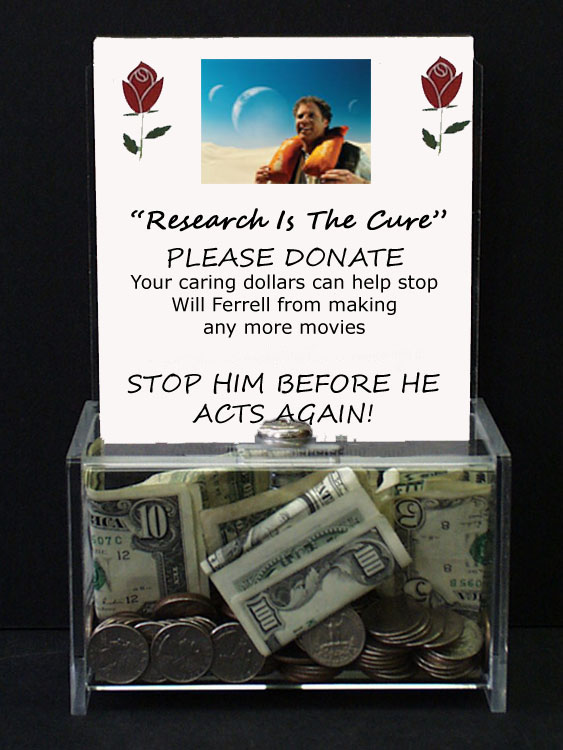
"Okay! And would you like to make a donation to fight prostate cancer today?"

"No, thank you."

"Would you like some carry out service?"

"No."

"Okay! Have a nice day. Thanks for shopping at HayleyMart."

It is bizarre that customers lose their crap, scream, throw things, phone-bombard the corporate office and twitter-rage when a cashier opens up an additional register and they were not first in line but not when they are put in a position to shift a personal paradigm. Maybe it is the thinking that makes all the difference.
Saturday, September 10, 2011

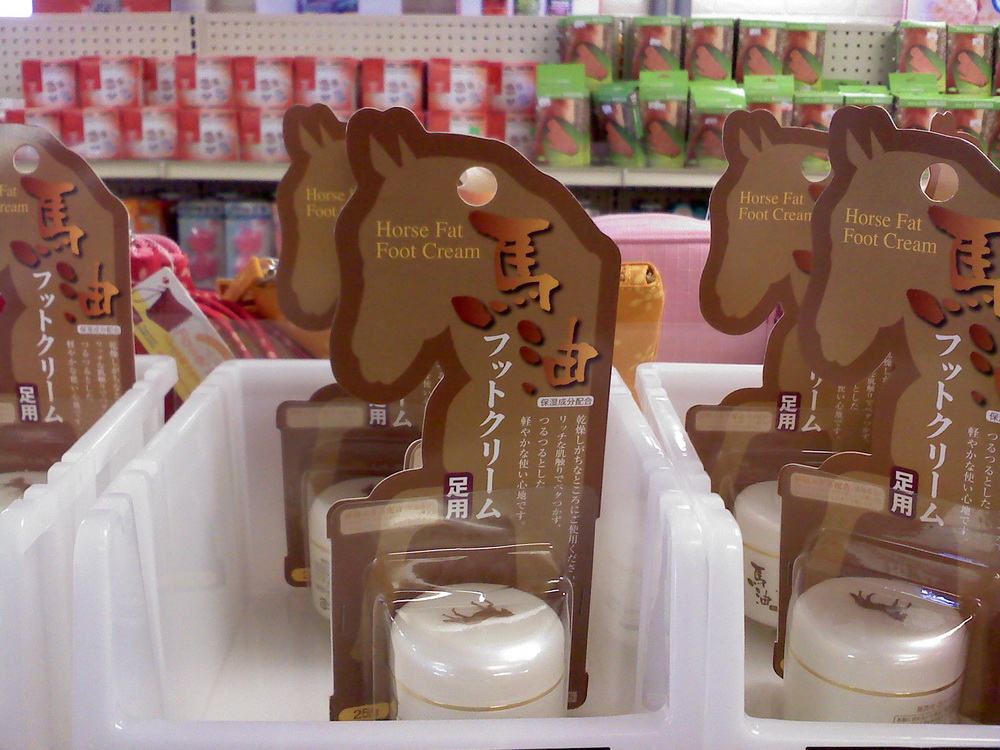
This Omnivore's Dilemma

I don't know whether to slather this stuff onto my feet or spread it on toast.

From a local San Diego Asian market 9-5-11.
Friday, September 09, 2011

The Great San Diego Blackout

Not that you'd know it from the national news media but yesterday San Diego suffered a major and nearly unprecedented power outage that lasted about 12 hours.

At about 3:30 p.m. the electricity failed due to some event in Arizona. The grocery store where I worked went into power-saving mode, which means the back-up generator can run the registers and some other systems for a time, but not for very long. Apparently, the contingencies some nationwide companies have in place for regions of extreme weather that have frequent and extended power outages are not distributed or adapted to the franchises in the relative paradise of Southern California. Historically for businesses outages in San Diego rarely last more than a few hours. This time though we lost untold thousands of dollars worth of product. Some stores are reporting up to $70,000 in spoiled product. Fingers are pointing at the heads that are expected to roll but this wasn't a disaster that began and ended at the store-level. Little or no local contingencies for extended power outages, few refrigerated trucks, limited and seemingly random ice and dry ice deliveries, many back up generators that were limited to support only registers and some lighting and not the refrigerated cases and freezers is a problem that started at and can only be fixed from a higher level.

Once the power went out we shut the doors, only letting customers out and none were allowed entry. This was for safety, mostly. The store was dark and we couldn't have people stumbling around and possibly getting hurt.

Initially, we did let in a mother and her newborn infant so she could get some baby formula and a bottle. We escorted her with us carrying flashlights. Being in panic mode from the power being out she forgot her payment card, didn't have cash and the ATM's were inoperative anyways so we just let her have the items. If she pays us back great, if not we are not worried about it. Babies gotta eat. Of course, when we let the mother and newborn inside another person outside threw a tantrum about being excluded. She wanted in so we let her grab a few things.
A bit later while we were prepping the store another person arrived and went all "Trigger Effect" on the person watching the front doors, claiming an emergency. He was pretty out of line about it and in interest of keeping peace the guy was allowed inside. I don't know what type of emergency is handled with the tortilla chips and strawberries he purchased but it is an odd world sometimes so who knows what his situation was. When I was notified of his behavior I made sure I checked this person out at a register. I dropped a few suggestions that in the future, he should behave better and that I would understand if he wanted to shop elsewhere from now on. FYI: You don't threaten people, not any I am responsible for and basically if I am anywhere in the vicinity. I won't stand for it. Threats will usually get you two things: At my place of work at minimum a banning and maybe a trip to the slammer. I've worked too many places where workplace violence is a reality to let things like that slide and hope the person doesn't get the "Big Headache" and return with a weapon or flip out and attack.
EMERGENCY TIP: Always check the International aisles of the store when panic/emergency shopping. Often people don't think outside their usual frames of reference and when the hardware aisle is cleaned out of regular emergency supplies the International foods section will usually still carry a good supply of veladoras (those prayer candles with religious icons on them) and Shabbat candles.

After the customers were out of the store all the employees pitched in and went to work covering all the cold items. Open chill cases are great for shopping but lousy for keeping things cold. If the power was restored in a few hours then everything would be alright (with the exception of the ice cream). Once we were all done with that we opened the store again. Taking advantage of the emergency lighting in the aisles, sunlight through the windows and using flashlights propped up on the checkstands we were able to remain open until later in the evening when it just became too dark for customer safety and we were unwilling to sell the remaining refrigerated items.

With a few exceptions the customers pretty much remained calm and didn't act out. No one mentioned terrorism without it clearly being a light-hearted jest. I heard more people suggesting that the Grocery Workers Union was responsible for the event than al Qaeda. I did observe one couple taking advantage of the chaos by walking out the door without paying for a bunch of stuff (among the loot was a bouquet of flowers. Not even the edible ones, just a pretty arrangement!), but over all thievery was at a minimum. I guess there will always be people who take advantage. Those kind of people would rifle through wallets and pull rings off of fingers at the scene of a disastrous jet crash so stealing munchies and a flower arrangement during a power outage probably won't cause them to lose any sleep. The truth was if anyone without access to funds (like the mother with the newborn) discreetly asked us (so others wouldn't jump on the idea) we probably would have just let them grab whatever they needed at no cost. I wasn't mad, mostly I was just disappointed.
Once the store was closed for the day I drove home. By then the streets and highways were clear. My neighborhood was still without power and the house was hot, hot, hot. I don't live in the kind of area where windows and doors can remain open unguarded so even though it was cooler and tolerable outside I just went to bed. The first I was aware the power was restored was at about 3:00 a.m. when the air conditioner kicked on and woke me up with a blast of sweet, cool oxygen.

What sold the most at the grocery store during the power outage? Ice, water and booze. All three items are obvious, at least for our regional climate. Whatever fear-mongering or distortions might be reported on later I didn't observe anyone really scared, just mostly unprepared. After everyone dumped ice in their respective fridges to prevent spoilage then it was Big Fun Party Time! Nearly every order had alcohol in it. And 13 hours without power? I wonder what kind of baby boom we can expect in the San Diego area 9 months from now.

Saturday, September 03, 2011

FREEEEEEE-BIIIIIIIIRD!

This simple drawing on a chopstick wrapper is a fine example of beautiful art under everyone's noses that is ignored or overlooked. Who could look at this bird taking flight, expressing such joy at quitting the Earth by sheer force of will and remain annoyed or angered or sad? And now, I share it with you. The world is a better place for it. You're welcome.

Regretfully, the artist that gave so much to the world will probably never be known.

From a local Asian eatery San Diego, 9-3-11.
Thursday, August 04, 2011

Checkstand Etiquette

This post exists only as a direct result of a customer completely losing their mind and embarking on a screaming tirade of threats, violence. libel and slander. What followed was a multi-week campaign of attacks via Twitter and Yelp (using sock-puppets or drafting others to assist) and harassing phone calls to the job site and corporate offices. All from one customer that was miffed the customers in from of him did not let him enter a new line ahead of the when an additional check stand became available. I nearly lost my job (or at the least I was in peril of a financially disastrous demotion) due to the unhinged attacks of a customer who acted like a spoiled brat. I received the ire of the customer because I did not step in and escort him to he front of the line. This happens more than one would think.

Unfortunately, businesses typically side with the customer no matter how deranged the complaint appears. This worry of being fired for "rudeness" is something grifters and revenge-minded for a perceived slight often use to their advantage, playing on the employees very-real concerns of what might happen if a customer doesn't get their way and even if they do, the worker doesn't display the right amount of obeisance or display that they don't know their place. Luckily for me, there was video recording the event.


To function smoothly our modern society relies on an agreed upon social contract to maintain peace and cooperate successfully among its members. Created through centuries of trial and error the social contract is a tenuous yet mutually agreed upon rules of expected behavior that allows strangers to get along in unfamiliar social situations. Sometimes that contract breaks down and chaos ensues, as anyone who has been in a major city during an extended power outage, cut off in traffic in Maryland, passed wind in an elevator or witnessed a Black Friday sale at a mall can attest.

Specifically and for the purposes of this study, the social contract often breaks down at the first moment when there are long lines of people waiting in a retail establishment
and an additional cash register opens. Unfortunate recent events in our country have made it imperative that some people are in need of a refresher course on checkstand etiquette and the proper way to behave in a public retail environment.

Waiting in long lines in stores is unpleasant and I can sympathize. I would really like to get back that ten
minutes of my life I lost when I was five people in queue behind the couple who insisted that they can buy DVDs with their WIC checks since they were purchasing children's movies. But the reactions by some waiting in line seems to be relative in nature. Oddly, the same person who shouts and screeches about a delay, throws a tantrum and threatens or acts with violence for waiting in line to pay for groceries is conversely just a few minutes later calm, patient and even pleased to be waiting in a long queue to rent a movie from an automated kiosk. I've personally witnessed an enraged customer upset over a harried coffee shop barista that are then placidly content to wait in a long checkout line at a big box discount store. They shockingly display such a personality change that it leads me to think they were replaced by a duplicate from an alien pod somewhere between the condiments section and the fifty-pack of toilet paper.

It should be obvious that if a retail establishment does not have enough cashiers to serve the number of customers present it is not because no one cares or receives some sort of delight in alienating the main source of income. Rather it is because that is all the people they have dedicated to the checkstands. Most stores rely on personnel from the other departments to fill in as needed. Depending on the type of store employees from the children's department, jewelry counter, dairy or meat sections will back fill and assist the front end with helping customers. Wander a major retail clothing store and witness that register after register and department after department is vacant of employees. This is is due to the staff being pulled in multiple directions. Is the shelf that displays your favorite shirt empty and no one is around to help? This is probably because the person responsible for stocking the shirts has been cashiering in the shoe department for the last four hours.
 

The degree to which an employee is available to immediately assist is often subject to reasonable availability. Breaks, lunches and some other duties are mandated by State and Federal laws and company policies. Employees can and have been terminated from their jobs for the simple act of delaying their scheduled meal break to assist a customer or trying to finish a task in a timely manner. While unfortunate for the employee this is as much to protect the store from future litigation and spurious labor claims as much as protecting the rights of the worker.

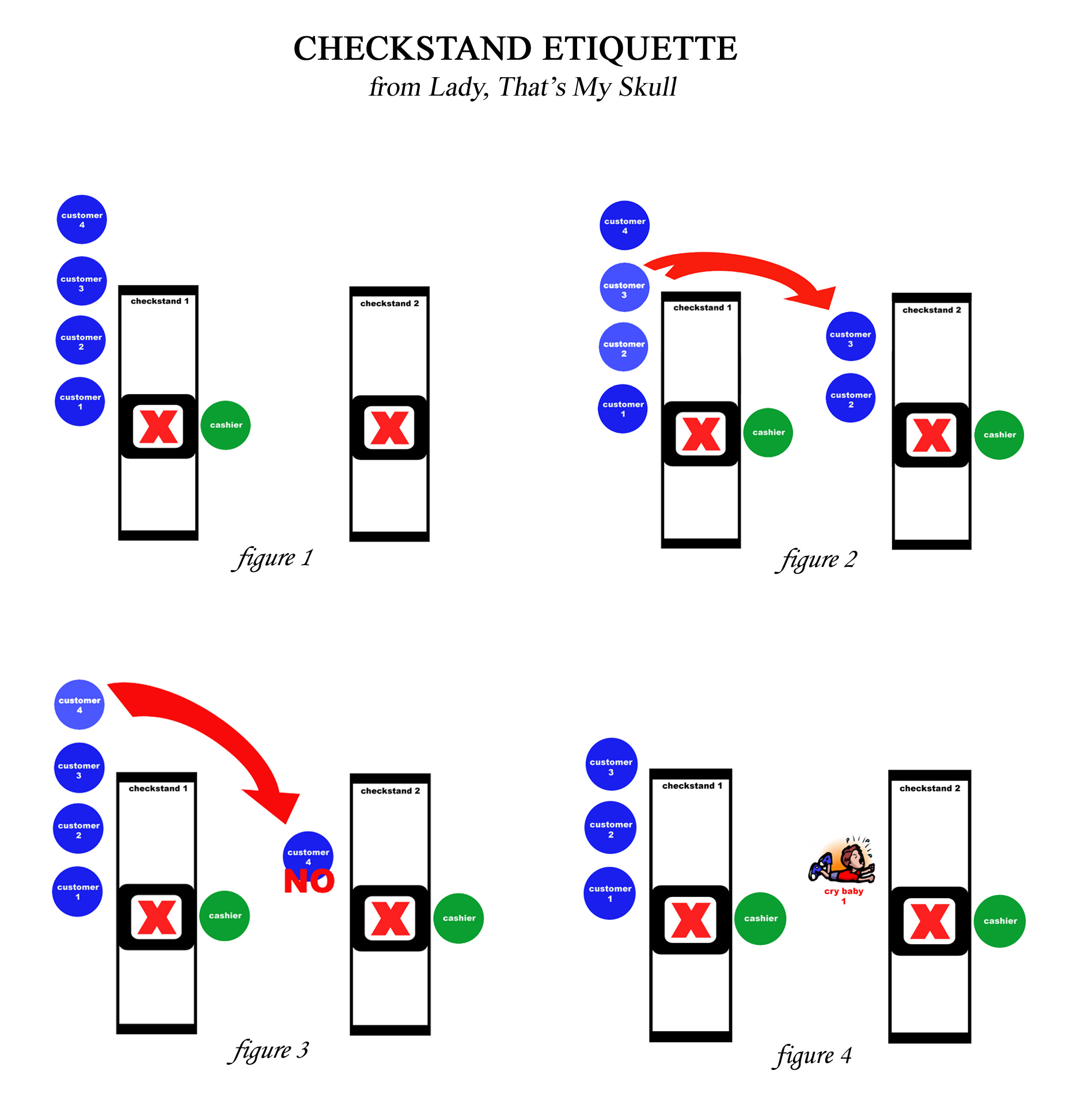
So here is a step-by-step refresher course for both retail employees and customers on the proper checkstand etiquette for when an additional register opens. Feel free to print it and hand it out to those who are most in need of it.


CHECKSTAND ETIQUETTE


Checkstand Etiquette - figure 1
Figure 1: This diagram is representative of a typical checkstand in almost any retail establishment. In this example Register #1 is open and populated by a cashier. There are four customers waiting. The common wisdom states that if there are three or more customers in a line then a additional register should be populated to assist in processing waiting orders.
Checkstand Etiquette - figure 2

Figure 2: When checkstand #2 opens it is policy and common sense for the cashier to call over, if they should so choose, the next persons waiting in line. That is, the customers who have been waiting the longest in a line have the right of first refusal to move to the other register. In this example Customers #2 and #3 move to checkstand #2 allowing the Customer #4 to move up in the checkstand #1 queue. This way, all waiting customers are expedited through the lines efficiently. Basically, everybody wins.


Checkstand Etiquette - figure 3

Figure 3
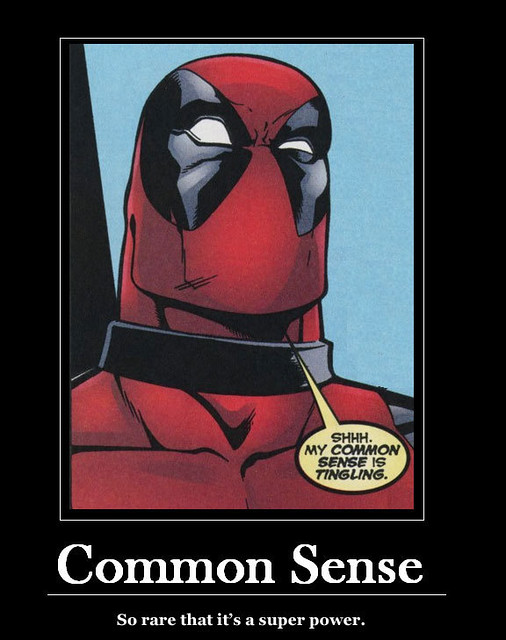
: The main drawback to the common sense application of the social contract as it relates to checkstand etiquette are the facts that politeness in our society is nearly extinct and "common sense is so rare it is a super power". Often, as in the example as diagrammed in Figure #3, the last customer in the line, who by virtue of arriving last and therefore has been in line the least amount of time, jumps ahead of the customers who have waited the longest. This is rude and violates basic checkstand etiquette and breaks the social contract.

The cashier is put in a difficult situation when this occurs. If the cashier points out that the other customers should be helped ahead of them they are typically berated by the line jumper. What also frequently happens is that if the cashier, seeking to avoid confrontation, does not stop the last customer from jumping the line the other customers take out their frustration on the employee in much the same manner. Rarely do the customers directly confront each other. Wisely, perhaps, though cowardly, merely because the employee is perceived as a safer and more vetted target for ire and is unlikely to react with violence as an unknown quantity, whereas a customer off the street purchasing an energy drink just might
.


Checkstand Etiquette - figure 4

Figure 4: This diagram represents the typical temper tantrum a customer indulges in when they can't be first in line, even when they were the last to arrive on the scene. The product they were attempting to purchase (and would have if they had a little patience) is often thrown at the cashier, down the register aisle or at a display. The proper course of action would be for the customer to wait, return at a more opportune time or decide to take their business elsewhere, handing the product to the cashier so it can be restocked to prevent damage or spoilage. Unfortunately the tantrum is sometimes followed by a Yelp-ing Twitter-rage of dissembling and distortions motivated by revenge that can and has escalated into concerted real world and online harassment campaigns, bullying, slander and libelous acts. This is an extreme example though not all that uncommon and is familiar to many Marketing, Security and Human Resources departments.

Any person that thinks companies only track sales are kidding themselves. Blogs, forums and all kinds of media sites are browsed, sifted through and monitored. It is not an exaggeration to state that seemingly untouchable companies have been brought down by a negative yet truthful campaign. A sudden torrent of opinions (even seemingly coming from different people over an extended period of time are sometimes sock puppets created to cause problems for an individual or company) is analyzed with great effectiveness and the revenge motivated, spurious, harmful, libelous, slanderous and exaggerated claims are readily evaluated for what they are. Companies spend millions, if not billions, annually on marketing research and analysis.

So let's clarify a few things clear for those people who feel too self-entitled to wait their turn and are caught up in the personal horrors of their First World problems:

Waiting for good dough
  1. It is not poor customer service to first assist those who arrived before you.
  2. It is not rude on the part of the employee to guide into the newly opened  checkstand customers who have been waiting the longest.
  3. Calls for the employee to be fired for acting according to common politeness are ridiculous.
  4. Threats, violence and acting out will not be tolerated, so don't be surprised if you are asked to leave and not return. Workplace violence is a concern and threats are taken seriously.
  5. Just about all stores have video cameras and all manner of claims are easily investigated so tell the truth.
  6. Cyber-bullying, online personal attacks, harassment campaigns and libelous tales of how terribly you were treated could be actionable by a company and employees that may suffer a loss of reputation and income due to statements that are not factual.
  7. A threat to "never shop there again" is...Well...No threat at all. Few establishments encourage the repeat business of the tantrum-throwing customer.
  8. Don't be a jerk.
For your convenience here is the entire 4-part Checkstand Etiquette worksheet suitable for framing, inclusion in a PowerPoint presentation or just for shoving into the faces of enraged a-holes: Checkstand Etiquette slides from LTMS.

Monday, August 01, 2011

Paper or plastic?

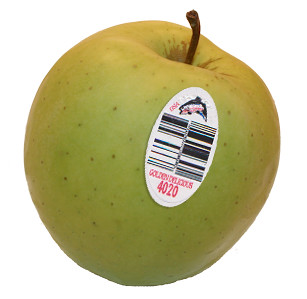
People that go to the store to buy just one apple and then ceaselessly giggle over the product code being '4020' is probably one of the greatest arguments there is against legalizing marijuana. Can't you kids handle it? It's embarrassing. Seriously, not cool.

I imagine a bio-degradable pipe that can be eaten or disposed of otherwise is easier than throwing a metal pipe out the window when the cop car lights turns on and is cheap enough to keep buying so mom won't find anything incriminating while searching your room. But are you really fooling anyone? Most telling is when I give the group of teen-aged girls purchasing just one apple among the six of them my best fatherly disapproving stare and one starts eating it, meekly claiming, "I'm really only just hungry."

Sure you are, sweetie.

Honestly? Don't care. Just make the penalties while driving under the influence or being stupid while intoxicated too horrifying to contemplate. If this keeps up some politician is going to demand that like cigarettes no one under 18 can buy fruit.

You can bet that when Hayley Mills buys an apple it is for eating.

Tuesday, July 19, 2011

The venison of vegetables

Baby carrots are the venison of the vegetable world. This is because they are not grown into such a convenient shape and size like baby corn is. Rather, a regular carrot is chopped, shaved and whittled down to a fun sized snack. A similar process is used in making veal, which is the tasty result of a calf being ripped from the beating womb of a cow. Such waste.

Annually millions of pounds of carrot shavings are then discarded into the streets creating traffic jams or toasted and made into non-caffeinated coffee substitute. Furthermore, a bag of baby carrots can cost the consumer $7.99 or more while a few bunches of carrots that the buyer would have to wash and cut themselves costs less than $5.

It is in Maryland that sales of baby carrots are the most brisk. This immoral act of environmental crime is ameliorated by the fact that for the most part anything sharp enough to cut carrots in the state of Maryland is typically used for preparing meth or stabbing neighbors, or both, usually in the same evening. Baby carrots are most appealing to children and it would be wrong to use blood-stained, meth-permeated knives to cut up carrots and then feed them to kids.

So already prepared carrot pieces manufactured in a smarter region and imported are preferable to warping another generation of Maryland spawn by getting them hooked too early on drugs and the taste of blood. It is better to delay the inevitable until they can be securely housed in a Super-Max prison jail instead of the rotating doors of Juvenile Hall. Somebody has to think of the children.
Tuesday, July 12, 2011

Or maybe it was demons

It's been months and months since I have fallen ill, corresponding with the decision to stop letting customers use my personal pen to make notes or write checks at the register. I rarely got sick before I worked in retail but shortly after I started I kept having various health issues that just wouldn't stop. I suspected it was exposure to customers, raw meats and blood and relatively unsanitary conditions from shared keyboards, phone handsets and other equipment.

A few weeks ago I got sick again resulting in a short hiatus. It felt like it was the same sort of respiratory and intestinal affliction I always got when customers used my equipment or I failed to clean the keyboards and phones we all share. This is an illness we all share at some time or another and you can actually track the progress of it moving through the store like WHO tracks disease through the members of a remote village.

No telling how I got the old familiar germs but some weeks ago one customer hacked and coughed directly in my face and I could feel the warm death-spray spatter into my face. Of course my first reaction was a surprised "What the hell, dude!" The anger followed nearly immediately and I let the guy have it. He was not at all apologetic, just stood there and refused to respond or meet my gaze. To make things worse I had to assist him in entering his store club discount card and payment in the point of sale pad since it seemed beyond his faculties. The fact that he carried more money on him than I see in a month and had a wallet full of high-end credit cards did not help my mood any. I really hate it when stupid people make more money then I do.

I expected the worst and a few days later I started feeling poorly and then lapsed into horribleness. Fever, intestinal problems and the sensation of drowning in my own mucous lasted about four weeks total. Medicine did little to help and merely allowed me to keep on my feet, though one customer called the corporate office the complain I wasn't very upbeat and nice to her. She was apparently oblivious to my near-constant retching, coughing and difficulty standing without shaking. Don't people have anything better to do?

I guess it's also possible I got sick from the equipment but I doubt it. Some time ago the liquid sanitizer we used on the equipment was replaced with a gel that isn't suitable for wiping on keypads or phones. The glass cleaner we now use may be a poor substitute but I'm pretty fastidious about cleaning the gunk off my work spaces. So I'm pretty sure it was the jerk violently assaulting me by splashing his yellow/green lung fluids in my face that got me sick but ultimately...Who knows?

While the illness didn't cause much pain it did leave me exhausted by the end of the work day forcing me to ignore the site and place on hold various To Do projects. Curiously, during my hiatus of a week or so when I was not posting I received more followers, links and "likes" to the blog than I did during the last four months of regular updates.

And that hurt.

Sunday, July 10, 2011

One shield to rule them all

Snagged this cool Captain America shield ring/cupcake topper from the bakery at work the other day. The shields are intended as value-added accessories to adorn cakes that a child or child-like fan can enjoy as a keepsake as a tie-in to the up-coming film Captain America, The First Avenger.

Unlike most of the official promotional items our bakery receives to be included on large and small decorated cakes the shield is remarkably well-constructed. Convex, the shield is firmly seated onto the mount and the paint job is clean, on-model and doesn't easily wear off. I had it in my coat pocket along with my car keys for three days and there isn't a scratch on it.

In comparison to the shield the Pirates of the Caribbean accessories were incredibly cheap and were of poor quality. The Pirates rings consisted of a flat recessed surface with a sticker placed within it. In the shipment we received most of the Pirates stickers were printed off-color and placed off-center. Like the last film, a truly disappointing experience for Depp fans.

I don't know how many Captain America-themed cupcakes we are are going to sell when the film comes out but kudos to the company that manufactured these what are primarily disposable toys.

Friday, July 08, 2011

MELTED ICE CREAM + RUINED MAGAZINES = HIGHER COST TO YOU

Sometimes my work day at my grocery store is filled with frustration and misery. Not from policies and procedures. Never by emergencies real or perceived. Long ago the military taught me what a real emergency was and how to keep calm during it. Nothing a high-rise building or a grocery store can throw at me gets me rattled. Losing your head just makes things worse. Usually it is the little things that repeat every minute all day long day after day that make me want to crawl into a supply cabinet, shut off the lights, curl up into a ball on the floor and hallucinate happier times.

It is usually the stunning amount of stupid I deal with all day that gives me migraines. Nearly everyone I meet acts the same way and has the same problem with the same equipment. It makes me think that the earth is populated by high-functioning zombies with only a rudimentary brain stem guiding their actions. I mean, HOW HARD IS IT TO USE A PAYMENT CARD? SWIPE A DISCOUNT KEY CHAIN TAG? READ A LABEL? ENTER A PHONE NUMBER? PUNCH IN A PIN NUMBER? REALLY? HUH?

To fix this, I propose that along with those already fantastic savings a customer receives by using their loyalty card at the grocery store that buyers should receive additional discounts when they successfully do any of the following (and only because maybe since common sense doesn't work and the use of cattle-prods outside the stockyards are illegal):

LOW, LOW PRICES!
A percentage off should be given to any customer that places their reusable bags in front of their order. 90% of the time the customer just stares while their entire order is bagged and then when everything is done and in the cart says "Oh, I have bags." And then wants everything taken out of plastic and put in their moldy, fungus-riddled, bacteria pockets. This is why we hate you.

On a side note, customers don't like when we throw the semi-used bags away or put them in the recycle bin and they typically remark or are hostilely emphatic that we should save them and use them for the next customer and their purchases. I am against that for a simple reason. Lets say a customer comes up with a bunch of fresh vegetables and the clerk uses a sack that the previous customer declined after their order was already bagged. As a new customer, would they be confident the bag wasn't used for insecticide, drain cleaner or meat products that leaked over the interior of the bag? What kinds of chemicals or toxins are getting transferred to that bundle of lettuce, loose carrots or box of baby cereal? Demand new bags or present your own bags at the start of the order. I do.

SILLY STRING THEORY
I think the existence of alternate universes are proven via the average grocery store. Because in what universe is it okay to just dump your hand basket of stuff on the belt and wait while we empty it, ring up your items and re-bag it? NOT THIS ONE. It really slows the lines down. So I think we should give 2% off any order where the customer empties their basket onto the belt AND then places the empty basket in a safe place under the checkout stand and not behind them on the floor so the next customer can trip and fall.

DID YOU JUST SPEND THE LAST THIRTY YEARS IN A CAVE?
I advocate giving a substantial discount to the entire purchase of anyone who can read the [expletive deleted] point of sale pad and figure out how to swipe a payment card without assistance and five minutes of wasted time. True, payment pads may differ from store to store but they are all similar and all have text instructions if not pictures detailing how to perform each step. As someone who works a register I am mystified that so many people are unable to perform a simple electronic payment function. Electronic payment cards have been around for about three decades, people! Catch up!

MELTED ICE CREAM + RUINED MAGAZINES = HIGHER COST TO YOU
4% off an order for any customer who decides they don't want their milk, ice cream, butter, meat or any other perishable item (heck, any item for that matter) and hands it to the cashier. A large part of any store's loss comes from spoiled items found dumped all over the store. Instead of stealthily depositing it in with the magazines, candy rack, on the floor or in a section that is not meant for it (don't put butter in the freezer, steaks in with the coffee, etc) give it to someone. I find ice cream left sitting in the magazine racks at the check stand nearly every day. The result is not only ruined product but a ruined magazine we have to compensate a vendor for. IF YOU DON'T WANT IT, GIVE IT TO THE CASHIER.

"I'VE GOT TO GO, THE $%##@&! CHECKER IS WAITING."
Anyone who hangs up the cell phone, stops playing with their e-reader or removes their ear buds in order to pay attention to the order should get another 5% off their order.

THANK YOU. NO, THANK YOU. I MEAN IT. THANK YOU.
The last discount idea isn't an incentive for pulling a head out of an ass but a bonus for honesty because I'm actually shocked when it happens: Anyone actually purchasing saffron instead of just stealing it should receive an extra 20% off that item. Those little bottles of spice cost nearly $20 a piece for a few threads of flavor enhancer and hardly anyone buys them. Usually ingredient-seekers just steal it. Where I work we only stock a few bottles at a time on the shelf but it is one of the most shoplifted items in our inventory. If saffron is stocked on Monday odds are the bottle is either stolen or the bottle is opened and the contents are emptied out by Tuesday. I'm actually to the point where I effusively thank any customer who actually purchases saffron.
"YOU BETTER GET MORE @%$#!^ CHECKERS OUT HERE! NOW!"
I'm not going to advocate that we give a discount to those customers who recognize that the employees are not robots, indentured servants or slaves. That should be the minimum expected and fines should be levied against any customer who acts out. I personally require customers to not be a-holeoids and expect them to act like human beings. Well, better human beings, actually. This doesn't apply to all customers. You know who you are. I've probably voided your order and kicked you out because of the way you have acted. Yes, I'm looking at YOU, snobby lady who voiced the opinion that "Mexicans shouldn't be allowed to shop in OUR store." If you are reading this please drop me a line and let me know what lucky establishment has had you as a customer these last two years.

FIRST WORLD PROBLEMS
Sometimes I don't understand people. The grocery business is the only industry I've ever worked in where people act like their human rights are being violated if they have to wait in line a few minutes. If lines to the cash register are long it isn't because the store is cruel or doesn't want to sell stuff. Likely it is all the people they have available.

"SHUT IT DOWN. SHUT IT ALL DOWN."
One job site I worked required me to start shutting departments early and sending staff home if the store did not make 80k in sales by noon. Falling short of that sales goal was an indicator that the store would not be profitable that day unless we cut operating costs. If you don't like the wait then please call and let the management know staffing isn't adequate. DON'T call and lie saying the staff wasn't helpful or ignored you. They can't magically poop trained and certified cashiers or clerks out of their butts. Overtime in most instances is not allowed so staff are required to leave when their shifts end, even if it is inconvenient to you. State and Federal laws determine when and how breaks and meal times are to be taken and it may not coincide a break in customer visits. FYI: Not going to a meal break on time means a large fine for the store from the state and usually results in the employee losing their job after three or less incidents.

WILL THINGS CHANGE?
Probably not. The economy is bad, sales are worse and there are few grocery stores that can operate with a full staff that might possibly be idle for a few minutes during the day. Under-staffed and hoping for the best is the standard operating procedure. One major grocery chain in San Diego is removing all the self-checkout lines because they are not profitable, taking up more time than they are worth. This won't mean a corresponding increase in cashiers either, just a sort of precarious balance in customers to staff. There will undoubtedly be good and bad experiences for customers when this happens.

"I DARE YOU TO CALL THE POLICE."
I have been assaulted by customers and witnessed the same to co-workers due to long lines (a five-ten minute wait at most). I have been punched, poked, screamed at and had canned foods thrown at me. One employee had a pizza whipped at her face like a Frisbee from a customer who refused to wait in line. Most recently, a cup of hot coffee was splashed over an employee by an angry customer at one of our job sites. Shrieking rage is often expressed at the staff. People have screamed curses, shaking with anger that since there are not "enough checkers" they are justified in walking out with their full baskets.

Ironically when areas of San Diego were devastated by fires a few years ago and hundreds of thousands of people were displaced civility was the rule. Stores were jammed with people buying supplies to use or donate for relief. I did not experience anyone acting out. They were patient, kind and for the most part realistic about goods running out (though one couple asked for a discount on spices and gourmet foods because their personal chef was inconvenienced by the quality of goods stocked in the hotel they occupied during the fire). I just wish that people acted on a typical Friday night like they did back during the brush fires.
Monday, June 06, 2011

Be patient, it isn't nine o'clock yet

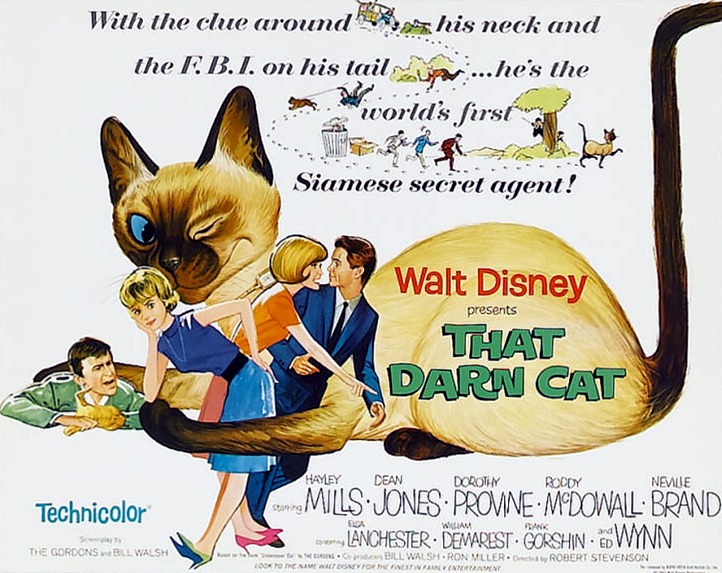
Shortly after the opening credits to the 1965 Disney Films incredi-opus That Darn Cat starring Hayley Mills a bank of newspaper vending machines are shown curbside to a street. The troublesome feline, DC, on a nightly prowl of the town is schmoozing one of the antagonists of the film for food. DC follows the villain which eventually leads the cat into a kidnapper's den and kick-starts the adventure of a meddlesome kid and her pet.

While the vending stands vary slightly in design the common elements of the machines is that the newspapers are not secured and simply rest in an open rack. A slot cut into a box or tube is provided so a customer can insert a coin and then take a paper. My memories of 1965 are a bit hazy from the distance of years but one thing I do recall is that the hippies were everywhere stealing anything not nailed down or bartering for food by spewing plagiarized poetry as they cleaned out a fruit-stand.

Like today, I can't imagine that the honor system of paying for your goods resulted in anything but serious financial losses on the part of the vendor. In my world within a half an hour those racks would be empty and a gum wrapper would be shoved into the money slot. But on Main Street, USA the narcissistic villain being stalked by DC in the movie actually pays for each paper headlining the crime he perpetrated. I guess bank robbery and kidnapping can be a plot point in a Disney film but the studio was reluctant to show an actual crime in progress, no matter how petty. Either that or the villain was playing it cool and behaving so as not to draw attention to himself.
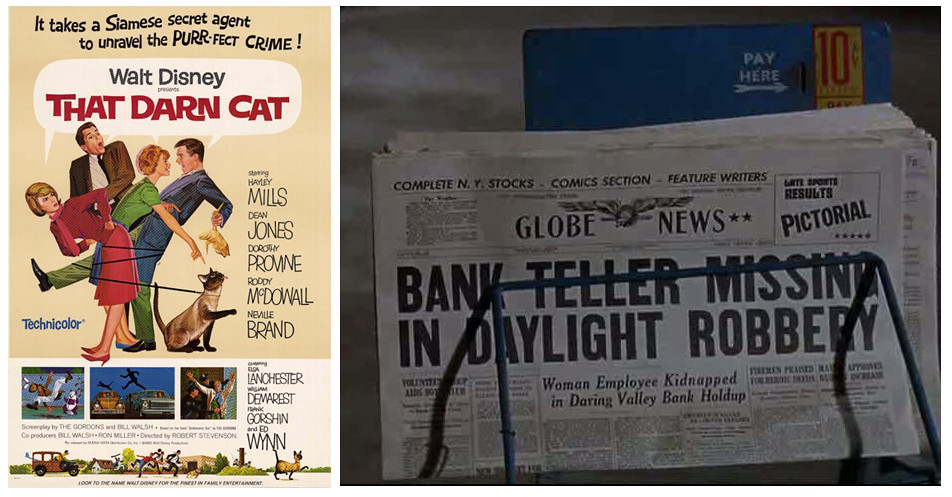
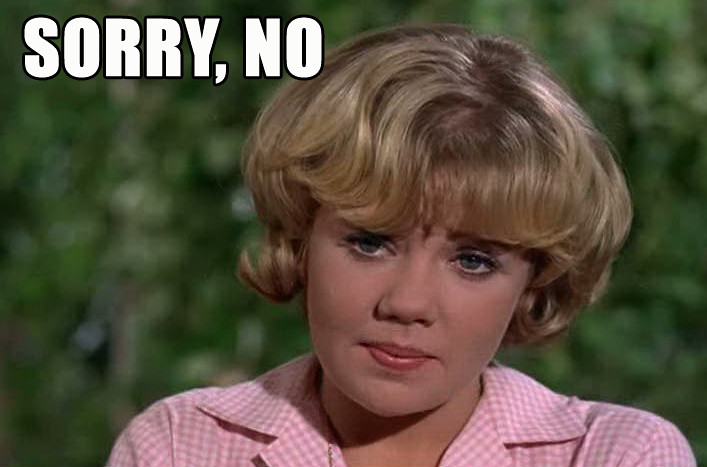
In the film the full vending stand attests that for the most part the unattended machines appear to be successful in practice. But would that honor system work anywhere but in the idealized Disneyverse? For the answer, let's ask Hayley Mills. She knows everything!

That's right, Hayley! In the real world machines and semi-unattended stands, even those inside stores within full view of cashiers and staff are routinely raided and emptied to be hawked by unofficial newsies at intersections and street corners all over the nation. So while art may have imitated life at one point it didn't take long for vendors to wise up and call for securely locking vending machines.

For those into head-knodding, finger-snappin' smooth tunes while waiting your turn to play the bongos at open stage night at the Coffee Bean here are the opening credits to 1965's That Darn Cat as sung by Bobby Darin. It's cool, Jones, cool. At the end of the clip you can see the newspaper stands being used in practice by bad guy Iggy, played by the scene-chewing Frank Gorshin.
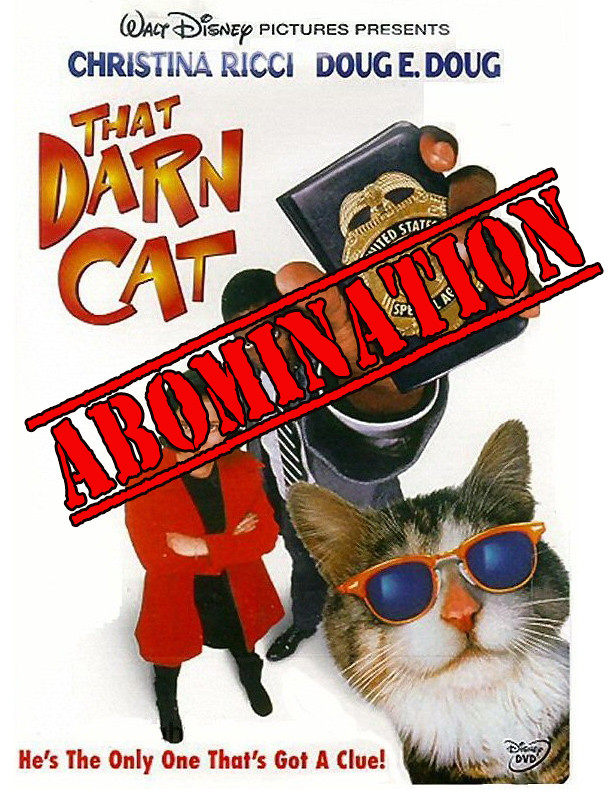

By the way...The remake should be burned, the ashes salted and the ashes burned again.

The only thing that would have made the remake watchable is if the bank-robbing kidnappers were the Gecko Brothers.