Monday, June 11, 2007

MORE Comic Book Romances of Liberated Women

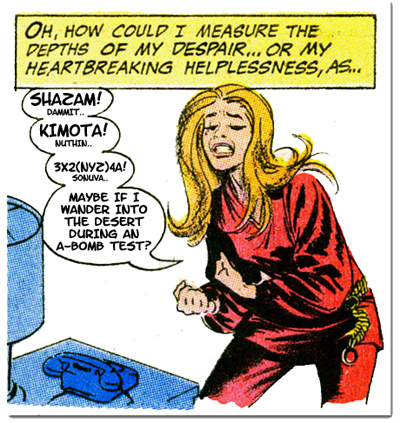
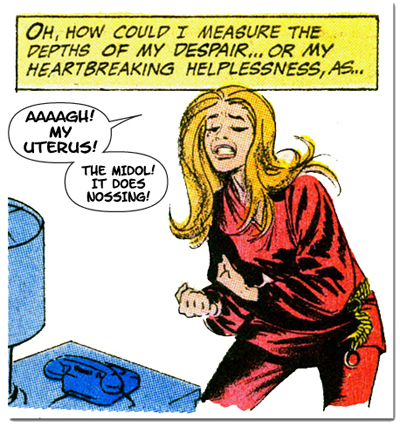
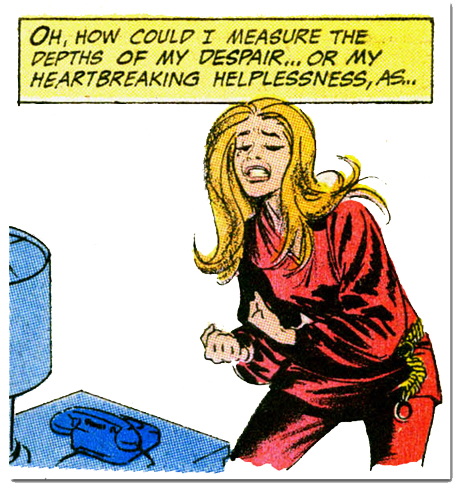
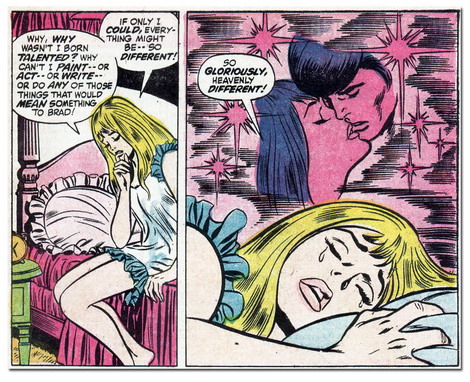
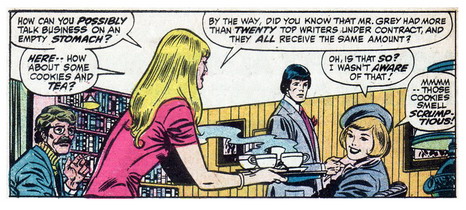
From Young Love #80 (May-June 1970) is another example of a love story featuring a liberated comic book woman. Liz is sexy, confident and capable until she meets her dream man. Then when he dismisses her in favor of his work she falls apart and goes totally psycho nutty insane as the fear she will live the remainder of her life without a father-figure as a husband consumes her.

Good thing for us guys that women don't behave like this in real life!

The story has the usual happy ending as Liz gets her man after Richard confesses his love instead of running screaming in the opposite direction. So long as Richard can keep slipping anti-psychotics into her food without Liz noticing then they will surely live happily ever after.

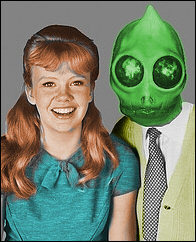
Of course, the above panel cries out like a Bronze Age comic book debutante stood up by the richest guy in town for the Sleestak comedy treatment!

Aww, who's got the cutest little daddy issues? You do! Yes, you!

Carole Danvers didn't handle very well losing her super powers that one time.

I'm so glad to be male. I will gladly put up with the occasional bout of impotence when I'm older than to have to go through the ordeal that gals have to deal with every month.

Suddenly, Zatanna pointed her hand at Liz and shouted, "ZIL POTS!"


As the world turns, these are the days of our sands through the hourglass...
The Love Doctor makes a house call.


Tags:

Grocery Store Artifact: PORN (Now that I have your attention...)

This shingle was attached to the newspaper racks around San Diego yesterday.

Is the local paper trying to bring to people's attention an article about the pervasiveness of pornography in popular culture and the media? I can't tell from the card display. Or, as the card suggests, is the Union-Tribune offering coupons good for over $699 in porn-savings?

If so, that's some pretty good porn discounts, right there.

The Union-Tribune has been aggressively pushing recently for subscriptions and the advertisement is probably a part of the campaign. As advertising designed to cause people to notice the brand it seemed to be kind of effective, at least from what I observed at work yesterday. Several times during the day I heard comments about the display and I saw a few people taking pictures of it with their cell phone cameras. Sadly, it's a juvenile sort of advertising and the kind of high school gimmick I'd expect from a place like Annapolis but not San Diego. Maybe the Union-Tribune out-sourced to a marketing agency from Maryland or something.

I've been on the fence about canceling the UT but hung in there because I receive my paper free of charge and I need something to protect the table for when I polish my shoes. But because of this campaign I think I'll cancel it anyways because the ad annoys me and is stupid.

Tags:

Sunday, June 10, 2007

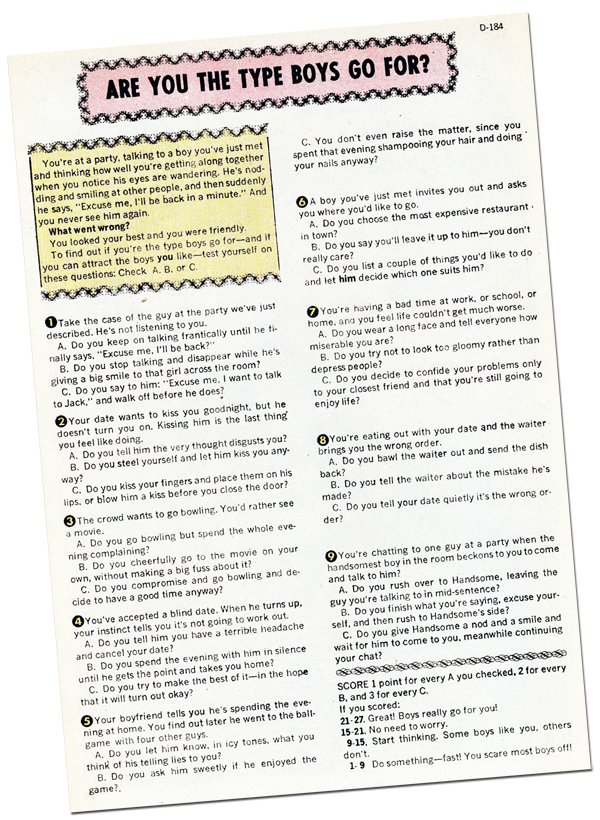
Are you the type boys go for?

I scored a 27! How did you do?

My version of the test would be a lot shorter:

1) Are you hot?
2) Are you easy?

If you answered "Yes" to either question then YOU are the type boys go for!

From Heart Throbs #132 (June-July 1971).

Tags:

Saturday, June 09, 2007

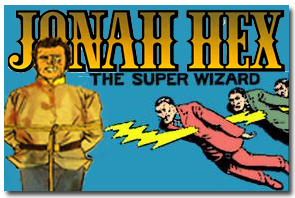
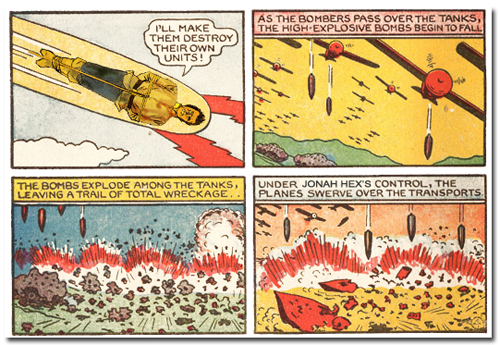
Jonah Hex the SUPER WIZARD!

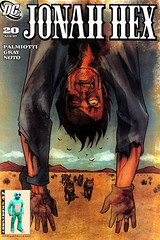
With issue #20 of the newest incarnation of Jonah Hex I have to admit the series is finally starting to grow on me. I have not been too thrilled with the the Palmiotti, Grey, et al version of Jonah Hex since it started because I like my characterization deep and Me Ling, but the recent Lady Hex story went a long way to changing my opinion. The idea of God's Wild West Revenge-Ninja was something that was okay when Clint Eastwood did it so long ago but I never cared for it in regards to the Hex character.

The most recent issue is still a bit shallow around the edges for my tastes as the story reads like a first draft was being published. I also found the art inconsistent, scratchy and hurried. For that one page it took me a second to realize Jonah wasn't picking up rocks to hurl at his tormentors but rather he was getting his hands stomped. And he punched out people with his mangled fingers? That makes sense for a guy who makes a living pulling triggers. Plus, what was up with the on-again/off-again bandages? My impression was that I was reading someone who copied the sparse style of the Whitman or Dell comics of the 1970s.

While it may not seem like it from the mini-review, I really am starting to like this Jonah Hex and that is mainly on the strength of the past six months worth of stories. I hope this isn't because any Jonah is better than no Jonah, if you get my drift.

That said, if I was writing Jonah Hex his adventures would be a little bit different than what readers might be used to.

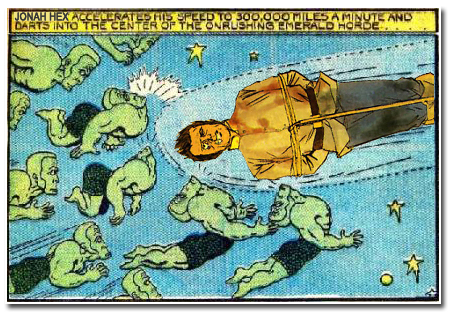
Script and art by "Fleisher Hanks".

Gasp!

Go get 'em, Pard!

Look out, Jonah Hex the Super Wizard!

America is saved! Yay!

Question: How is that the most reviled concept ever in the Jonah Hex universe, when he traveled through time into the future, can be so cool when it was done in the Justice League cartoon? Weird.

Link: For some fine on-going reviews and summaries of Jonah Hex' entire career, hitch up your cayuse and mosey on over to Matching Dragoons.

Jonah Hex images from Jonah Hex #20 (August 2007). Stardust the Super Wizard panels by the insane master, Fletcher Hanks.

Tags:

Friday, June 08, 2007

Girl's Love Stories #152: Flying under the gaydar

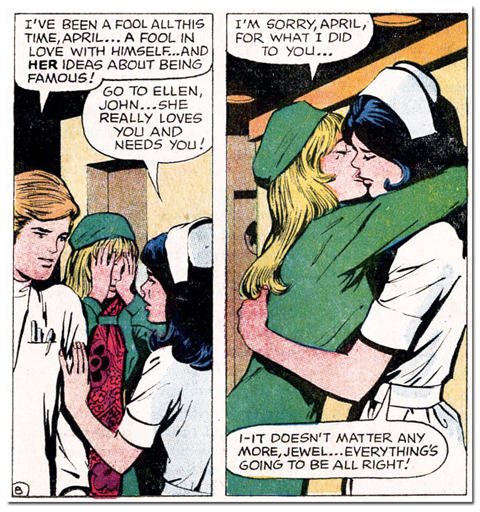
These final panels from the six-part comic book soap opera "Confessions" are supposed to convey the reconciliation between two sisters who were feuding over men. But due to the text and the poses of the characters what is supposed to be a hug with a sibling really comes off as something pretty different altogether.
In reading the story one could easily ignore that the scheming, blond starlet and kind-hearted, black haired nurse were related. I came away from the stories with the impression that the pair could really be considered "sisters" only in the sense that they were both women and that by stating they were family DC Comics could keep the Comics Code Authority away.

At every turn Jewel sabotaged any budding romance between April and any possible suitor. Jewel later confessed that she interfered in her sister's relationships out of jealousy of April's potential happiness. In my mind that really signified that Jewel was worried that she would lose her chance forever to be with April if her "sister" went ahead and conformed to traditional standards of gender identity and sexuality. The final unnecessary and gratuitous expository panel immediately after the kissing scene only reinforces my impression that this story was ultimately about two women finding each other back before it was acceptable to have openly gay characters in pop-media.
From the appropriately named Girl's Love Stories #152 (July 1970).

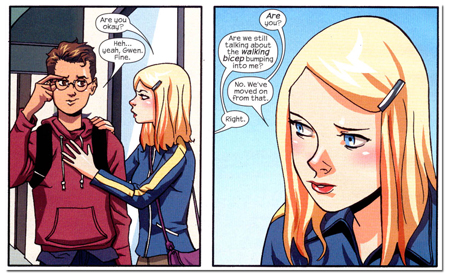
A question about the Spider-Man Loves Mary Jane comic

In the Marvel comic title Spider-Man Loves Mary Jane, when does the story arc begin when this version of Gwen Stacy gets knocked up by Norman Osborn and dropped off a bridge?

Just asking.

Tags:

Thursday, June 07, 2007

Love and the Single Girl

Romance comics had a hard time going in the 1960s and 1970s. As a useful plot device the dreams of a girl finding a husband and setting up home that populated the love titles of the previous two decades were now out of fashion. Now women had to be portrayed as liberated, sexy, confident and no longer defined by a man or the traditional roles of a homemaker and housekeeper. In the midst of a cultural revolution and with sales threatened by the theme of the books, comic companies were forced to portray modern, educated and strong liberated women who were not defined by their partners and traditional female roles.

However, the romance comics of the 1960s and 1970s became a bit schizophrenic, due in no small part to the old men who were the editors. They tried to make the stories contemporary to the times but usually failed, unable or unwilling to tell a story that was different from what they were used to in their experience and also partly because of the Comics Code Authority, which was slow to embrace changes like the graphic depictions of bra-burning and Jane Fonda-like characters having orgies.

The young ladies of the Bronze Age romance comics were definitely liberated but it was a superficial sort of surrender to popular culture and feminism. While the women were no longer living at home, were out on their own in the big city, earning a living, dressed in "happening" fashions and were active sexually (never stated but the subtext was there), the idea of what constituted a liberated woman in the comics of the time was still very mired in the stories of the 1950s. More often than not the heart-sick young woman searching for love was a secretary, maid or nurse. They were usually confined in the story to supporting or 2nd tier jobs while mooning over the handsome doctor or professional man that callously ignored them. Rarely was the woman considered an equal in the setting where the drama took place and while there were usually a few nods to feminism and equality the sentiment was only panel deep.

A typical example of a liberated female romance story of the time can be seen in the Marvel Comics title My Love #20 (July 1974) in the story "The Boy Who Can't Be Mine!".
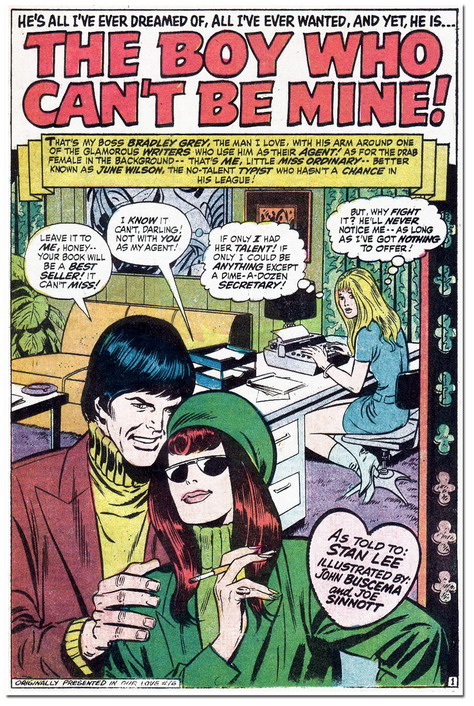
My Love #29 - Splash page

The end of romance comics was in sight by the time this issue hit the stands. If the company repackaged as new a story from another book from barely two years before then it is clear the publisher is saving some cash and not really supporting the genre. Romance comics limped along a few more years before they finally withered and died, unlike love, which lasts forever.

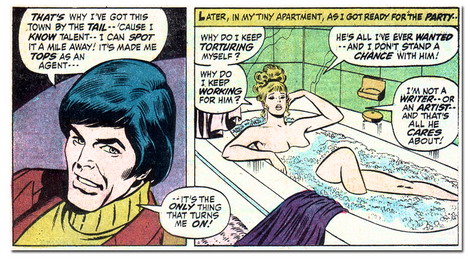
The featured story is about a secretary named June. She is considered to be a little more than office furniture to her hip boss, the high-powered book and art agent Bradley Grey. Bradley is hardly the boy the story title and June claim he is and craves excitement and stimulation. Busy being awesome, Brad does not even notice that June is alive, which makes her sad and depressed and feel worthless.

My Love #29 - bath scene

June has such poor self esteem from Brad's failure to notice her that she does not remember that she is incredibly hot as this bathtub scene from the book reveals. Maybe that turtle-neck sweater Brad is always wearing is too tight and is restricting the flow of blood to his brain or something. It was a common feature of nearly every romance comic book story that the troubled girl is featured in some manner of sexy scene in the story somewhere. Often the women were portrayed changing clothes or lounging around in their lingerie. Not even go-to guy romance comic inker Vince Colletta could spoil some of those. He inked a majority of romance titles and apparently liked scantily clad women as he seemed to spend a little more time on their figures than he did for the backgrounds and other art.

As usual in these stories and much like every similar story of the past three decades, June is portrayed as obsessed with her unrequited love interest. Also much like every other romance book this includes the heroine having a gratuitous, feverish, naughty, dirty, filthy, nasty, hot hot hot, exciting sex dream sequence when they fitfully drop off to sleep.

My Love #29 - Naughty dream

Since attractiveness and being highly competent at her job fails to make an impression on Brad, June then resorts to the time-honored and most effective way to trap a man into marriage: BEING JUST LIKE THEIR MOTHERS!

My Love #29 - Being domestic

It is only when June plays house and steps into the traditional domestic role of his mommy that Brad finally notices her and realizes he is in love. Actually, he noticed her "talent" whatever that may be. I could guess, though, and I would bet it has to do with with something really Freudian and icky.
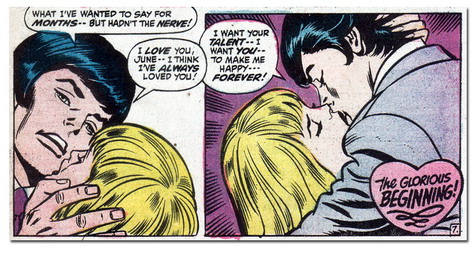
My Love #29 - True love. Now make me a sammich!

If this was a 1950s romance comic June would be shown in an apron preparing dinner in the final scene while her husband read the paper and smoked a pipe in the background. Since this story was published in the 1970s the promise of marriage is only hinted at. But for the young female reader a permanent relationship was certainly implied since it was "true love" which everyone knows lasts eternally. The bonus about this era's form of the liberated female romance story is that for a male reader who secretly reads his sister's copy of the book the marriage-ambiguous endings hinted at hot no-strings sex while at the same time it gave them a few nicely crafted drawings of women in their underwear.

Tags:

Must...Think!

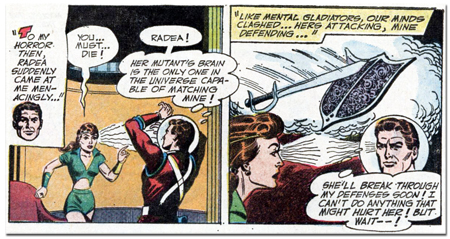
An angry Radea turned evil thinks about Captain Comet, who in turn thinks about her.

Worlds Finest #204 - Mental fight

Tags:

Wednesday, June 06, 2007

The not-so-mundane Phantom Stranger

In the early appearances of the Phantom Stranger the character was not so much mystical as a private detective. The Phantom Stranger investigated crimes that appeared to have a supernatural origin but were actually perpetrated by con artists. He was a free-lance ghost-buster with plots and stories that were much like those much later seen in the Scooby-Doo cartoons. The Stranger and the Scooby Gang shared similar themes in which someone would dress as a monster or ghost to frighten away people from a circus or resort so an unscrupulous business man could buy it cheaply or to swindle people out of money.

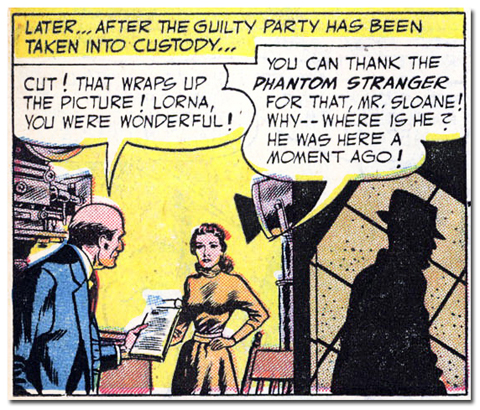
At the end of each adventure after the Phantom Stranger had solved the crime the players would suddenly notice that the Stranger had mysteriously vanished. While the impression was that the Stranger had magically dismissed himself there was always an "out" in the scene to allow the comic book company to claim in the event of complaints or Comics Code censorship that it was not accomplished by magic.

Look down the hallway, Lorna!

There was always an open door, exit sign, shadow or familiar figure in the crowd in the background whenever the incidental players noticed the Stranger had "suddenly" disapeared from the scene. The Comics Code Authority of the day did not allow for magic to be represented as "real" in any form. Any monsters, demons and such that appeared had to be explained away as trickery or had an origin in the science fiction genre. The gimmick that it was humans in costumes, drug-induced hallucinations or alien beings were the usual explanation for the monsters and unusual events.

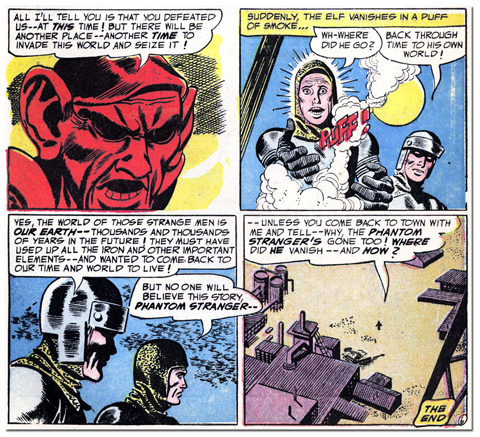
It is in the last issue of the 6-issue run of the Phantom Stranger's original series where the mundane explanations behind the adventures starts to break down a bit. In the story Horror In Miniature, Phantom Stranger #6 (v1, June-July 1953), a mining town is plagued by elves that vandalize equipment and attack the workers. The Phantom Stranger becomes involved and with the aid of one of the workers defeats the elves and drives them away. What is different about this story is that the culprits were not revealed to be using trickery or by being midgets in fanciful costumes. At the end of the tale the "elves" confessed to being mutated humans from the far future who had come back in time to take over the earth.

Phantom Stranger #6 (v1, June-July 1953)

The art and story has many references to the mythological and it is my impression that the climax of the story may have been tweaked. It may be that the story was about legendary elves but in order to avoid Comics Code problems the creators had the invaders claim to being time travelers and not mystical creatures. The mining town was their entrance point into 1953 and the advance scout "elves" sought to destroy the iron works because it was deadly to them, as iron was to the faerie of legend. It is an explanation that is closer to science fiction than magic, but the overall impression is that it was intended that the Stranger was fighting legendary elves, particularly by the reference to iron being deadly to the touch. In all the other stories the Phantom Stranger revealed the villains in the end to be clever thieves and petty crooks.

More proof that the creators were weary of the rational resolution to the stories is seen at the end of this tale. As usual the Phantom Stranger does his mysterious exit thing from the scene, but with a difference. The difference being that is this instance the Stranger (wearing full medieval armor by the way), disappears from a wide opened area when the other protagonist of the story glances away for a moment. The creators did not leave a convenient way for the Phantom Stranger to have vanished from the field unless it was by some manner other than natural.

The next time the Stranger would appear in his own series he was acting as a fully empowered mystic who easily hopped dimensions, fought demons and monsters, conversed with gods and fired spells that burst like fireworks. In a change of tone from the 1950 series, any other-worldly creatures that were exposed to have been con men usually met a grisly, ironic death by supernatural means or the Stranger narrated a tale where 'fate' inevitably caused a suitable revenge to befall an evil-doer.

Tags:

Tuesday, June 05, 2007

Cool Golden Age Page of the Day: My wife, I think I'll keep her!

I think the new Mrs. So Long Copper has been kidnapped twice.

From Gang Busters #2
(Feb-March 1948).

Tags:


Being Pat Boone? That's a spankin'!

The image is scary enough with all the horrifying scene elements, but read the accompanying biographical text for an added dose of childhood trauma.

From Pat Boone #1 (DC Comics, Sept-Oct 1959).

"Deserved" beatings with a leather, square-edged machine belt?

Monday, June 04, 2007

His magnetically-attracted what?

From Tales of Suspense #59 (November 1964).

Tags:

Six of one, half a dozen of the other?

I don't usually respond to the few troll-attempts I receive but in a response today to this 9/22/2005 post about a teen-age Robin being propositioned by an adult, a commenter confirmed exactly why comic book publishers continue to pander to the baser instincts of fans.

Generation Y said...

That was pathetic.You mean when you were underage, you never thought about being about women over 18? How did you bring tentacle rape into this? Man you 40 yr old fans suck.You should have been drafted.

Neat-o.
  • The concept the commenter doesn't seem to grasp, and I sincerely hope he does before he finds himself in a pair of handcuffs, is that sexual advances or sexual activity by a legal adult between someone who is not of the age of consent is wrong. I don't care what they do on Walton Mountain or in India or even back in the year 1625. An adult has a power over a younger person. It is predatory, illegal, immoral and unethical. Period.
  • Yes, of course when I was a teen-ager I often thought about the gender I had a preference for in sexual terms. But thinking about and actually being molested by a 21 year old, wiser and experienced adult if when 16 are very, very, very different acts. No, I have not been molested nor do I know anyone who has been. I'm not a super-hero with a tragic back story. I know the difference between right and wrong. By your statement you are equating fantasizing with doing. It is alarming that those two blend together in your mind.
  • The 'tentacle rape' comments in the post come from my referring to the trend in American comics to bring over to this industry concepts from popular Japanese strips that routinely depict sexual violence, rapes with foreign/alien/human objects and under-aged relationships. The recent Heroes for Hire cover being an example.
  • I don't understand the 'drafted' part. You mean, I should have been drafted into a war and possibly killed in combat? Drafted into a bizarre sex cult so I would have a different outlook on the concepts of right and wrong? Help me out here.
Comic book publishers appear pretty savvy about how best to depict their male and female characters to leverage sales and gain publicity. The critic's perception of comic books is that the percentage of the fan base that will buy a comic based solely on the rape and bondage elements of the cover is not great enough to support the book. I wonder if that is true. If Generation Y is a typical young fan then the art for H4H #13 makes a lot more sense. Publishers must feel confident that while the a vocal number of readers are turned off by exploitative scenes the purchasing power of those fans that embrace it, even as a small percentage, are enough to keep a title afloat long enough for their purposes, whatever that may be. It is possible that the mature reader who wants some depth to a comic book may not be much of an actual consideration as a target audience. It may be a case of "six of one, half a dozen of the other."

Tags:

Saturday, June 02, 2007

Who Does Cheryl Love?

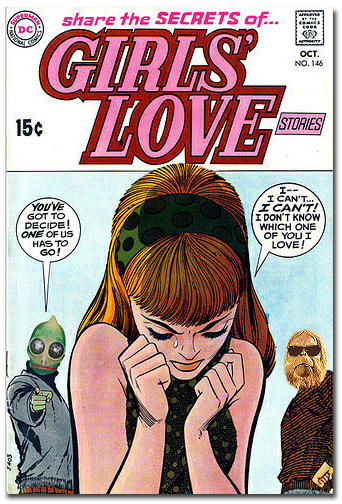
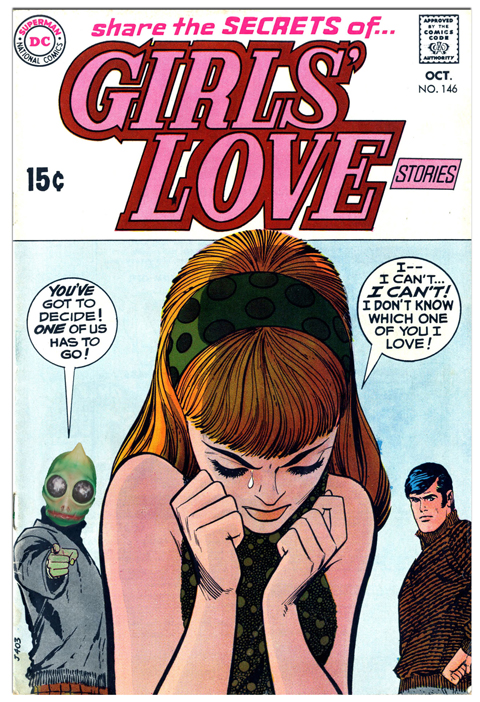
Dr. Zaius of the Zaius Nation fancies himself a rival for Cheryl's affections!

Foolish, damned dirty Ape!

Don't you know that women prefer the smooth bare chest of a lizard-bug with the muscular structure of the rock star Sting (circa 1986) over the musky, damp pelt of a fur bearing animal? Okay, so you are a Doctor (Lah-de-dah, lookit me! I lobotomize astronauts!) and I work middle-management retail, but the fact is that true love always prevails! While I've found the babes usually only truly love Jaguars, plenty of jewelry and summer vacation homes, I date only non-threatening, emotionally crippled females like Bronze Age Cheryl. Careful selection allows me to defeat the Doctor's superior Cash-Fu using only my natural charm. And lies.

This isn't a meme but is a follow up to one, because this is the second time the good Doctor sent me a photo, which is much appreciated! The original cover of Girl's Love #146 that I Slee'd up was snagged from the always helpful GCD. The Doctor got the image after I finished with it from over here. It was an unintended team effort, but those are the best kind!

Tags:

Comic Book PSA: Psychological Warfare?

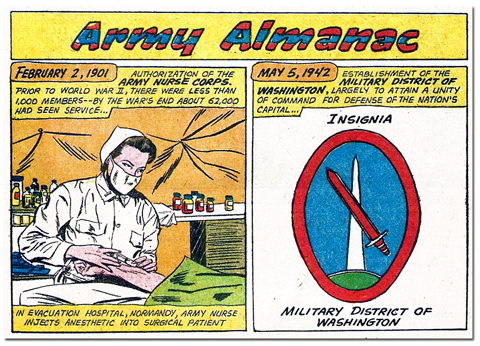
Let's skip the panel of the drug-addicted Army nurse pretending to administer an anesthetic to the injured soldier on the gurney while actually injecting herself in the hand and look at the panel with the titled date of May 5, 1942. This representation of the military insignia of the Military District of Washington from World War Two would give anyone the willies. Or rather...Does the patch give one the impression of willies being taken away?

From Our Army at War #104 (March 1961).

Was the symbolism of a sword set against the background of the Washington Monument a simple image of American strength and unity? Or was it a subtle, clever message to any enemy planning to attack Washington, DC that they will suffer a horrible, emasculating fate for their effort?

Let me just confirm that my soldier isn't going to DC anytime soon.

Tags:

Friday, June 01, 2007

I got it just for this panel

It's like an internet meme in comic book form!

Slightly photoshopped from Intergalactic #1 (2007).

Tags:

Grocery Store Artifact: Not passive-agressive, just aggressive

I previously worked at a place where due to the slobs wrecking the break room the privilege of tables, couch, refrigerator, microwave and everything else was revoked. Basically the employees had access to a water fountain to get a drink and had to plastic classroom chairs to sit on. It sucked that so many people would eat and then just leave stuff on the table that we were forced to take away the amenities.

I'm not the sort that leaves polite notes in the break room to keep the microwave clean an dispose of your trash. My style is from the old school of management: "KEEP IT CLEAN OR I TAKE IT AWAY." In a heartbeat I will take away the microwave, put a lock on the refrigerator and put away all the other toys that make life bearable.

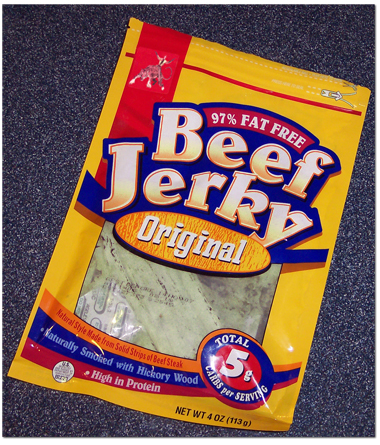
I hate coming in and spending precious minutes of my lunch (which will inevitably be interrupted) cleaning up after adults who abandon a table top full of used microwaveable trays, spilled drinks and wrappers. I dislike prying my lunch bag from the sticky shelf in the refrigerator it has adhered to. I do not want to have to forcibly peel the bag off a shelf like it was a naked, dead fat guy in a vinyl chair on a hot day. Yesterday, I came across this in a cabinet:

Furry, green beef jerky. Ugh.

So I decided to spend some time cleaning up a bit. Which by "cleaning" I mean opening cabinets and dumping entire shelves of old food, moldy cake, half full bottles of vitamin-enriched water and other items into the garbage. If it was edible (or formerly edible) and I saw it was there over a period of two days it was in the garbage. It was a break room holocaust.

While I was cleaning an employee came in, saw what I was doing and asked "Do you, like, do this at home?"

Clean? Yes, occasionally I like to sit on non-gritty couches and eat off plates that do not have bits of old food encrusted on them. Spoiled food will quickly make rotten other foods, a waste of precious money and time. I also shower. I moved out from home a long time ago and Mommy does not clean up after me any longer. That's why I got married.

FYI: Dirt destroys things. It is entropy. Things do not improve with age or use. They break down. The break room will not hold. Want to know why the Government still has in service vehicles and equipment from the 1950s? Because every time they are used in the field they get cleaned and maintained. If I spend $800 on a clothes dryer you can bet your bippy I will clean the lint trap before every load.

I'm not fussy or a Felix Unger. I just don't want to sit down for a meal at work and have threads of a sticky something trailing from the bottom of my coffee cup when I pick it up from the table.

Some people complained about the break room being cleaned.
"I put a soda in there last Thursday and now it's gone."
  • Oh, you mean the uncovered fountain drink with the straw in it I looked at every day for six days? Yeah, I threw it out. The cup was soaked through and was leaking all over the shelf and dripping down onto other stuff.
"Hey! My sammich is gone! Some [expletive deleted] stole it!"
  • No. The dark threads of mold spreading out from the thumb print in the center of the slice of bread bothered me so I threw it in the garbage.
"Did you throw out my Doritos?"
  • I don't know. Which one of the eight bags containing crushed Doritos powder in the refrigerator was yours?
"Where is all my Tupperware/insulated lunch bags/non-spill travel cups?"
  • In the sink or in plastic bags. Take them home by tomorrow because if you don't, when I leave at end of my shift tomorrow I will be throwing all of them into the trash.
"I was going to eat those tamales, man."
  • No, you were in fact not going to eat them. From the date on the receipt, I saw that the three uncovered Tamales were put in the freezer in late April. It is the end of June. They were freezer-burned. They had ice cream spilled on them. Into the trash they went.
Makes me wonder what some living spaces look like.

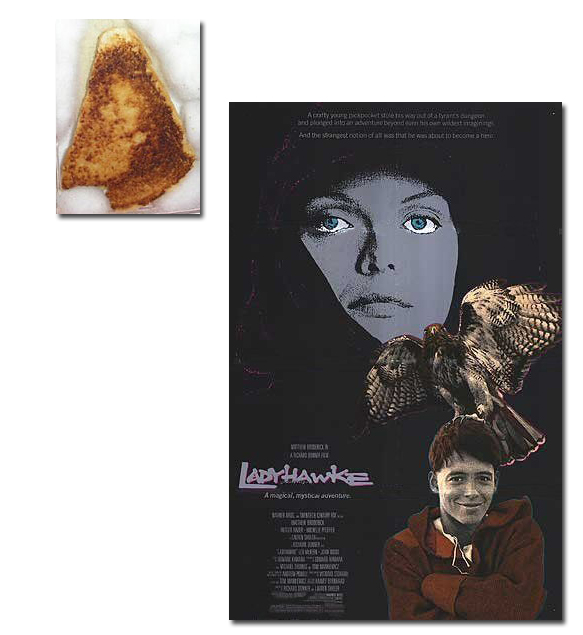
One thing I look for in cleaning up a break room is financial opportunity. Not lost wallets or forgotten purses, mind you. I don't roll like that. For instance, I keep my eyes peeled for that moldy sandwich with an image of the Virgin Mary/Michelle Pfeiffer on it. I'll sell that in an on line auction in a second! Cha-ching!

Tags:

Wednesday, May 30, 2007

Comic Book Ad: 2-Fer

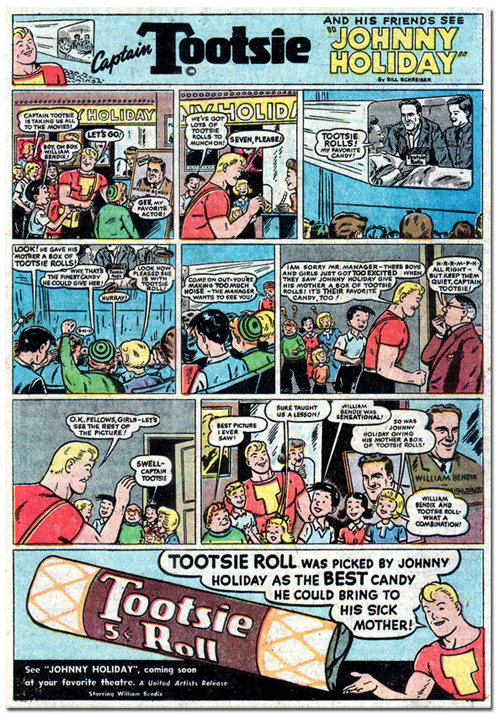
This advertisement in Young Men #4 (June 1950) not only pushes candy but also the recent release of a William Bendix film, in which a character from a Boy's Town-like youth center visits his sick mother in the hospital and gives her a box of candy he probably nicked from the nearby Woolworth's.

Has anyone seen the 1949 William Bendix film Johnny Holiday? I'd be interested to know if such blatant product placement as the character giving a box of brand candy to his mother and her delighted reaction actually appeared in the movie.

Once upon a time, people in films often drank from fictional label soda bottles and smoked generic cigarettes. While there would be partnerships among the companies to use their product in films they either owned or produced, with the exception of cars and other items that would be too bothersome to duplicate as props it took a while before someone hit upon the idea of accepting payments for prominently featuring consumer goods in a film. Prior to that bad idea brand name appliances and goods were just props. The actors did not extol the virtues of a self-cleaning, the smooth ride of a particular car or awkwardly hold a bottle so the label would not be obscured in every scene. The camera did not linger overlong on the sleek design of the shiny new refrigerator. Consumer goods were props and background, just incidental scenery.

Overt product placement is a relatively new part of the process of movie making. Becoming more obvious in the cinema of the 60s it increased until such fare as the James Bond movies were little more than 2 hour commercials for boy toy gadgets. Let us not forget the less than subtle, fast-food inspired Mac and Me and the uncredited inanimate cast members in the form of the volleyball and international delivery service in the Tom Hanks vehicle Cast Away.

The Bendix film was not the only movie advertised in that issue of Young Men. Beneath the ad for chewing gum is the promo for classic World War 2 film The Sands of Iwo-Jima.

It's John Wayne in comic book form!

Tags:

Tuesday, May 29, 2007

Just a LOL stuffed bull

Blame Bully

Tags:

Sleestak's Movie Review: Pirates of the Caribbean 3

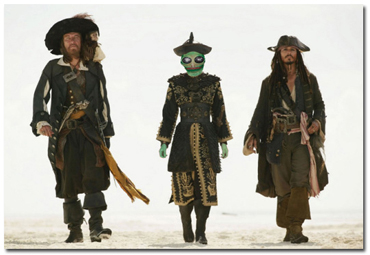
I went and saw Pirates of the Caribbean - At World's End yesterday. Really, that film stank and it wasn't from the Squid-Guy. Sitting in the theater I lost track of exactly what movie I was watching. At different times I kept thinking I was watching either Time Bandits or Erik the Viking.

Everyone, with the exception of Geoffrey Rush, kind of phoned the acting chores in, as if they wanted to get done in a hurry so they could go sip drinks on the beach. Even then there were a few scenes where you could tell that Rush had a long day in costume standing in front of a Green Screen with the director instructing him to "Yell a bunch of random piratey stuff and we'll leave the cameras rolling." that they would cut and fit into scenes later during editing. I also kept wishing for subtitles so I could understand what the heck the Swamp-Witch was saying.

The only reason I could imagine that anyone would be enthusiastic about the movie was if they were irrationally hot for Depp, Bloom or the Broomstick With Hair. Then the film would be good enough, I suppose. Over all the film was boring, boring, boring.

One positive note: Keith Richards.

Tags: