Showing posts with label gay. Show all posts

Saturday, June 02, 2012

Great Scott

The big news in comic books this week is that a character based on the Golden Age Green Lantern,  created by Bill Finger and Martin Nodell in the 1940s, is gay. Pundits and groups have decried the decision to reboot Alan Scott, the old man and spiritual father of the Justice Society as a young gay man as nothing more than a publicity stunt. Maybe it is.

But that's okay, really. As long as a positive message of diversity, no matter the intent, is disseminated and represented as much as possible then that ultimately helps people and lets them know they are allowed to thrive.

Few comic book companies have avoided presenting gay characters in their books though often they were hesitant or clumsy in their presentation (though not so misguided as much as it was well-meaning as most of the depictions of African-Americans in the comics of the 60s and 70s). Among the current higher profile gay characters are of course Archie's Kevin, Marvel's Northstar, who has been out for years and DC's Batwoman. The latter two being good examples of characters the respective companies have been mostly at a loss since their creation as to how to portray them.

A few groups had issue with the news of Northstar getting married to his long-suffering boyfriend and the re-introduction of Alan Scott as gay. They claimed an agenda on the part of the comic companies and the usual tired old argle-bargle of the negative influence of comics. They have been mostly dismissed and marginalized by those motivated to be vocal about the issue. I'm cynical enough to believe that the only agenda Archie, Marvel and DC have is to make money. It is from the increased national discourse on homosexuality and the demands for equal human rights that companies like DC can comfortably exploit (and I mean that in the best way) sensitive political and cultural issues. That their savvy marketing direction can also positively add to the discourse in however a small way is a benefit.

In the 1970s Marvel  successfully tapped into the sentiment of the young on many hot-button issues, a trend that benefited the bottom line well into the 1980s. From the 1960s through the 1970s DC was the company that had the most precedent, albeit steeped in subtext, in exploring gay issues though this was found mainly in the pages of the various romance titles amd one had to read between the lines and ignore the conclusions to most of the tales to see it. Marvel, however, reveled in being relevant and routinely tackled social issues such as class and race. This was all about what the audience would accept and want. The same company that railed against "The Man" in the 70s was fully behind the institution of authority a decade or so earlier even in the progressive and socially conscious 1960s, when mainstream comic companies adhered to the idea of Camelot and the Cold War.

Both Marvel and DC had comical, if not insulting, missteps along the way concerning homosexuality. Marvel infamously managed to draw a lot of criticism over the stereotypical depiction of sexual predators as being gay in an issue of The Rampaging Hulk magazine. DC most recently appeared to be at loss of what to do with Batwoman after the initial PR interest in her being a lesbian faded. The Golden Age Alan Scott had a son who was a gay superhero/villain but he was rarely utilized and often was often depicted as nothing more than a menacing shadow haunting the headquarters of the JSA. Take that how you will.

DC also missed an opportunity to introduce the first openly gay Green Lantern back in the 1990s. When Kyle Rayner (whom I always thought of as bi-sexual) was injured he sent his ring for safe-keeping back to Earth to his intern Terry, a gay man. My expectation was that Terry would spend the next several issues using the ring, going through a steep learning curve and maybe experiencing some interesting character growth. That didn't happen. The next issue Kyle reclaimed his ring and continued his adventures as if nothing had happened and it seems DC either dropped the ball or felt they dodged a bullet.               

However progressive a comic book might be it isn't going to change the world in and of itself. Alan Scott being gay and Northstar getting married won't change anyone into a homosexual anymore than the Teen Titan Spotlight book featuring Starfire ended Apartheid. What it might do, hopefully will result in, someone feeling better about themselves in spite of what the cranks, superstitious, evil and simply backwards have to say to the contrary. Being gay is not different. Being gay is not evil. Being gay is not wrong. It just is.

Monday, February 18, 2008

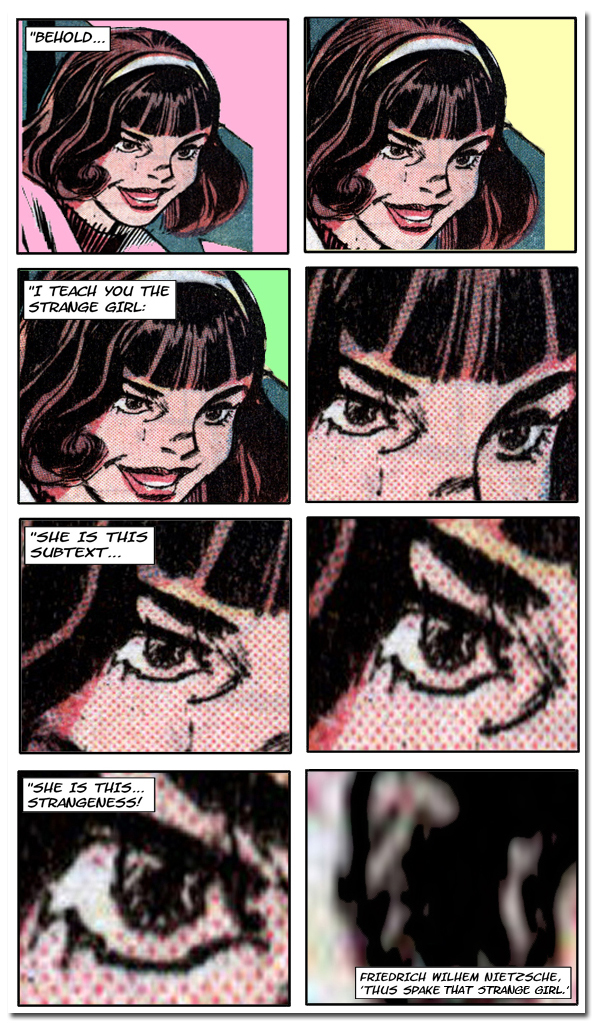
That Strange Girl

To assert that the story that appeared in Young Romance #197, That Strange Girl, was rife with subtext would be an understatement. On the surface it is another comic book romance tale of an ugly-pretty tomboy too busy to fall in love. The story is infamous, if not notorious, for featuring early in Bronze Age of Comics a lesbian or bi-sexual character who begins a relationship with a persistent and popular male classmate once she buckles under to peer pressure and conforms to the local societal standards of expected behavior.

Currently, comic books and other media rely upon more than just the typical shallow male and female demographics and try to appeal to other niches of the consumer market by specifically courting all of them and their disposable income through various plots, characters and gimmicks. But in 1974 the Comics Code Authority could not allow an openly gay character to appear in a comic book and creators wanting to tell a certain type of tale or use a ready-made semi-controversial plot device had to find a way to tell the story in a manner that would both allow readers to get the gist of it and still be published. No one other than the author could say if most of these stories were intentionally written to have a hidden meaning and they may be what they are on the surface...cautionary morality tales and lessons on acceptable behavior from the status quo. What That Strange Girl and many of these stories have in common is the final panel or panels that use an awkward inclusion of exposition to abruptly and against all plot direction reinforce the traditional male and female gender roles. This device of exposition at the finale of the story was also common in the crime and horror comics, where the final panel would reveal the criminals paid for their crimes and that a character wasn't really Satan but was a man in a mask teaching someone a lesson. In the romance comic books the final panel of exposition usually depicts some woman declaring her eternal love and devotion to a man in spite of everything else the story may have been hinting at .

Depictions of sexuality in comic books that did not meet the criteria of the CCA (whether intended or not, there are thousands of questionable examples in comics) meant the creators had to be for the most part very subtle in their presentations. As any reader of the Golden, Silver and Bronze Age of Comics knows this was accomplished with varying degrees of success and subtlety. If there existed any hints or behavior associated with a character that violated the CCA standards then that usually meant the character had to be a villain or depicted as mentally disturbed and their sexuality was portrayed as deviant and extreme, i.e. the "Terrible Trio" hippies featured in Wonder Woman #185.

The subtext in That Strange Girl is not at all subtle ("Agnes isn't shy once you get to know her") and is only one of several stories of the type that appeared in romance titles of DC, Marvel and other companies of the era that dealt with similar issues. Most of the entries however did not present so ridiculous or heartbreaking of a climax to the story.

You can read That Strange Girl by clicking the cover to Young Romance #197 (Jan-Feb 1974) below.

That Strange Girl - 00
Enjoy!

Friday, June 08, 2007

Girl's Love Stories #152: Flying under the gaydar

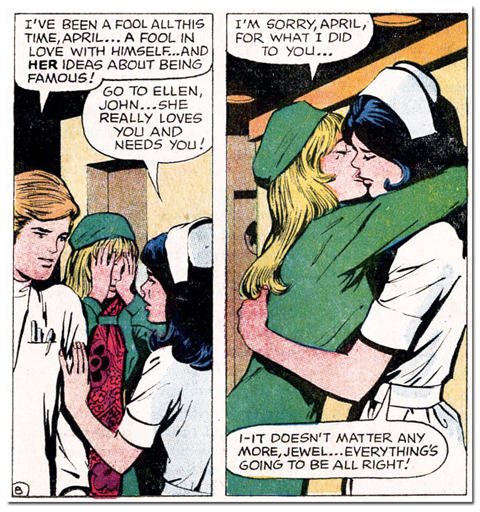
These final panels from the six-part comic book soap opera "Confessions" are supposed to convey the reconciliation between two sisters who were feuding over men. But due to the text and the poses of the characters what is supposed to be a hug with a sibling really comes off as something pretty different altogether.
In reading the story one could easily ignore that the scheming, blond starlet and kind-hearted, black haired nurse were related. I came away from the stories with the impression that the pair could really be considered "sisters" only in the sense that they were both women and that by stating they were family DC Comics could keep the Comics Code Authority away.

At every turn Jewel sabotaged any budding romance between April and any possible suitor. Jewel later confessed that she interfered in her sister's relationships out of jealousy of April's potential happiness. In my mind that really signified that Jewel was worried that she would lose her chance forever to be with April if her "sister" went ahead and conformed to traditional standards of gender identity and sexuality. The final unnecessary and gratuitous expository panel immediately after the kissing scene only reinforces my impression that this story was ultimately about two women finding each other back before it was acceptable to have openly gay characters in pop-media.
From the appropriately named Girl's Love Stories #152 (July 1970).